Popular Crater Lakes in Queen Elizabeth National Park
Crater lakes are among the popular features and a major attraction in Queen Elizabeth National Park. Located in western Uganda, Queen Elizabeth National Park is the second largest and popular National park in Uganda, one of the most visited tourist destinations in the Pearl of Africa. The savannah comprises several exploration craters, which you must visit on your next visit. These crater lakes were formed as a result of volcanic eruptions in the past. A drive around each lake is an experience of its kind! Each lake carries a different significance and hence is worth visiting.
A visit to Crater Lakes is an add-on experience on Uganda safaris to Queen Elizabeth National Park. Other popular travel experiences in the park include game viewing, boat cruising at Kazinga channel, chimpanzee trekking, Lion tracking, and community tours, among others. Explore crater lakes and other attractions in Queen Elizabeth National Park with Superfine Safaris Limited
Popular Crater Lakes
Most crater lakes in Queen Elizabeth National Park are found in the Katwe Kikorongo explosion area, located in the northern part of the park near Mweya peninsula. The top crater lakes in this area include
Lake Katwe
 Famous for local salt mining, Lake Katwe is the most famous and visited lake in Queen Elizabeth National Park. The pace is a study field for most students on study trips and also for researchers. The lake contains intense salt content, which local people mine for commercial purposes. A guided tour around the lake is an opportunity to learn about this salt formation and mining processes. This lake has no outlet, which allows minerals to concentrate as water evaporates. Lake Katwe has no fish, but several bird species are seen on the lake shores.
Kyemengo Crater
Located in the Katwe field, Kyemengo is the largest and enormous crater in the whole of Queen Elizabeth National Park. The crater was formed by violent, steam-driven volcanic eruptions known as “phreatic explosions.” These eruptions did not build up cones but instead blew out large, deep, circular basins in the landscape. Kyemengo is not a lake but rather a dry crater
Lake Munyanyange
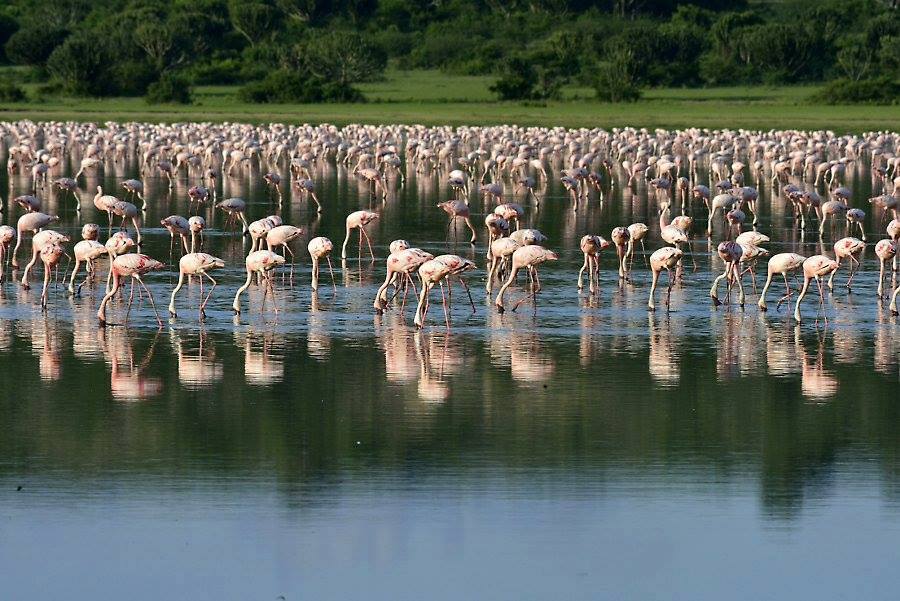 Lake Munyanyange is another popular lake, most visited in Queen Elizabeth National Park. The seasonal small shallow lake is famous for hosting the migratory lesser flamingoes, which come from as far as Lake Turkana in Kenya. The lake is the best spot and a must-see for birders
Lake Nyamunuka
The lake is named “Nyamunuka,” a local word which translates as “smell” due to the lake’s smelly waters, which heal wild animals from injuries. It’s also a wallowing ground for wild animals, especially the Cape buffalo. The sulphur gases from underneath are the reason for the “rotten egg” smell at Lake Nyamunuka. The lake is located in the Kasenyi plains and is normally seen during the game drive
Lake Kitagata
This is yet another beautiful crater lake in the Katwe field, worth visiting
The Bunyaruguru Crater Field
Travel to the western part of Queen Elizabeth National Park, in the Kichwamba escarpment, the Bunyaruguru crater is known for having both saline and freshwater. Lake Rutoto, naturally designed in the shape of the African Map, is the major lake in this field. The beautiful lake can be seen along the Kasese-Mbarara highway
Ndali Kasenda Crater Field
These crater lakes are located outside Queen Elizabeth but are normally visited by travelers on the safari circuit, including Queen Elizabeth Park. These lakes are near Fort Portal, hence easily visited by travelers to and from Kibale Forest National Park
The Crater Drive
Enjoy the 27-kilometer crater drive for breathtaking views in Queen Elizabeth National Park. The drive is an opportunity to clearly view the vast western Rift Valley Escarpment, Lake Edward, Lake Gorge, Kazinga channel, and the Rwenzori Mountain ranges.
Other things to see and do in Queen Elizabeth National Park
Besides Crater Lake exploring, Queen Elizabeth National Park offers a long list of interesting travel activities for clients to do. These include
Game viewing
Go game viewing in the Kasenyi plains, Mweya Peninsula, and Ishasha sector of Queen Elizabeth National Park. Guided day and night game drives are an opportunity to see various wild animals that live in this park. Expect to see animals, including Elephants. Lions. Leopards, Cheetahs, Uganda kobs, Buffalos, Waterbucks, and Topis, among others. Queen Elizabeth National Park is known for having a high concentration of wild animals, hence it is the best place for game viewing. Drive via Ishasha sector to see the famous tree-climbing lions not found anywhere else in Uganda
Launch Cruise
 Done at Kazinga channel, a launch cruise is a must-do in Queen Elizabeth National Park. Enjoy a cruise on the calm waters of the 40 km river which connects Lakes Edward and George. For birders, a boat cruise is the best spot for bird watching, offering panoramic views of various birds on the banks and swampy areas near the river. It also offers general, clear views of the Whole Park, fishing communities, and wildlife
Chimpanzee trekking
In addition to savannah game viewing, Queen Elizabeth National Park is a spot for chimpanzee trekking in Kyambura Gorge. A trek through this underground forest brings you close to the endangered chimpanzees, which are man’s close relatives.
Lion tracking
Join this experimental lion tracking adventure in the Kasenyi plains of Queen Elizabeth National Park. Follow the footsteps of lions with a guide of the tracking device. The travelers and guides tune into the radio frequency connected to the directional antenna. You drive off track to reach the exact point where lions are roaring.
Bird watching
 Sheltering over 600 bird species, Queen Elizabeth National Park is undeniably a haven for birders. The varied vegetation, comprised of forests, swamps, and savannahs, favors the habitation of various birds, some of which are not found anywhere else in Uganda. Some of the birds seen in Queen Elizabeth National Park include Black headed gonolek, Great white pelican, Long-crested eagle, Yellow-throated longbill, Grey crowned crane, African fish eagle, African finfoot, Caspian Plover, Lesser Flamingo, Yellow-billed stork, White winged tern, Pink-backed pelican, Papyrus Canary, shoebill, and water thick-knee, among others. Late May to September is the best time for bird watching in Queen Elizabeth National Park
In conclusion, Queen Elizabeth is one of the best places you should visit on your next Uganda Safari. Contact us at Superfine Safaris Limited for a crafted safari to this beautiful park for Crater Lake exploration, and other wildlife experiences