
Ruaha National Park is Tanzania’s largest national park and one of the most rewarding wildlife destinations on the African continent — and remarkably few people have heard of it. While the northern circuit draws the majority of Tanzania’s safari visitors to the Serengeti, Ngorongoro and Tarangire, Ruaha sits in the south-central part of the country absorbing a fraction of that traffic over a landscape more than twice the size of the Serengeti. The result is a safari experience with a quality and intensity of wildlife that equals the north, at a density of visitors that is a fraction of it. If the trade-off between wildlife and solitude matters to you, Ruaha National Park belongs at the centre of your Tanzania itinerary.
What Makes Ruaha Different

Ruaha sits at the convergence of two distinct ecological zones — the miombo woodlands of southern Tanzania and the acacia-commiphora bushveld of the semi-arid interior — and the meeting of these two systems produces a biodiversity that few parks in East Africa match. More than 570 bird species have been recorded here, including several species at the northern and southern limits of their respective ranges, making Ruaha one of the most productive birding destinations in the region. On the mammal side, the park holds one of the largest elephant populations in East Africa — estimated at around 12,000 individuals — alongside lion, leopard, cheetah, wild dog, greater kudu, sable antelope and roan antelope, several of which are absent from the northern parks entirely.
The Great Ruaha River runs through the heart of the park for much of its length, and in the dry season from June to October it becomes the axis around which all life organises. Elephants come to drink in groups of dozens. Hippo pools form wherever the water deepens. Crocodile lie motionless on every exposed sandbank. Along the banks, the vegetation thickens into a gallery forest of tamarind and fig that provides cover for leopard and creates the kind of layered, complex wildlife scene that open grassland cannot produce. Spending a morning driving the river circuit at Ruaha in July or August is as dense a wildlife experience as you will find in Tanzania at any price point.
Safari Activities in Ruaha

Ruaha National Park permits a range of activities that many of the northern circuit parks do not. Walking safaris with an armed ranger are available from several camps and are among the best in Tanzania — the combination of broken terrain, dense thickets and a permanent water source means encounters with elephant, buffalo and lion on foot are genuine rather than staged. The experience of tracking at ground level, reading spoor on a sand bank, understanding wind direction relative to a pride of lions 200 metres away — these are lessons that no vehicle can teach.
Game drives cover the river circuits and the wider park, with afternoon drives timed to catch the light when the predators become active and the river fills with elephant. Night game drives are available from most Ruaha camps — restricted in the northern parks — and produce encounters with leopard, genet, spring hare, African wild cat and occasionally lion on a kill that the daytime drives do not. Fly camping — sleeping out in the open under the stars on a mobile expedition — is operated by a handful of the premium camps in Ruaha and represents one of the most authentic safari experiences available anywhere in Africa. Our clients who have done it describe it as the moment the safari stopped being a holiday and became something they think about for years afterward.
Wildlife in Ruaha National Park
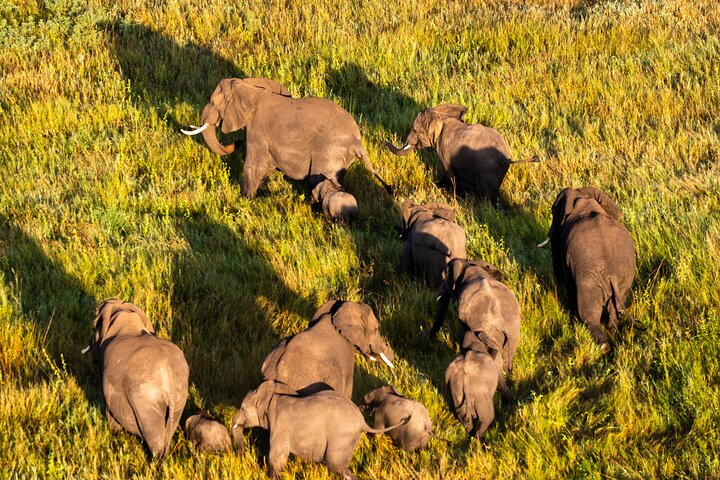
The wildlife profile at Ruaha National Park is what separates it decisively from most of the parks that receive more visitors. The elephant herds are extraordinary — both in number and in the relaxed, unhurried way they move when human pressure is low. Ruaha’s lions are well studied but not habituated to tourist vehicles in the way that Serengeti prides are, which means lion encounters here feel different: less predictable, less managed, more wild. The park holds the largest wild dog population of any national park in East Africa, and watching a pack hunt on the open floodplains in the early morning is one of those wildlife events that long-term Africa travellers specifically come to Ruaha to see.
The antelope diversity in Ruaha is exceptional for Tanzania. Greater kudu — the tall, spiral-horned woodland antelope uncommon in the north — are regularly seen in the miombo thickets. Sable and roan antelope, both rare elsewhere in the country, are present in modest numbers. Lesser kudu, Grant’s gazelle, eland and impala fill the middle layers of the savannah, while klipspringer navigate the rocky outcrops above the river. For serious wildlife enthusiasts, the species list alone justifies the detour south.
Best Time to Visit Ruaha
The dry season from June to October is the best time to visit Ruaha National Park, and for straightforward reasons. The vegetation thins as the rains retreat, opening sight lines across the miombo woodland. The Great Ruaha River drops to its lowest levels, concentrating all water-dependent species along the remaining pools and sand banks. Animal density along the river in August and September rivals anything the northern circuit produces in peak season — with the crucial difference that you may be the only vehicle watching it. Temperatures in the dry season sit between 20°C and 28°C, cool enough for walking safaris in the morning.
The wet season from November to April transforms the park into a greener landscape that the dry-season visitor would not recognise. The miombo turns deep green, the river rises and spreads, and the bird diversity explodes as migrants arrive from Europe and Asia. Driving becomes more difficult on some tracks and the tall grass reduces visibility for game viewing. Most camps reduce rates significantly in the wet season — by 30 to 50 per cent — making November and January particularly attractive for budget-conscious travellers willing to accept the trade-offs.
Getting to Ruaha National Park
The practical reality of visiting Ruaha is that it requires more planning than the northern circuit, which is partly why it stays so quiet. The park is roughly 625 kilometres from Dar es Salaam by road — a 10 to 12-hour drive through the town of Iringa — or around 90 minutes by charter flight from Dar. Most visitors arrive by air, landing at the Msembe airstrip inside the park. Charter flights connect from Dar es Salaam, Zanzibar, Arusha and Seronera in the Serengeti, making combination itineraries straightforward to build even if the distances look daunting on a map.
For travellers already visiting the northern circuit, combining Ruaha with a Serengeti-Ngorongoro trip is entirely feasible on a 10 to 14-day itinerary: fly from Arusha or Seronera to Msembe, spend three to four nights in Ruaha, then connect onward to Zanzibar or back to Dar for the return flight. This circuit gives you the wildebeest migration context of the north and the solitude and wild dog density of the south within a single trip — and it is one of the combinations we build most often for clients who have already done the northern parks and want something different.
Where to Stay in Ruaha
Accommodation in Ruaha National Park is deliberately limited in number — the park and its operators have resisted the proliferation of camps that has affected some northern circuit destinations — and the result is that even in peak season the camp-to-wilderness ratio feels right. The lodges and camps that do exist tend toward the high end of the market, with the mid-range tier thinner than in Tarangire or the Serengeti.
Jongomero Camp, on an island at the confluence of two seasonal rivers in the far south of the park, is consistently ranked among the finest safari camps in Africa: eight tents, exceptional guiding, walking safaris into genuinely remote country. Kwihala Camp combines open-sided architecture with one of the most productive locations on the Mwagusi River circuit. Mwagusi Safari Camp has been operating in Ruaha since the early 1990s and remains a benchmark for authentic, unfussy bush hospitality. For the wet season or for travellers looking for a more accessible price point, Jabali Ridge and Tandala Tented Camp both provide good access to the river circuits without the full premium-camp tariff. Booking should be done several months ahead for the July to October dry season, when the dozen or so camps between them hold relatively few beds.
Ruaha and the Southern Tanzania Circuit

Ruaha National Park pairs naturally with the Selous-Nyerere ecosystem two to three hours to the east, and combining the two parks into a southern Tanzania circuit is one of the most compelling safari itineraries the country offers. Ruaha provides the dry-country, river-and-miombo wildlife experience with walking safaris and wild dog tracking; the Selous-Nyerere adds boat safaris on the Rufiji River, enormous hippo pools and a completely different landscape character. Fly between them in under an hour and you have two entirely distinct safari environments within a single trip — without ever seeing a tourist minibus or sharing a game drive road with another vehicle.
At Superfine Safaris, we build Ruaha itineraries as standalone three to four-night park stays and as part of longer southern Tanzania circuits combining Ruaha with Selous-Nyerere and a Zanzibar beach extension. Contact our Kampala office for a tailored itinerary and pricing.
Frequently Asked Questions
How many days should I spend in Ruaha National Park?
Three nights is the comfortable minimum for a meaningful Ruaha experience. It allows two full game drive days on the river circuits, one walking safari morning and time to explore the northern game drive loops that most short-stay visitors miss. Four nights is better if wild dog tracking is a priority — the packs range widely and sightings are not guaranteed on a single outing.
Is Ruaha National Park safe to visit?
Yes. The park is professionally managed by TANAPA and operates to the same safety standards as Tanzania’s northern parks. Walking safaris are conducted with armed, trained rangers. The park receives few incidents and has an excellent safety record. The main practical consideration is that the remoteness of the southern Tanzania circuit means medical evacuation distances are longer than from the Serengeti — comprehensive travel insurance with emergency evacuation cover is important.
Can I combine Ruaha with the Serengeti?
Yes, and this is one of the most popular longer Tanzania itineraries. The standard structure is four to five nights in the north (Serengeti and Ngorongoro) followed by three to four nights in Ruaha, connected by a charter flight from Seronera to Msembe. On a 10-day itinerary you can do both; on a 12 to 14-day trip you add Zanzibar at the end and have a complete Tanzania experience.
Are there wild dogs in Ruaha?
Yes, and Ruaha National Park holds one of the largest African wild dog populations in any protected area in Tanzania. The packs are well-monitored by the camp guides and sightings during the dry season are good, particularly in the early morning when packs are active. Ruaha is one of the places in East Africa where wild dog sightings are a realistic expectation rather than a lucky bonus.
Ready to explore Tanzania’s wildest park?
Superfine Safaris designs Ruaha National Park fly-in itineraries, southern Tanzania circuits and combined Ruaha–Selous packages. Contact us or WhatsApp our team to start planning.
Plan Your Ruaha Safari
- ✓ Ruaha National Park fly-in packages
- ✓ Walking safari & night drive add-ons
- ✓ Combined northern & southern circuit
- ✓ Ruaha & Selous/Nyerere combination
- ✓ Transparent all-in pricing
Ruaha at a Glance
| Size | 22,000 km² — Tanzania’s largest |
| Location | South-central Tanzania |
| Nearest city | Iringa (120 km) |
| Best months | Jun–Oct (dry season) |
| Entry fee | USD 30 per person per day |
| Fly-in from Dar | ~1.5 hrs charter flight |
| Big cats | Lion, leopard, cheetah |