
Mahale Mountains chimpanzee trekking offers something that no other safari destination in East Africa can replicate: the experience of tracking wild chimpanzees through a montane forest that drops directly to the shore of Lake Tanganyika, one of the world’s oldest and deepest lakes. The combination of the trek itself, pushing uphill through vines and fig trees to find a community of over a hundred chimpanzees in the canopy above, and the camp setting on a white-sand beach with the clear blue lake stretching to the DRC horizon makes Mahale uniquely affecting in a way that even seasoned African travellers rarely expect. No roads reach the park. No vehicles are used. Everything here is on foot, on water, or overhead in the trees.
Why is Mahale Mountains Chimpanzee Trekking Different from Other Chimpanzee Destinations

Chimpanzee trekking is available at several places in East Africa — Kibale Forest in Uganda, Nyungwe Forest in Rwanda, Budongo in Uganda’s Murchison Falls area but Mahale Mountains chimpanzee trekking is distinct from all of them in ways that matter. The habituated M Group at Mahale has been studied since the 1960s by researchers from Kyoto University, making it one of the longest-running chimpanzee research programmes in the world. The habituation is consequently very deep , the chimpanzees are so accustomed to human presence on foot that encounters often happen at a few metres, with individuals continuing to groom, feed or move without the alertness that newly habituated communities display.
The landscape is the second distinction. Mahale’s forest climbs from the lake shore at 773 metres up to peaks above 2,400 metres, and the trek to find the community can range from a gentle hour on the lower slopes to a serious three-hour uphill push if the chimpanzees have moved to their highland range. The variability is part of what makes Mahale honest as a wildlife experience you are tracking wild animals in genuinely wild country, following the same forest trails that the research team uses, with a ranger and a scout reading signs in real time. When you find them, the hour you are permitted to spend observing has a quality that the more accessible chimpanzee sites cannot fully match.
What to Expect on a Mahale Chimpanzee Trekking Day
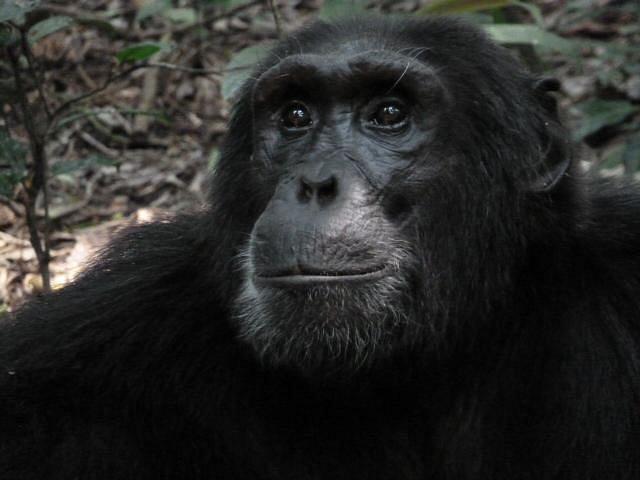
Treks depart from camp early in the morning, typically by 6:30 a.m. before the heat builds. The group is limited to six visitors per habituated community per day — one of the lowest visitor limits of any primate trekking destination in East Africa — ensuring that your encounter with the M Group is genuinely intimate rather than shared with a crowd. A park ranger leads the group and a scout, who has likely been tracking this specific community for years, reads vegetation disturbance and vocalisation to close the distance as efficiently as possible.
The forest itself is an experience independent of whether you find the chimpanzees quickly or not. Mahale’s lower slopes hold a mature tropical forest of fig, mahogany and oil palm that was never cleared for agriculture, no roads, no logging, no settlements have reached it, and the biodiversity is extraordinary. Red-tailed monkeys, olive baboons, colobus and blue monkeys are common along the route. The bird life, though secondary to the chimpanzee objective for most visitors, is exceptional, over 360 species recorded in the park, including the Ross’s turaco, white-naped pigeon and rare fishing owl along the lakeshore.
When you reach the chimpanzees, regulations require you to maintain a seven-metre distance and limit the visit to one hour. In practice, the chimpanzees often approach closer than the regulation allows and the hour passes quickly. Our clients consistently describe this as one of the most emotionally affecting encounters they have had in Africa — not the spectacle of seeing large numbers, but the quality of seeing a single individual, at rest in a tree ten metres above you, watching you back with the same frank curiosity.
Lake Tanganyika: Swimming, Snorkelling and the Beach Camp
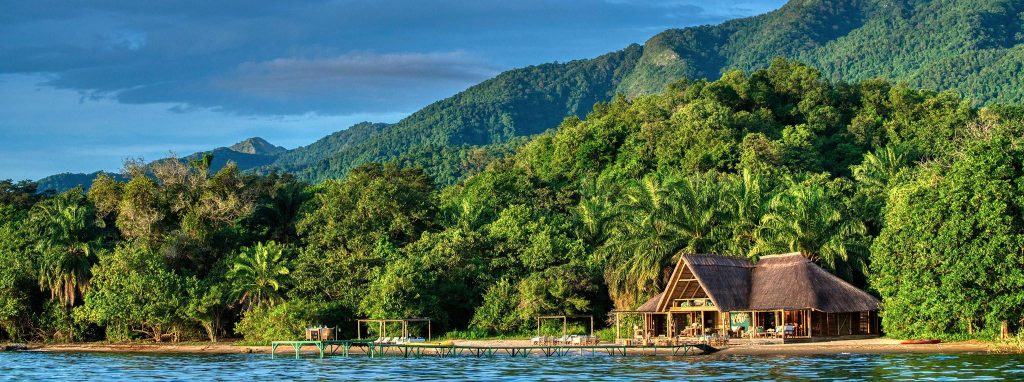
Lake Tanganyika is the world’s second-deepest lake, measuring 1,436 metres at its maximum depth, and the second-largest freshwater lake by volume on earth. It is also warm, clear and essentially free of dangerous waterborne disease — the depth and flow of the lake make it safe to swim in, which is unusual for East African lakes and makes the beach camp experience at Mahale genuinely extraordinary. After a morning trek through the forest, returning to camp to swim in water so clear you can see the bottom at ten metres is a transition of environments that stays with you.
The lake supports a unique cichlid fish fauna — over 350 endemic species, many of them brilliantly coloured and found nowhere else on earth — that makes snorkelling here a miniature version of snorkelling a coral reef. The colours and diversity of the fish visible from the surface in the bay below the camp are comparable to anything the Red Sea offers, in freshwater, at the edge of an African forest. Kayaking and sunset boat trips on the lake complete the range of camp activities available when you are not trekking.
Best Time for Mahale Mountains Chimpanzee Trekking
The dry season from June to October is the best time for Mahale Mountains chimpanzee trekking for practical reasons. The forest trails are less slippery, the lake is calmer for boat transfers between the airstrip and camp, and the chimpanzees tend to stay at lower elevations near the lake where the fig trees are fruiting. Trek distances are shorter and encounter rates are higher in this period. July and August are the peak months; booking several months ahead is advisable for these periods as the very limited camp capacity fills quickly.
January and February offer a second dry window and are a good alternative for those who cannot travel in the main dry season. The rains from March to May and again in November are the most challenging period — the trails become extremely muddy, the lake develops strong winds that complicate boat operations, and some camps close entirely. The chimpanzees can be found year-round, but the conditions underfoot make the wet-season trek physically demanding in a way that puts it beyond many visitors.
Getting to Mahale Mountains
Mahale has no road access, which is both the reason it stays unspoiled and the reason it requires more planning than most Tanzania destinations. The standard routing from Dar es Salaam is a scheduled flight to Kigoma, followed by either a charter flight or a long boat ride to the park. Charter flights connect directly from Dar, Arusha, Ruaha or Katavi and land at the Mahale airstrip; from there, a camp speedboat transfer takes 20 to 40 minutes. The logistics are well established by the camp operators and for most visitors the journey is part of the experience — the final approach by boat along the forested lakeshore, with the Mahale peaks rising directly from the water, sets the tone for everything that follows.
Where to Stay at Mahale
Mahale Mountains has very few camp options — the park limits the number of beds deliberately to protect the chimpanzee community and the experience — and the main property, Greystoke Mahale, is consistently rated among the finest safari camps in Africa. It operates ten bandas on the beach, each open to the lake, with a guiding team that includes some of the researchers and rangers who have worked with the M Group for decades. Meals are served on the beach or in the forest; the atmosphere is more like an exclusive private expedition than a conventional safari camp. Given the very limited number of beds and the difficulty of reaching Mahale at all, most clients who make the journey consider the premium price fully justified.
A second camp, Nomad’s Chimpanzee Forest Camp, operates on a simpler platform at a lower price point while still providing access to the habituated community. It is the better option for travellers focused primarily on the trekking rather than the lake experience.
Combining Mahale with Other Tanzania Destinations
Mahale Mountain chimpanzee trekking combines naturally with Katavi National Park, a two-hour charter flight to the south and one of the most remote and wildlife-rich parks in Tanzania. A Mahale–Katavi combination covers two parks that almost no tourists visit and produces a genuinely different Tanzania itinerary from the standard northern circuit. From Katavi, onward connections to Ruaha or to the Selous are straightforward by charter, building a full western and southern Tanzania circuit. At Superfine Safaris, we design these circuits for clients who have already done the northern parks and want to see what the rest of Tanzania looks like. Contact our team for itinerary options and current camp availability.
Frequently Asked Questions
How fit do I need to be for Mahale chimpanzee trekking?
A moderate level of fitness is required. The chimpanzees range widely and on some days the trek involves two to three hours of uphill walking through uneven forest terrain. Steep slopes, thick undergrowth and tree roots underfoot make the walk genuinely physical when the community has moved to higher ground. You do not need to be an athlete, but you should be comfortable walking uphill for several hours without stopping. People with serious knee or hip conditions should discuss the terrain with the camp before booking.
Is Mahale suitable for families with children?
The minimum age for chimpanzee trekking at Mahale is 12 years. The remoteness and the physical demands of the trek make it better suited to older children and teenagers who can manage a full-day outing. The lake swimming, kayaking and beach setting are excellent for families. The camp environment is intimate and the boat transfers are an adventure in themselves for younger travellers.
Can I combine Mahale with a Uganda gorilla trekking safari?
Yes — and this is one of the most compelling primate safari combinations in Africa. Gorilla trekking in Uganda or Rwanda and chimpanzee trekking at Mahale cover the two great ape families available in East Africa in a single trip. The routing requires a connecting flight via Dar es Salaam or Nairobi between Uganda and western Tanzania, which adds a travel day. On a 14-day itinerary, four days at Bwindi and three days at Mahale (with Ruaha or Katavi added) is entirely feasible. Contact our Kampala office to discuss the logistics.
Planning a Mahale chimpanzee trekking trip?
Superfine Safaris builds Mahale Mountains itineraries with chimpanzee permits, camp bookings and connections to the wider Tanzania circuit. Contact us or WhatsApp our team to start planning.
Plan Your Mahale Safari
- ✓ Mahale chimpanzee trekking permits
- ✓ Lake Tanganyika beach camp stays
- ✓ Combined Mahale & Gombe itineraries
- ✓ Tanzania southern circuit packages
- ✓ Transparent all-in pricing
Mahale at a Glance
| Location | Western Tanzania, Lake Tanganyika |
| Park size | 1,613 km² |
| Chimpanzees | ~1,000 individuals, M Group habituated |
| Best months | Jun–Oct & Jan–Feb |
| Access | Charter flight only (no road access) |
| Trek duration | 2–6 hours return |
| Permit cost | USD 150 per person |