
Ruwenzori colobus monkey trekking in Nyungwe Forest National Park is one of Rwanda’s most distinctive wildlife experiences — and one that remains far less known than gorilla trekking, despite offering something genuinely different. The Ruwenzori colobus, a striking black-and-white monkey with a flowing white mantle and extravagant tail, lives here in troops that can exceed 400 individuals, making them among the largest primate groups anywhere on the African continent. Unlike the managed, time-limited encounter of most primate treks, a session with the colobus often feels more immersive — you walk into the middle of their world as the troop moves freely above and around you through the oldest montane rainforest in Rwanda.
The Ruwenzori Colobus: Meet the Animal
The Ruwenzori colobus (Colobus angolensis ruwenzorii) is a subspecies of the Angola colobus, named after the Rwenzori mountain range that runs along part of the Albertine Rift. In Nyungwe, it is one of thirteen primate species and the most visually arresting of them — a glossy black body framed by a long white mantle across the shoulders and flanks, a white face fringe and a mostly white tail that streams behind the animal as it leaps between trees.
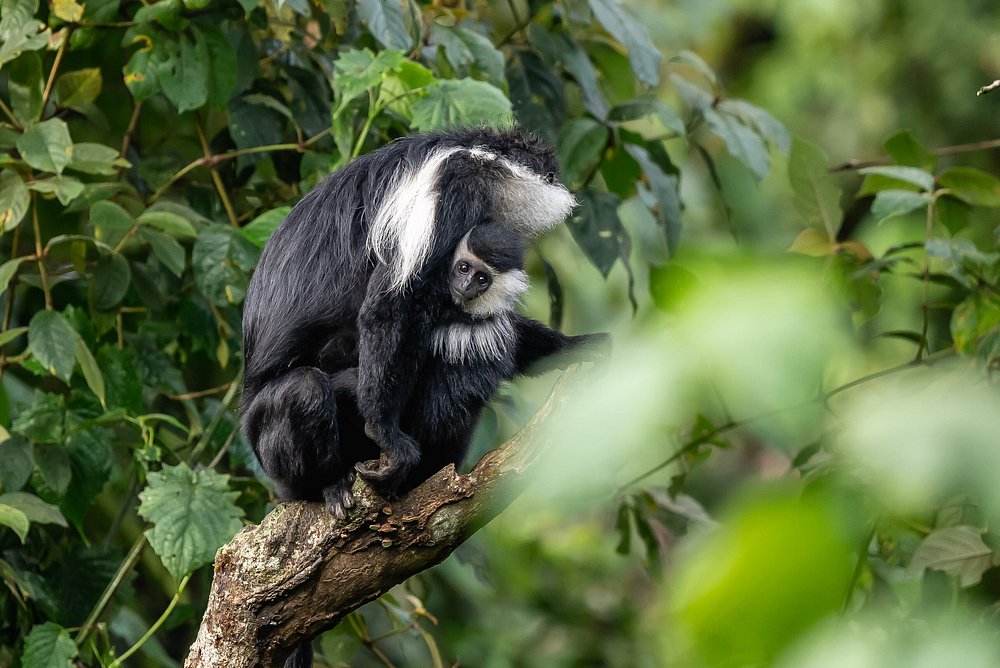
Newborns are entirely white at birth and darken gradually over their first months, making family groups easy to identify at a glance. Unlike most primates, colobus monkeys have no thumbs — an adaptation to their exclusively leaf-based diet that allows them to swing and grip branches with exceptional speed. They are also among the loudest primates in Africa: the deep, resonant roaring call of adult males carries across Nyungwe’s valleys for over a kilometre on a still morning and frequently announces the troop’s presence before any visual sighting.
Ruwenzori Colobus Monkey Trekking: How It Works
Ruwenzori colobus monkey trekking in Nyungwe is managed by the Rwanda Development Board (RDB) and departs from Uwinka, the park’s main visitor centre on the northern edge of the forest. Permits cost USD 100 per person and must be booked through the RDB or a licensed tour operator. Group sizes are capped at eight trekkers per session, with two sessions each day: a morning departure at around 7:30 am and an early afternoon session at around 1 pm.
A ranger-guide leads each group into the forest on one of Nyungwe’s established trail network. The colobus troops are habituated — accustomed to the presence of human observers and undisturbed by them during sightings. Because the main Gisakura troop has numbered over 400 in recent censuses, it is rarely difficult to locate; your guide typically radios ahead to confirm the troop’s position before you set out. The trek itself lasts two to four hours depending on where the animals have moved.
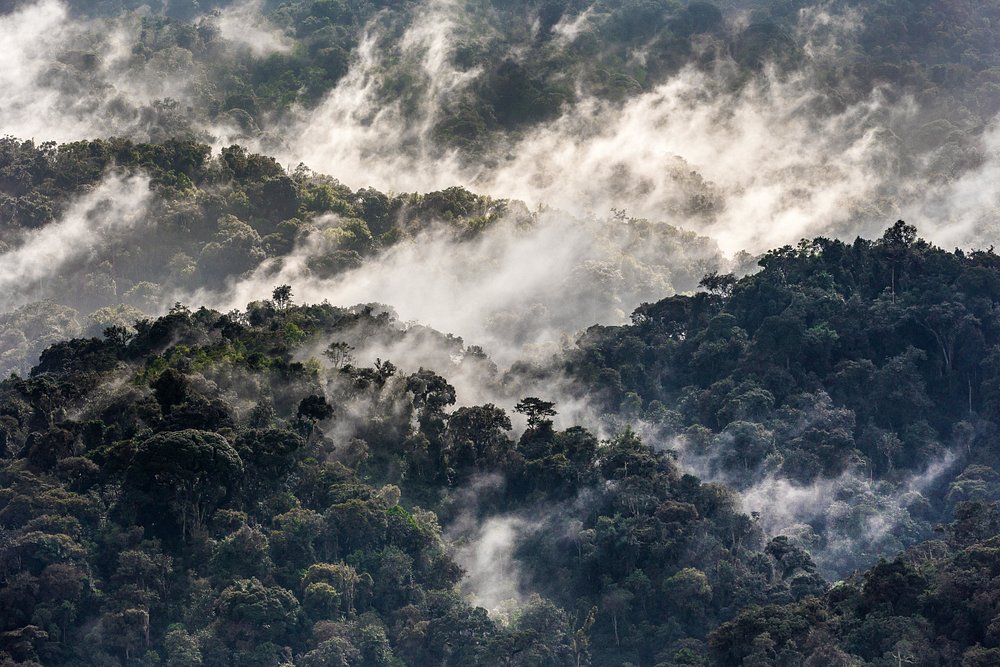
The terrain demands respect. Nyungwe rises from around 1,600 metres near the tea estates at the park edges to nearly 2,950 metres at its highest ridges. Trails are steep in places and the undergrowth dense after rain. Good boots, long trousers and a waterproof jacket are essential. Mornings are cool and often misty; the temperature at the higher elevations can surprise visitors accustomed to the warmth of Kigali or the Rwandan lowlands.
What the Trek Feels Like
Encounters with the colobus troop are rarely brief. Because the group is so large, it tends to spread across a wide section of canopy through which the trekking party can move, watching different family units feeding, grooming and carrying infants. The sound of the troop moving overhead — the crack of branches, the rustle of leaves, the occasional explosive leap from one tree to the next — creates an atmosphere that feels very different from the quiet intensity of a gorilla sighting.
Good encounters include extended periods watching the troop in the canopy as well as moments when individuals descend lower to feed or cross an open section of trail. The white-on-black coloration makes the colobus highly photogenic even in the dappled forest light, and a wide-angle lens often captures the spectacle of dozens of animals in the same canopy section better than a telephoto focused on a single individual.
The Canopy Walkway
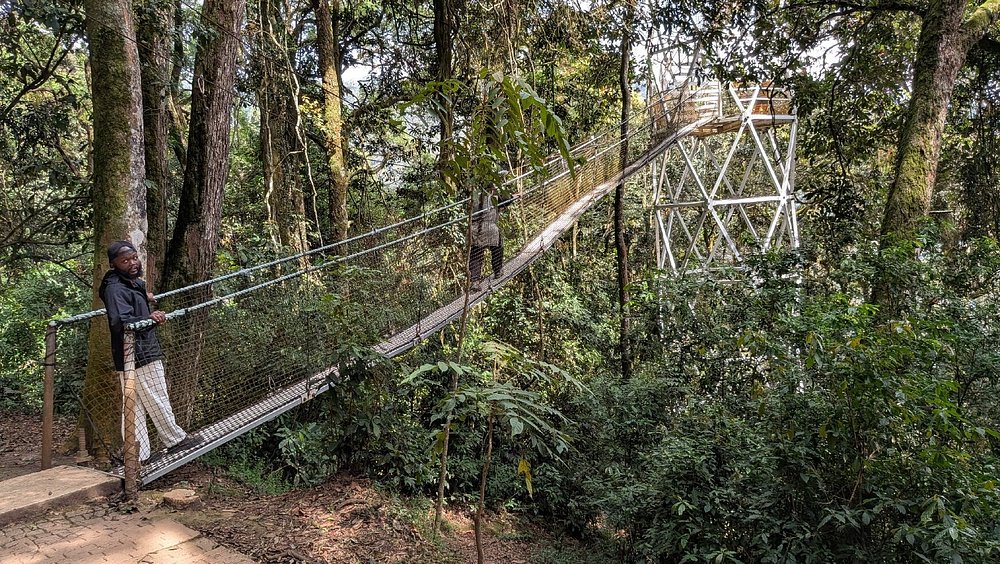
Nyungwe’s canopy walkway — a 160-metre suspension bridge spanning a valley at canopy height — is a separate activity from the colobus trek but is almost always combined into the same half-day visit. It is accessed on the Igishigishi trail, which begins at Uwinka.
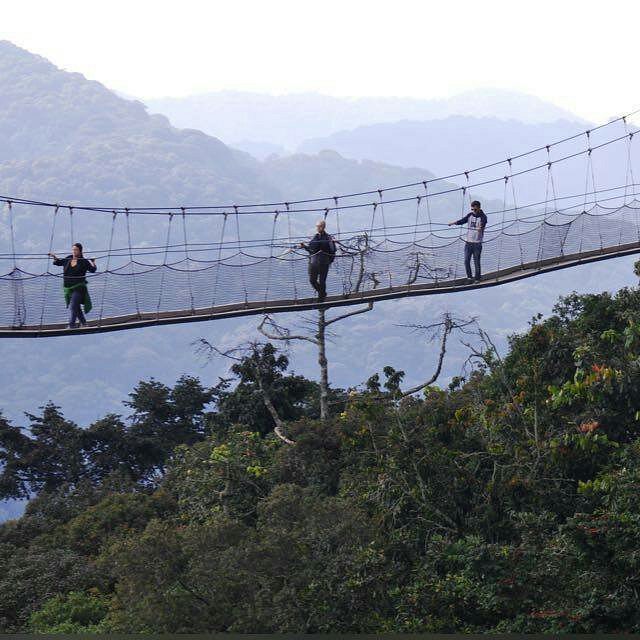
Walking the walkway at dawn, when the mist has not yet lifted and the forest is alive with bird calls, is one of the more atmospheric experiences available anywhere in Rwanda. The colobus troops frequently pass close to the bridge, and the view across an unbroken canopy to the ridgelines beyond gives a sense of Nyungwe’s scale that ground-level trekking cannot convey. Those with a fear of heights should note that the walkway sways noticeably in wind and the drop to the valley floor is real.
Chimpanzee Trekking in Nyungwe
Nyungwe is also one of Rwanda’s two chimpanzee trekking destinations, the other being Gishwati-Mukura National Park. The chimpanzee permit costs USD 150 per person. Groups are capped at six trekkers per session, and the experience is more variable than the colobus trek — chimps range more widely and unpredictably, spend time on the ground as well as in the canopy and tend to move faster.

Spending two consecutive days in Nyungwe — one for colobus monkey trekking, one for chimpanzee trekking — is a sensible and rewarding itinerary. The contrast between the aerial, leaf-eating world of the colobus and the terrestrial, tool-using intelligence of the chimpanzee makes for a genuinely rounded primate experience. Combined with gorilla trekking in Volcanoes National Park, Rwanda’s primate circuit covers three entirely different encounter types within a country that takes under four hours to cross by road.
Other Primates and Wildlife
Thirteen primate species in one forest is an unusual density. Alongside the colobus and chimpanzee, Nyungwe holds L’Hoest’s monkey — a medium-sized dark-coated monkey with a distinctive white beard that is often the most confiding of the park’s primates toward human observers — as well as grey-cheeked mangabeys, olive baboons, blue monkeys and the small nocturnal bushbaby. Nyungwe is also one of Rwanda’s premier birding destinations, with over 320 species recorded including 29 Albertine Rift endemics. The Rwenzori turaco, African green broadbill, red-collared mountain babbler and Grauer’s rush warbler are among the key target species for birders.
Best Time to Go
The dry seasons — June to September and December to February — are the most comfortable periods for trekking in Nyungwe. Trails are firmer and less slippery, visibility in the forest is better and mornings are more likely to be clear. The colobus troop is present year-round and sightings are reliable in all seasons, but the wet season (March to May, October to November) brings consistently heavy afternoon rain and muddy trail conditions that make trekking harder work.
June and July coincide with the peak birth period for the Ruwenzori colobus — white-coated infants are particularly visible during these months, making family group observations especially rewarding. September to October marks the transition between the dry and wet seasons, when the forest is lush from recent rains but trails are still largely passable.
Getting to Nyungwe Forest
Nyungwe Forest is in southwestern Rwanda, approximately 225 kilometres from Kigali. The drive takes around four to five hours on good tarmac via the RN1 highway through Huye (Butare). Most visitors combine Nyungwe with a stay on Lake Kivu — the lake lies immediately west of the park and the lakeshore towns of Kibuye or Rusizi make natural overnight stops either side of the forest visit.
Where to Stay
One&Only Nyungwe House is Rwanda’s flagship forest lodge, set among tea plantations at the park edge with guided forest experiences included in the stay. For a mid-range option, Gisakura Guest House — managed by the RDB — sits within walking distance of the Uwinka trailhead and is the most convenient base for early-morning treks. Budget travellers sometimes base themselves in Huye (Butare), around 60 kilometres east of the park, though the early start times for trekking make the longer transfer less convenient.
Combining Nyungwe with Volcanoes National Park
The classic Rwanda primate circuit links Nyungwe Forest in the southwest with Volcanoes National Park in the north. The two parks are separated by around five hours of driving through Kigali. A typical circuit spends two nights at Nyungwe (colobus day, chimp day) and two nights at Volcanoes (gorilla trek, golden monkey trek), giving four distinct primate encounters within a single Rwanda trip. Superfine Safaris designs these circuits regularly and can incorporate Lake Kivu, cultural visits and Kigali’s Genocide Memorial for those with a week or more available.
Practical Tips
- Permits: Book through the Rwanda Development Board (rdb.rw) or a licensed operator. Advance booking is recommended during peak season (June–September).
- Fitness: Nyungwe’s trails are steep and the altitude is real. A reasonable level of fitness is needed; the trek is not technical but wet conditions require care.
- What to wear: Long trousers, long sleeves, waterproof jacket and proper hiking boots. Dark or neutral colours. Garden gloves protect hands on steep sections.
- Photography: A wide-angle or standard lens captures large numbers of colobus in the canopy better than a telephoto. Good high-ISO performance helps in low forest light.
- Visa: Most nationalities obtain the East Africa Tourist Visa (USD 100, valid across Kenya, Uganda and Rwanda) on arrival at Kigali International Airport or online at irembo.gov.rw.
- Health: Malaria prophylaxis is recommended. Bring a warm layer — temperatures drop sharply at night at Nyungwe’s altitude.
Frequently Asked Questions
How do I book a Ruwenzori colobus monkey trekking permit for Nyungwe?
Permits are booked through the Rwanda Development Board (rdb.rw) or through a licensed tour operator such as Superfine Safaris. Payment is in USD. Book at least two to three weeks ahead during peak season (June–September) as permit numbers are limited per session. Your operator can handle all permit logistics as part of your itinerary.
Is a colobus sighting guaranteed in Nyungwe?
The main colobus troop in Nyungwe is fully habituated and regularly located by the ranger teams. Sightings are achieved on the vast majority of treks — the combination of habituation and the troop’s large size means the animals are rarely difficult to find. The Rwanda Development Board does not issue refunds if the troop is not located, but this is an uncommon outcome.
Can children do colobus monkey trekking in Nyungwe?
The minimum age for primate trekking in Nyungwe is 12 years. Children aged 12 and above can participate if they are comfortable hiking on uneven forest terrain for two to four hours. Younger children can visit the canopy walkway, which has a lower minimum age, but are not permitted on primate treks.
What is the difference between colobus and chimpanzee trekking in Nyungwe?
Colobus trekking typically involves a larger animal group — the main troop can exceed 400 — moving through the canopy, giving a more expansive, aerial spectacle. Chimpanzee trekking is a smaller-group encounter (maximum six trekkers) with more variable conditions: chimps range further, move faster and spend time on the ground as well as in the trees. Both are excellent and complement each other well across two days in Nyungwe.
Planning Ruwenzori colobus monkey trekking in Nyungwe? Superfine Safaris arranges permits, lodge bookings and full Rwanda primate circuits combining Nyungwe Forest and Volcanoes National Park. Contact us for a tailored quote.
Plan Your Nyungwe Trip
- ✓ Ruwenzori colobus monkey trekking
- ✓ Chimpanzee trekking permit
- ✓ Canopy walkway experience
- ✓ Birding & forest trails
- ✓ Rwanda gorilla & chimp combos
Key Facts
| Best time | Jun–Sep & Dec–Feb |
| Permit cost | USD 100 per person |
| Troop size | Up to 400 individuals |
| Trek duration | 2–4 hours |
| Altitude | 1,600–2,950 m |
| Currency | RWF / USD accepted |
| Visa | East Africa Tourist Visa – USD 100 |
| Malaria | Prophylaxis recommended |