
Detailed comparisons on Uganda safari vs Kenya safari with Superrfine Safaris Limited. Uganda and Kenya are both world-class safari destinations in East Africa, and the question of which one to choose comes up constantly among travellers planning their first or second East African safari. The honest answer is that they are very different experiences, with different strengths, different price points and different wildlife highlights — and the right choice depends entirely on what matters most to you. This guide from Superfine Safaris Limited compares Uganda and Kenya across the factors that matter most: wildlife, primates, cost, exclusivity, the wildebeest migration, birding and the overall safari experience.
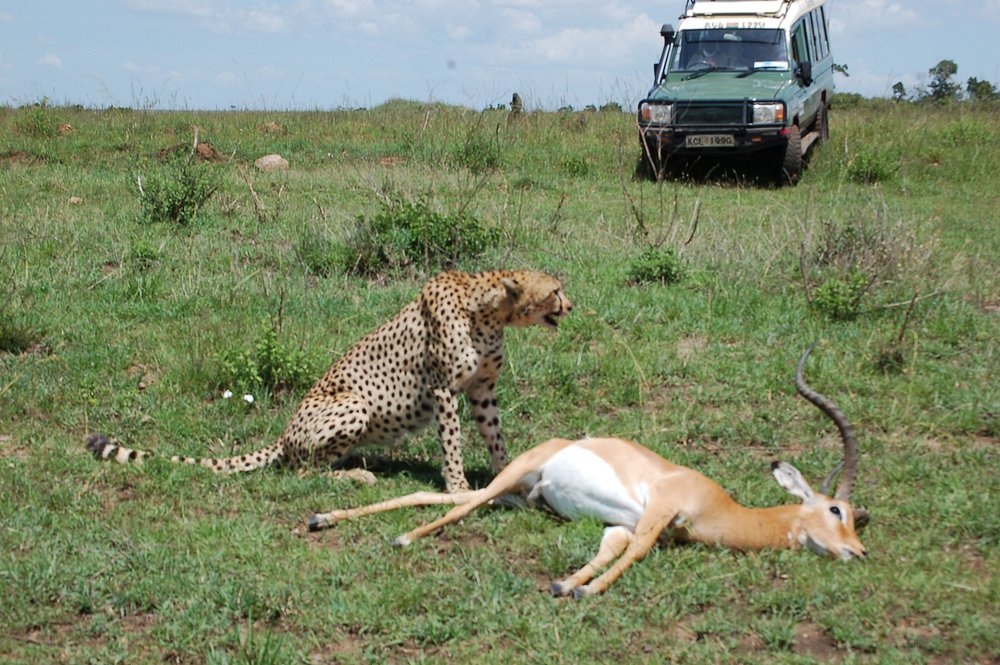
Kenya Safari — What to Expect
Kenya is where modern safari tourism began, and the country’s parks and reserves have been refined over decades into one of the most polished and accessible wildlife experiences available anywhere in Africa. The Masai Mara, Amboseli, Samburu, Tsavo and Lake Nakuru collectively cover an enormous range of habitats and species, and the infrastructure, lodges, airstrips, guides, roads, is among the most developed on the continent.
Kenya’s defining advantage is the density and reliability of its big game. The Masai Mara in particular supports extraordinary concentrations of lion, leopard, cheetah, elephant and buffalo in a relatively compact area of open savannah, and the visibility is exceptional, the flat Mara grass makes spotting animals from a vehicle straightforward in a way that Uganda’s denser, forested parks sometimes do not. For first-time safari visitors who want guaranteed sightings of multiple large mammals in a short time, Kenya is hard to beat.

Kenya is also home to the Great Wildebeest Migration — the annual movement of around 1.5 million wildebeest, zebra and Thomson’s gazelle between the Serengeti in Tanzania and the Masai Mara in Kenya. Between July and October, as the herds enter the Mara from the south, river crossings at the Mara and Talek rivers produce some of the most dramatic wildlife spectacles available anywhere on earth. If the migration is a priority, Kenya and the Masai Mara between July and October is the destination.
Uganda Safari — What to Expect
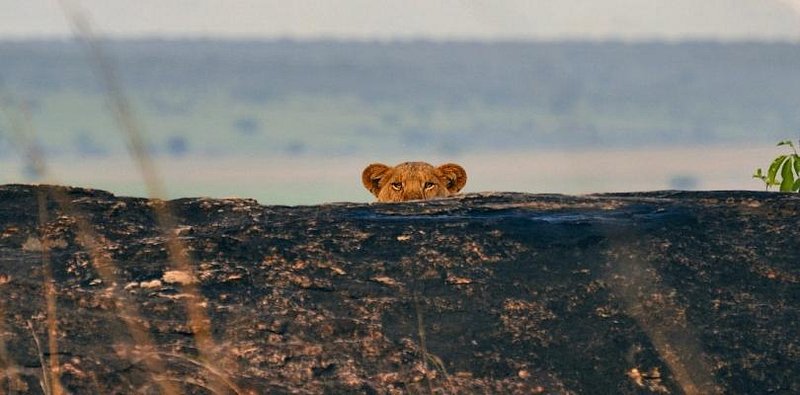
Uganda offers a fundamentally different safari experience from Kenya. Where Kenya is defined by open savannah and the sheer volume of big game visible from a vehicle, Uganda is defined by diversity — primates, birds, mammals and landscapes that no other East African destination can match within the same geographic footprint. In Uganda you can trek mountain gorillas in the Bwindi Impenetrable Forest in the morning and watch lions on open savannah in Murchison Falls in the afternoon, and no other country in East Africa offers that range of experience.
Uganda’s parks are less visited than Kenya’s most popular reserves. Murchison Falls National Park, Queen Elizabeth National Park, Kibale Forest National Park and Bwindi Impenetrable Forest receive a fraction of the visitor numbers that flow through the Masai Mara each year. This translates directly into a more exclusive, more personal experience — fewer vehicles at a predator sighting, greater guide attention, more flexibility in activity timing, and a genuine sense that the park belongs to you and a small group of other travellers rather than a mass tourism operation.
Wildlife Comparison: Uganda vs Kenya

For classic Big Five safari wildlife — lion, leopard, elephant, buffalo and rhinoceros — Kenya has a structural advantage. The density of lion and cheetah in the Masai Mara is exceptional, reliable cheetah sightings are extremely difficult to find anywhere in Uganda, and black rhino can be seen in Kenya’s Ol Pejeta Conservancy and Lewa Wildlife Conservancy in a way that has no Uganda equivalent (white rhino are present at Ziwa Rhino Sanctuary in Uganda but require a separate visit).
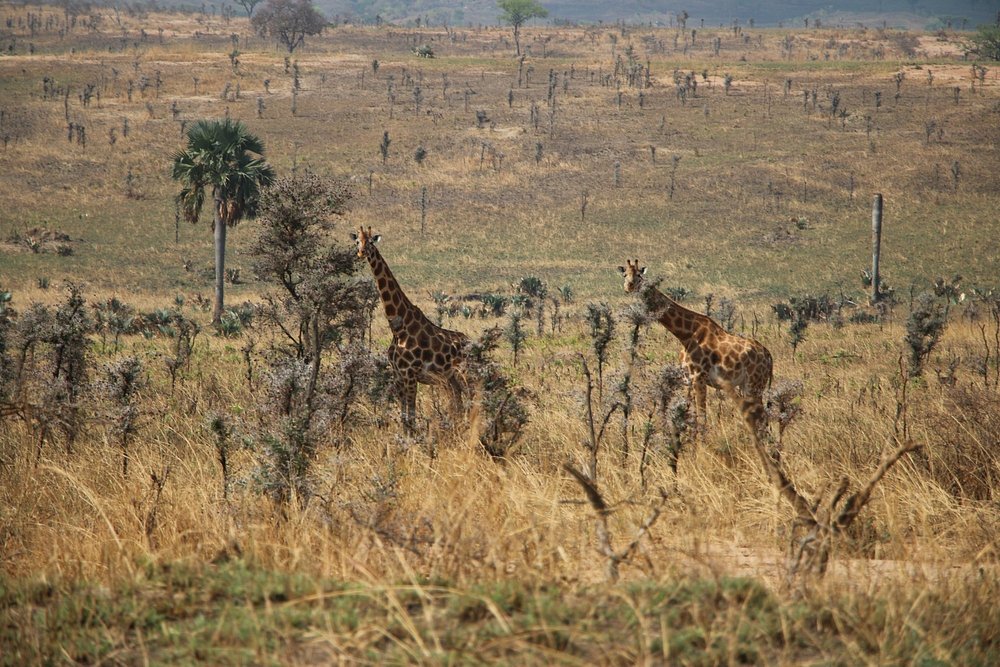
However, Uganda’s wildlife portfolio contains several species and experiences with no equivalent in Kenya. Mountain gorillas — the most compelling wildlife encounter available anywhere in Africa — are found in Uganda and Rwanda, not in Kenya. Chimpanzees are present in Uganda’s Kibale Forest, Budongo Forest and Kyambura Gorge at higher densities and with better trekking infrastructure than anywhere in Kenya. Rothschild’s giraffes, one of the most endangered giraffe subspecies in the world, are found primarily in Murchison Falls National Park in Uganda — they are absent from Kenya entirely. Uganda kob, the national animal of Uganda, exists nowhere in Kenya.

Both countries have lions, elephants and buffalo. Uganda’s lion population in Murchison Falls and Queen Elizabeth national parks is healthy and reliable on game drives, though the density is lower than the Masai Mara. Leopard are present in both countries but more reliably spotted in Kenya. Elephant are abundant in both — Uganda’s Murchison Falls elephant population is one of East Africa’s largest recoveries after near-extirpation in the 1970s and 1980s.
Gorilla and Primate Trekking — Uganda’s Decisive Advantage

This is the clearest point of differentiation between the two destinations, and for many travellers it settles the decision immediately. Mountain gorilla trekking is available in Uganda (Bwindi Impenetrable Forest and Mgahinga Gorilla National Park) and Rwanda (Volcanoes National Park). It is not available in Kenya. If trekking mountain gorillas is on your list, Uganda is the destination.
Uganda also has the highest concentration of chimpanzee trekking opportunities in East Africa. Kibale Forest National Park — with approximately 1,500 chimpanzees — is the best place in Africa for habituated chimpanzee encounters. The Chimp Habituation Experience in Kibale allows guests to spend a full day with a chimpanzee group being habituated to human presence, an experience available in no Kenyan park. Budongo Forest, Kyambura Gorge and Bwindi all offer additional chimpanzee encounters.
Kenya has primates — colobus monkeys, vervet monkeys and baboons are common across its parks — but no mountain gorillas and no comparably accessible chimpanzee trekking. For any traveller whose primary motivation is primate encounters, Uganda wins decisively.

The Great Wildebeest Migration — Kenya’s Defining Event
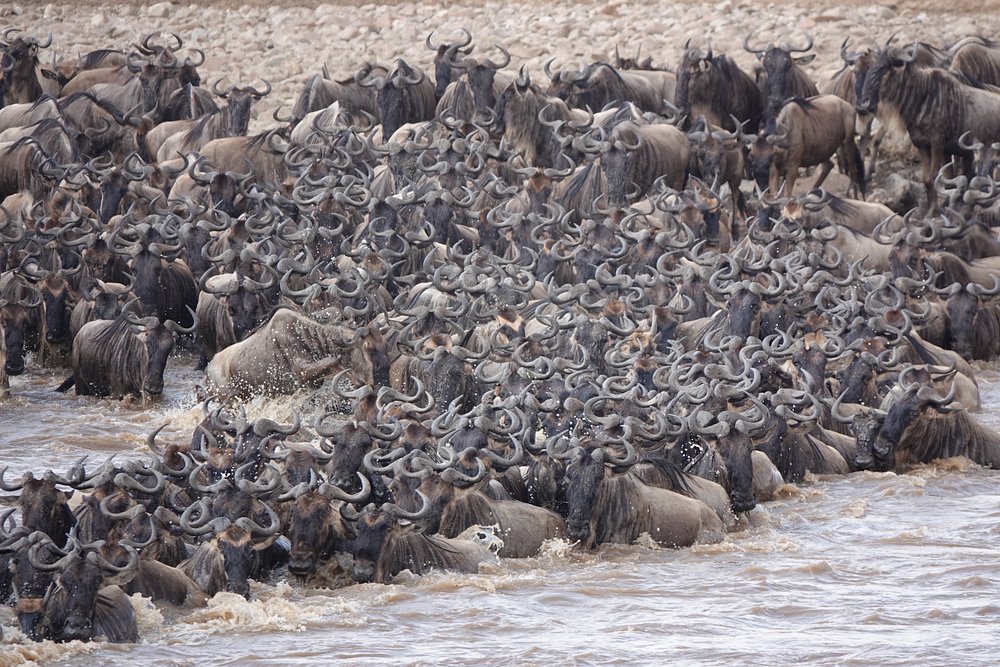
The wildebeest migration is the single most spectacular wildlife event on earth and it gives Kenya a genuine advantage during the July–October window when the herds are in the Masai Mara. Approximately 1.5 million wildebeest, 200,000 zebra and 500,000 Thomson’s gazelle move in a continuous circuit between Tanzania’s Serengeti and Kenya’s Masai Mara, following rainfall and grass growth. The Mara River crossings — where the herds plunge into crocodile-filled water to continue north — produce scenes that defy description and are available nowhere else in East Africa.
Uganda has no equivalent of the wildebeest migration. If you are travelling between July and October and the migration river crossings are a priority, the Masai Mara wins that comparison directly. Uganda’s response is the shoebill stork — a prehistoric-looking bird found in the Albert Nile papyrus swamps of Murchison Falls and in several other Ugandan wetlands — which draws dedicated birders with the same intensity that the migration draws wildlife generalists, but it is a different category of experience.
Birding: Uganda vs Kenya
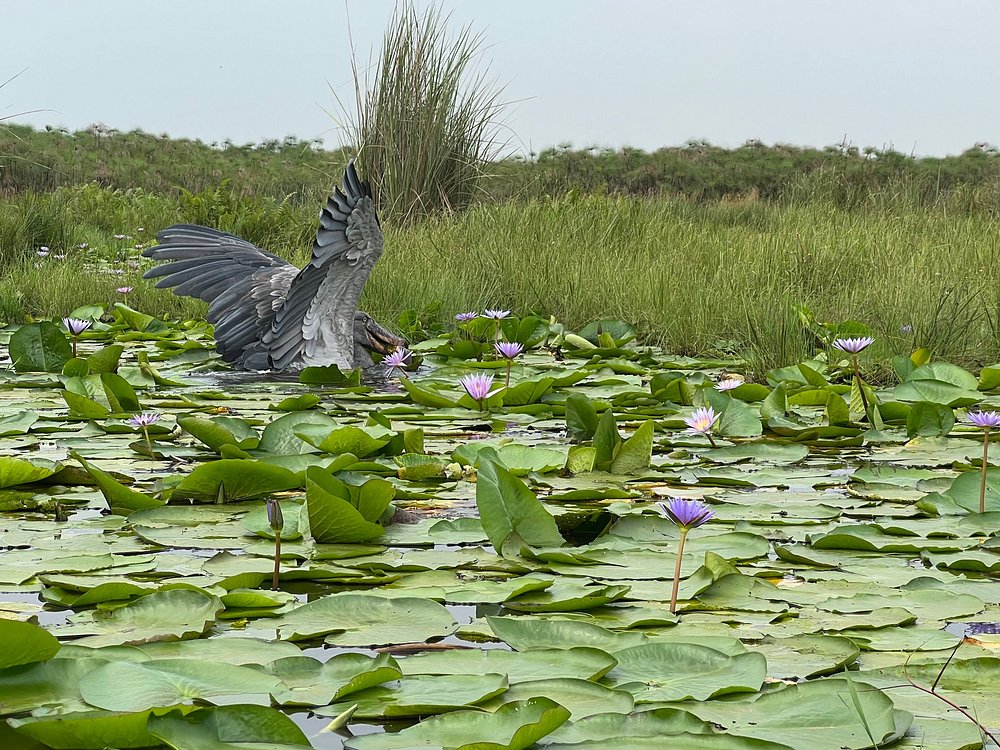
Uganda is one of the top birding destinations in the world, with over 1,060 recorded species in a country slightly smaller than the United Kingdom. That species count is extraordinary for the geographic size — Uganda sits at the crossroads of East African savannah species and Albertine Rift endemics, producing a diversity that Kenya’s more open-country bird community does not match. The shoebill stork, the African green broadbill, Shelley’s crimsonwing, the Grauer’s broadbill and dozens of Albertine Rift endemics are found in Uganda and virtually nowhere else.
Kenya has excellent birding — particularly in the Rift Valley lakes (flamingos at Nakuru), the Kakamega Forest (western species) and the coast — with over 1,100 recorded species nationally. The edge goes to Uganda for the Albertine Rift endemics and the combination of forest, savannah and wetland species accessible on a single itinerary. For serious birders, Uganda is the stronger destination.
Cost Comparison: Uganda vs Kenya
Uganda is generally more expensive than Kenya for the signature experience it is most known for — gorilla trekking permits cost $800 per person per trek in Uganda. That single cost has no equivalent in Kenya. However, outside of the gorilla permit, Uganda’s safari costs are broadly comparable to Kenya’s mid-range lodges and significantly less than Kenya’s top-end properties in the Masai Mara conservancies.
Kenya’s luxury conservancy lodges — particularly the private conservancies bordering the Masai Mara — can run $1,500 to $3,000 per person per night, putting them in a tier that has no Uganda equivalent in terms of price. However, Kenya’s mass-market lodges are also less expensive per night than Uganda’s lodge average, because the scale of Kenya’s tourism industry supports a wider range of accommodation at lower price points.
For a comparable 7-night safari, Uganda typically costs more than Kenya at the budget end (gorilla permits are unavoidable) but is competitive or less expensive at the mid-range level. The gorilla trekking experience is genuinely without equivalent anywhere in the world at any price, which puts the $800 permit in a different category from an ordinary admission fee.
Crowds and Exclusivity
This is one of Uganda’s clearest structural advantages. The Masai Mara during peak migration season (August–September) can have dozens of vehicles surrounding a single lion kill, with convoys of minibuses queuing at the Mara River crossing points. The Masai Mara experience at its most crowded is still spectacular — the wildlife volume justifies it — but it is a shared spectacle rather than a private one.
Uganda’s parks are genuinely uncrowded by comparison. A game drive on the north bank of Murchison Falls National Park in peak season encounters a handful of other vehicles, not dozens. A gorilla trekking group is limited to eight people per gorilla family per day — the entire human presence in front of a gorilla group at any moment is eight people and two or three guides. Chimpanzee trekking in Kibale is conducted in groups of six. The scale and intimacy of Uganda’s wildlife encounters is simply not available at an equivalent price point in Kenya’s most popular reserves.
Getting There: Accessibility Comparison
Kenya wins on direct international flight connections. Nairobi’s Jomo Kenyatta International Airport is one of Africa’s busiest hubs with direct flights from London, Amsterdam, Paris, Dubai, New York and dozens of other major cities. Getting to Nairobi from almost anywhere in the world is straightforward.
Uganda’s Entebbe International Airport has fewer direct connections — the main routes are via Nairobi, Addis Ababa, Dubai, Amsterdam and London — but connections have improved significantly in recent years. For most travellers, getting to Uganda involves one connection via a major hub, adding a few hours to the total travel time. Domestic flights within Uganda to Murchison Falls (Pakuba or Chobe airstrip) and to Bwindi (Kihihi airstrip) are reliable and practical, reducing overland driving time significantly.
Uganda vs Kenya — Which Safari is Right for You?
Choose Uganda if: gorilla trekking or chimpanzee trekking is a priority; you want a more exclusive, uncrowded safari experience; birding is a significant part of your trip; you want dramatic landscapes including the Nile, the Albertine Rift and rainforest alongside the savannah; or you are returning to East Africa and want something beyond the standard Kenya circuit.
Choose Kenya if: it is your first Africa safari and you want the most reliable, polished big game experience available; the Great Wildebeest Migration between July and October is a specific goal; cheetah sightings are a priority; you want the most developed infrastructure and widest range of lodge options; or direct international flight connections and ease of arrival are important factors.
Do both: Many of the best East Africa itineraries combine Uganda and Kenya — gorilla trekking in Bwindi or Mgahinga plus chimpanzee trekking in Kibale, followed by or preceded by the Masai Mara and the migration. A 10 to 14-day combined itinerary covers the greatest diversity of East African wildlife experiences available and Superfine Safaris Limited designs these combined itineraries regularly. Contact us to discuss what your itinerary could look like.
Frequently Asked Questions
Is Uganda or Kenya better for a first safari?
For a first safari with no specific primate interest, Kenya is typically the easier and more reliable introduction — the open landscapes, high big-game density and well-developed infrastructure make the wildlife viewing straightforward and the logistics simple. However, for travellers whose first safari priority is mountain gorilla trekking, Uganda is the only option — and the gorilla experience is compelling enough that many first-time safari guests choose Uganda specifically for it.
Can you see gorillas in Kenya?
No. Mountain gorillas are not found in Kenya. They live in the Virunga Massif (shared between Uganda, Rwanda and the Democratic Republic of Congo) and in Bwindi Impenetrable Forest in southwest Uganda. To trek mountain gorillas, Uganda or Rwanda is the destination.
Is Uganda cheaper than Kenya for a safari?
Uganda and Kenya are broadly comparable in mid-range lodge costs. Uganda is more expensive at the entry level because gorilla trekking permits ($800 per person) are a significant fixed cost on any Bwindi or Mgahinga itinerary. Kenya is more expensive at the luxury end — the top private conservancy lodges in the Masai Mara are among the most expensive safari accommodations in Africa. For a mid-range 7–10 day safari without gorilla trekking, Uganda and Kenya are similar in total cost.
What can you see in Uganda that you cannot see in Kenya?
Mountain gorillas, the shoebill stork (in accessible numbers), Rothschild’s giraffes, the full Albertine Rift endemic bird suite, chimpanzees at the density and accessibility of Kibale Forest, and the Murchison Falls — the most powerful waterfall in the world — are all Uganda exclusives or Uganda-dominant experiences that Kenya does not offer. The combination of these within a single country is what makes Uganda increasingly the destination of choice for experienced safari travellers returning to East Africa for a second or third time.
Is Uganda safe for tourists?
Yes. Uganda is a stable and well-established safari destination with a strong tourism infrastructure. The national parks are well managed by the Uganda Wildlife Authority, and Superfine Safaris Limited has operated Uganda safaris for many years without significant security incidents. Standard travel precautions — avoiding unnecessary night driving on rural roads, following guide instructions in the parks, taking appropriate anti-malarial medication — apply as they do anywhere in East Africa.
Plan Your Safari
Uganda or Kenya — our experts help you choose and build the perfect East Africa itinerary.
Quick Verdict
- Gorilla trekking: Uganda wins
- The Migration: Kenya wins
- Value for money: Uganda wins
- Big cats: Kenya wins
- Primates: Uganda wins
- First-time Africa: Kenya wins