
Murchison Falls National Park is one of Uganda’s most rewarding birding destinations, and for many visiting birders it comes as a genuine surprise just how productive a single visit can be. The park records 451 bird species — a total that reflects its exceptional range of habitats: open savannah and acacia woodland on the north bank, Victoria Nile riverine forest along both shores, the gorge and mist zone around the falls themselves, and the vast papyrus swamps and floodplain wetlands of the Albert Nile delta in the park’s northwest corner. Few parks anywhere in East Africa pack this diversity of habitats into a single location, and for birders combining a wildlife safari with serious listing, Murchison Falls National Park delivers on both counts.
At Superfine Safaris Limited, we have guided birding trips in Murchison Falls National Park for dedicated listers, casual wildlife watchers and photographers at every level of experience. This guide covers the park’s signature species, the best birding zones, seasonal timing, and how to build a birding itinerary around the park’s other activities.
The Shoebill Stork — Murchison’s Most Wanted Bird
No species defines birding in Murchison Falls National Park more than the shoebill stork (Balaeniceps rex). This extraordinary bird — standing up to 1.4 metres tall, with a massive shoe-shaped bill evolved to ambush lungfish in shallow papyrus swamps — is one of Africa’s most sought-after species and Uganda’s signature birding target. Uganda holds an estimated 50 percent of the global shoebill population, and Murchison Falls National Park is one of the most accessible and reliable locations in the country to find one.
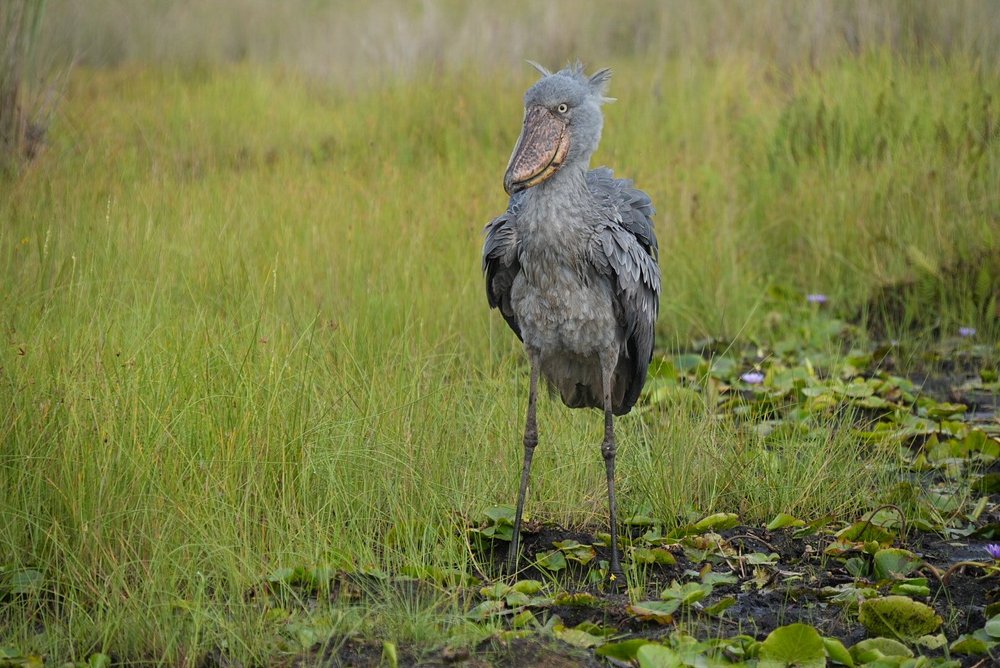
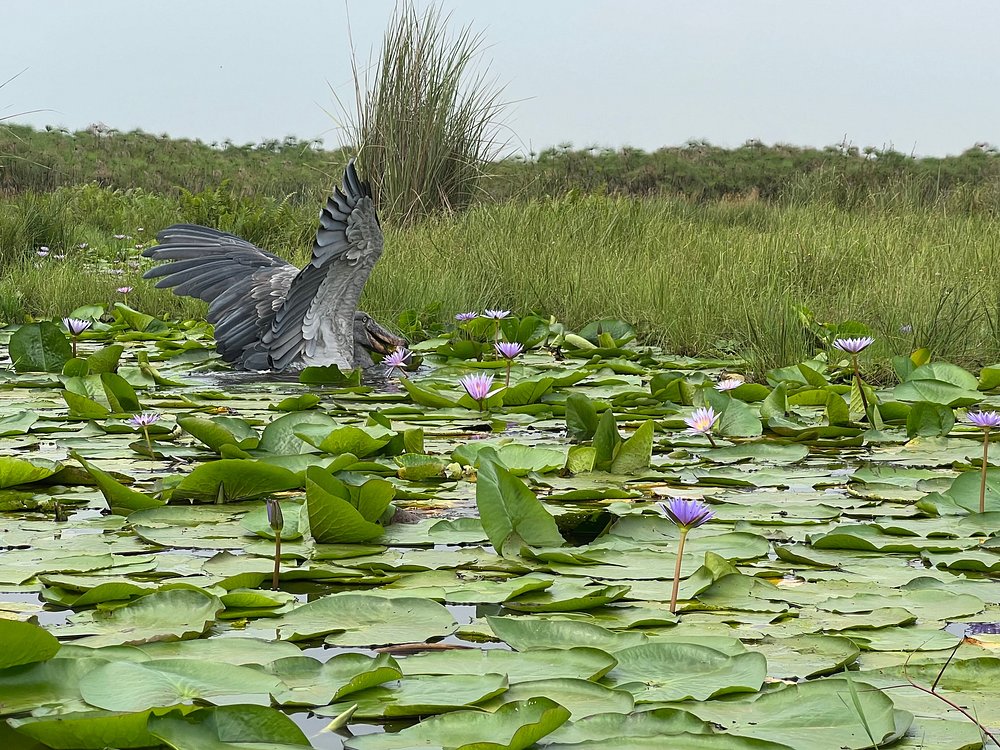
Shoebills in Murchison Falls inhabit the papyrus swamps and shallow backwaters along the Victoria Nile, particularly in the lower reaches between Paraa and the Albert Nile delta. They are almost entirely sedentary — a shoebill may stand motionless for 30 minutes or more, waiting for a lungfish to surface — which makes them rewarding to observe once located but occasionally difficult to find when water levels shift their preferred feeding grounds.

The three best approaches for finding the shoebill in Murchison Falls are a boat cruise along the Victoria Nile, where rangers and guides scan the papyrus edges throughout the trip and sighting rates are consistently high; a dedicated canoe excursion into the papyrus channels and backwater lagoons before the main boat traffic starts, which allows access to shallow areas a launch cannot reach; or a drive to the Albert Nile delta in the park’s far northwest, where the open floodplain makes scanning for the bird considerably easier than searching in dense papyrus. For birders whose primary target is the shoebill, we strongly recommend combining both the boat cruise and the canoe excursion — they cover different parts of the habitat and the approaches complement each other.
Savannah and Acacia Woodland — North Bank Birds
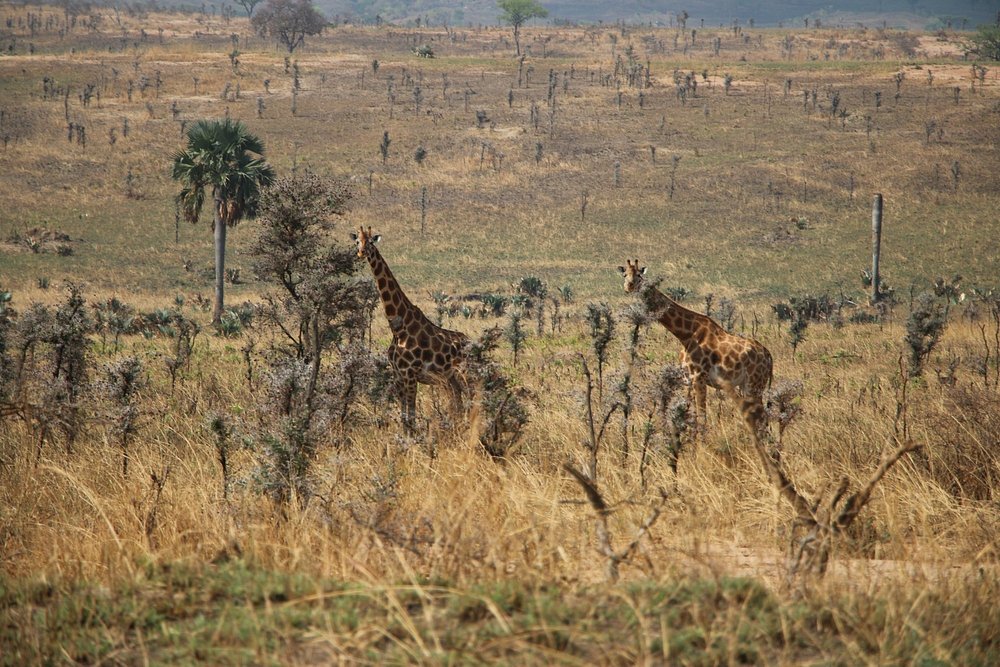
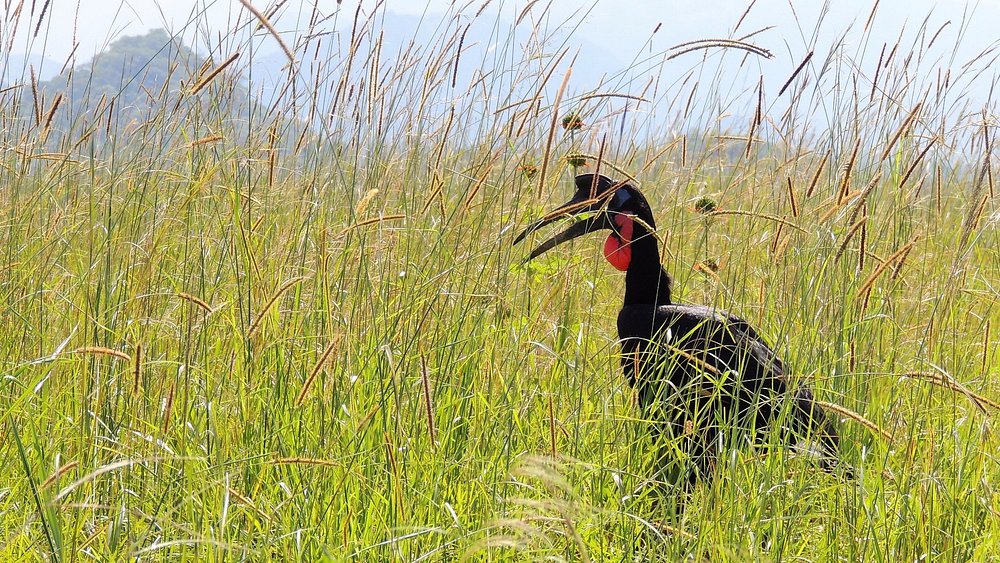
The open savannah of the north bank holds a rich community of grassland and woodland birds that reward methodical coverage on morning game drives. The Abyssinian ground hornbill is among the most charismatic — large, black and red, striding across open ground in pairs or small groups, and reliably seen on the Buligi circuit most mornings. The secretary bird, one of Africa’s most distinctive raptors, walks through long grass hunting snakes across the flat plains and is a regular sighting on the wider savannah sections.
Flocks of black-headed lapwing number 20 to 50 birds along roadsides and short-grass areas. The grey-crowned crane — Uganda’s national bird — appears in pairs and small groups near wetter grassland edges. Denham’s bustard is less common but recorded on the broader Buligi plain. Along the sandy banks of the Victoria Nile, colonies of red-throated bee-eater are spectacular in flight, their bright orange-red throats catching the morning light as birds pour in and out of nesting burrows. From August through October, large numbers of northern carmine bee-eater arrive as intra-African migrants and roost in the acacia trees along the river — on peak days, flocks of several hundred birds can be seen moving over the Nile in the late afternoon.
Raptors are well represented across the north bank. The bateleur is almost always visible soaring on its flat-winged, tail-less profile. Martial eagles perch in the tops of the largest trees on the savannah edge. Long-crested eagles, identifiable by their extravagant head plumes, sit on low perches near forest edges. African harrier hawks are common throughout, probing tree cavities and cliff faces with their double-jointed legs. On wider open areas, grasshopper buzzard and lizard buzzard add to a raptor list that can exceed 30 species in a focused morning.
The Victoria Nile — Richest Birding Corridor in the Park
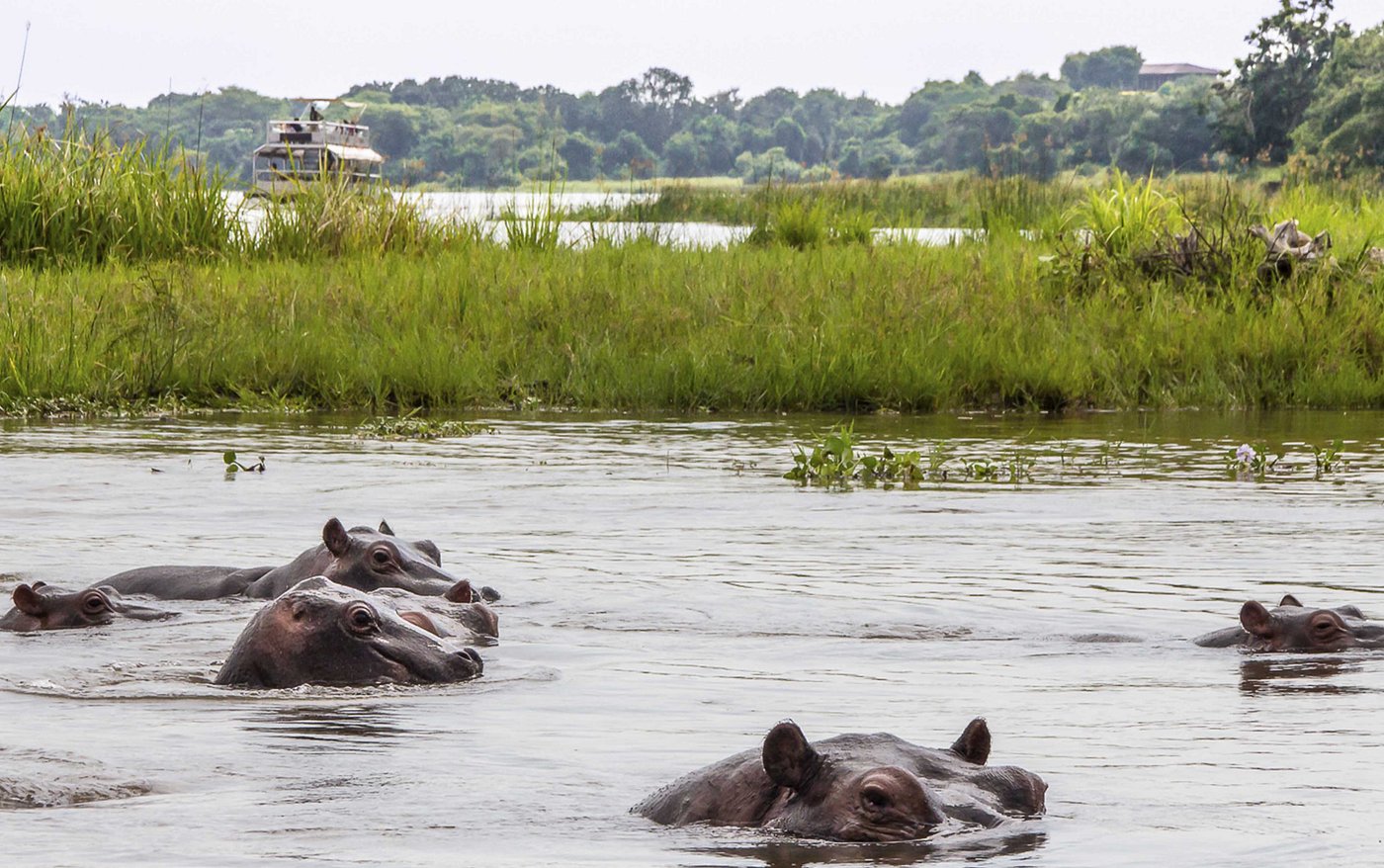
The Victoria Nile running through the park is the single most productive birding zone, accessible from both the boat cruise and the south bank road. The African fish eagle is the defining sound and sight of the river — pairs hold territories along the entire Nile through the park and their calls carry across the water from before dawn. Among the herons, the goliath heron is unmissable at 1.5 metres tall, wading in the shallows or roosting on sandbanks; black-headed heron, purple heron, squacco heron, little egret and great white egret are all regular alongside it.
Four of Uganda’s six kingfisher species are found along this stretch of the Nile. The giant kingfisher is the most visible, perching prominently on overhanging branches before plunging for fish. Pied kingfishers hover above the open water in numbers. Malachite kingfisher and woodland kingfisher work the riverside scrub. The African skimmer — one of Africa’s most elegant waterbirds — breeds on sandbanks in the Nile from December to February, and the active colonies are one of the most spectacular birding sights available anywhere in Uganda during those months. Hamerkop, immediately identifiable by its hammer-shaped head, is common near water along the entire Nile corridor. Water thick-knees roost on sandbanks by day, flushed by approaching boats and relocating further downstream in their characteristic low, rapid flight.
The Albert Nile Delta — Wetland Specialists
The Albert Nile delta in the park’s northwest — where the Victoria Nile broadens into a wide floodplain before entering Lake Albert — is the park’s most specialised birding zone and the least visited by general tourists. The combination of extensive papyrus beds, open floodplain, shallow lagoons and gallery forest produces a species list that overlaps with but extends meaningfully beyond what the main Paraa area delivers. The saddle-billed stork, Africa’s tallest stork with its spectacular red, yellow and black bill, is found in pairs on the delta floodplain. African openbill storks gather in large flocks around flooded grassland edges. Lesser jacana and African jacana pick across floating vegetation on the lagoons. In the reed beds and papyrus edges, specialists including papyrus yellow warbler, white-winged warbler and papyrus gonolek reward patient searching with a guide who knows their calls. The shoebill is reliably present in the delta year-round, often more accessible here than in the denser papyrus of the main Nile channel.
The Falls Zone and South Bank Forest
The south bank road between the Paraa ferry crossing and the base of Murchison Falls passes dense riverine forest and riverside scrub that hold a different bird community from the open savannah. The mist zone immediately around the falls gorge creates a permanently humid microhabitat where African broadbill, black bee-eater, white-browed robin-chat and grey-capped warbler are reliably found. Broad-billed roller perches on exposed branches along the forest edge. The forest canopy here holds little green sunbird, yellow-mantled widowbird and, with patience, the African green pigeon feeding in fruiting trees. The south bank drive is the most reliable part of the park for leopard and it is worth combining a careful forest bird search with attention to mammals — the same dense vegetation suits both.
Best Time for Birding in Murchison Falls National Park
Birding in Murchison Falls National Park is productive in every month of the year, but different seasons offer different highlights. The long dry season from June through September is the most popular period for birding: sparse vegetation improves visibility dramatically, making it easier to spot ground-level and understorey species, and water concentrations bring birds to predictable locations. The northern carmine bee-eater migration peaks in August and September, adding hundreds of birds to the acacia woodlands.
The short dry season from December through February is arguably the most exciting period for specialist birders. The African skimmer breeds on Nile sandbanks from December to February and the active colonies — sometimes 50 to 100 pairs — are one of the most extraordinary birding spectacles in Uganda. Palearctic migrants are present throughout the park in good numbers, and the cooler temperatures make full-day birding more comfortable than the hot dry season months.
The long rains from March through May bring breeding plumage and active nest behaviour among resident species. The park is significantly quieter in terms of visitor numbers, which makes for more relaxed birding on every circuit. Palearctic migrants are moving through on their northward journey in March and April, and intra-African migrants arriving from the south add species to the daily list that are absent in the dry season. Some tracks become muddy but remain passable with a good 4×4. The short rains in October and November see the northern carmine bee-eater still present in early October before departing, and the first arrivals of wintering Palearctic migrants from late October onward, including European bee-eater, woodland kingfisher and various warblers and flycatchers.
Best Birding Routes in Murchison Falls National Park
The morning boat cruise departing Paraa jetty at 9:00 AM is consistently the most species-rich single birding activity in the park. The 2-to-3-hour trip upstream to the base of the falls passes the entire range of Nile habitats in one go — open water, sandbanks, papyrus edges, overhanging forest — and covers African fish eagle, goliath heron, giant and pied kingfisher, African skimmer in season, red-throated bee-eater and the shoebill in a single morning. Serious birders often choose the morning cruise over the more popular afternoon version specifically for the quality of the light and the undisturbed shoebill search.
The north bank Buligi and Albert circuits are best run as a full morning game drive starting at 6:30 AM. Raptors are soaring by 7:30 AM, ground hornbills are active before 8:00 AM, and bee-eater colonies at the Nile banks are busiest in the first hour of daylight. Allow 4 to 5 hours for a thorough circuit with regular stops at productive areas. Combining Buligi for savannah birds with the Albert circuit extension to the delta gives access to both the grassland and wetland bird communities in a single morning.
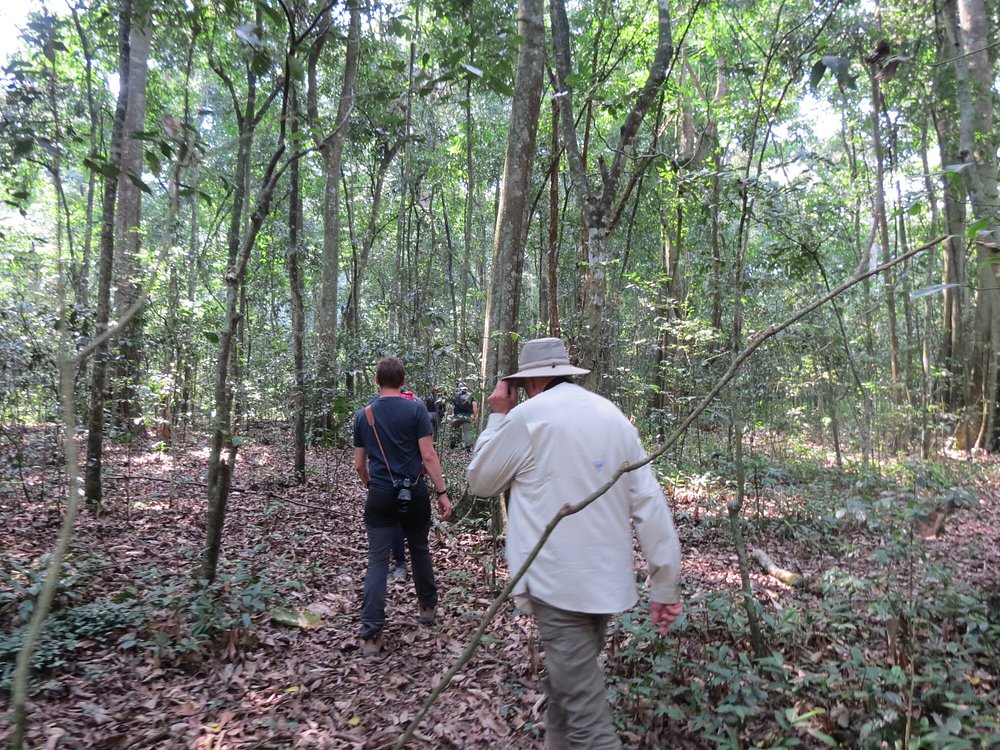
The south bank road is best birded on foot from the falls trail base or by slow driving along the riverine edge. Walk quietly through the forest understorey for the black bee-eater, broadbill and robin-chat, and check the open sections along the river for skimmer in season and large wader flocks on the sandbanks. Morning and late afternoon are the most productive times.
A dedicated canoe excursion is the highest-probability approach for the shoebill and delta specialists. The canoe departs before sunrise, poles into the papyrus backwaters before other boat traffic disturbs the birds, and positions for shoebill at first light. This excursion can be arranged through Superfine Safaris Limited as an add-on to any Murchison Falls itinerary.
Combining Birding in Murchison Falls with Other Uganda Destinations
Murchison Falls National Park sits at the top of Uganda’s northwest birding circuit. Most dedicated birding itineraries from Superfine Safaris Limited combine it with one or more complementary destinations. Budongo Forest, 90 minutes south of Paraa, holds 360 species including the spectacular chocolate-backed kingfisher and several West African forest species at the eastern edge of their range — adding even a single morning in Budongo to a Murchison Falls trip is one of the best-value birding extensions available. Our post on chimpanzee trekking in Budongo Forest covers the forest in detail.
Kibale Forest National Park, with its 375 species and 6 Albertine Rift endemics including the African pitta and Nahan’s francolin, covers highland rainforest bird communities entirely absent from Murchison’s savannah and river habitats. A Murchison–Kibale circuit in a 6-to-8-day itinerary is one of the most complete Uganda birding combinations available. Queen Elizabeth National Park adds the Kazinga Channel, where over 100 waterbird species can be logged in a single afternoon boat trip, and Maramagambo Forest for forest species. See our full guide to the top birding destinations in Uganda for a complete circuit comparison and species highlights across all parks.
Birding Guides and Equipment Tips
All Superfine Safaris Limited Murchison Falls itineraries include experienced driver-guides who know the park’s birds well and consistently identify the iconic species. For dedicated birders targeting a high species count, a specialist birding guide with formal ornithological training adds significant value — particularly for rarer species, call identification and locating shy riverine forest birds. We can arrange specialist guides for any Murchison Falls birding tour.
For equipment, binoculars of 8×42 or 10×42 work well for general birding across all habitats. A spotting scope is particularly useful for delta birding, skimmer watching on sandbanks and scanning roosting raptors at distance on the north bank. A camera with 500mm or longer is recommended for flight shots and distant raptors on the open savannah. Clothing in neutral colours — khaki, olive, brown — minimises disturbance near the shoebill and on the canoe excursion. Carry a field guide: Birds of East Africa by Stevenson and Fanshawe covers all Murchison Falls species in detail.
How to Get to Murchison Falls National Park
Paraa — the main birding hub — is 305 kilometres from Kampala, approximately 5 to 6 hours by road via the Kampala–Gulu highway. Domestic flights from Entebbe to Pakuba or Chobe airstrip take approximately 1 hour and are the preferred option for dedicated birding tours where time in the field matters more than road travel. All Superfine Safaris Limited Murchison Falls packages include road or air transfers with your driver-guide. Contact our team to discuss a custom birding itinerary.
Frequently Asked Questions
How many bird species are in Murchison Falls National Park?
Murchison Falls National Park records 451 bird species — one of the highest totals for any single savannah park in East Africa. The count reflects the park’s exceptional habitat diversity: open savannah, acacia woodland, Victoria Nile riverine forest, the falls gorge mist zone and the Albert Nile delta wetlands, each with its own distinct bird community.
Is the shoebill stork guaranteed in Murchison Falls?
No wildlife sighting is ever guaranteed, but Murchison Falls is one of the most reliable shoebill locations in Uganda. With an experienced guide and a dedicated canoe excursion or morning boat cruise, sighting rates are consistently high. The Albert Nile delta and the papyrus backwaters near Paraa are the most productive zones. Current water levels significantly affect where shoebills are feeding — our guides track conditions before each trip and adjust the approach accordingly.
Can I combine birding with game drives in Murchison Falls?
Absolutely — and it is the standard approach. Game drives on the north bank circuits naturally yield a large portion of the savannah bird checklist: ground hornbill, secretary bird, eagles, bee-eaters, lapwings and bustards all appear during normal wildlife-focused driving. Adding a morning boat cruise and an afternoon canoe excursion covers the waterbird and shoebill targets. A full 3-day Murchison itinerary with a birding-focused guide can realistically reach 200 species or more.
What is the African skimmer and when can I see it in Murchison Falls?
The African skimmer is a graceful black-and-white waterbird that feeds by flying low over the water surface with its elongated lower bill trailing through the water to catch fish. It is among Africa’s most elegant birds in flight. In Murchison Falls, skimmers breed on sandbanks in the Victoria Nile from December to February — the breeding colonies of 50 to 100 pairs are active and easily visible from the boat cruise during this period. Outside the breeding window, skimmers are much less reliably seen and the sandbanks are largely unoccupied.
Do I need a specialist birding guide or will my safari driver-guide be sufficient?
For casual birders who want good birds alongside the mammal safari experience, an experienced driver-guide is entirely sufficient. Superfine Safaris Limited driver-guides know Murchison’s birds well and consistently find the park’s iconic species. For dedicated birders targeting a high species count — particularly the rarer papyrus specialists, call-identified warblers and the more elusive forest edge species — a specialist birding guide with formal ornithological training adds real value. We can arrange specialist guides for any Murchison Falls birding tour. Get in touch to discuss your requirements.
Ready to Book?
Talk to our safari experts and get a custom itinerary built for you.
Get a Free Quote