
Mount Meru hiking is one of the most underrated trekking experiences in East Africa, and its relative obscurity is entirely unjustified. At 4,566 metres, Meru is Africa’s fourth-highest peak and Tanzania’s second-highest mountain, rising from the edge of Arusha National Park 30 kilometres west of Arusha city. It is almost invariably described as an acclimatisation climb for Kilimanjaro, the mountain that looms on the horizon to its east, but that framing misses the point. Mount Meru hiking is a rewarding and technically interesting experience in its own right, passing through some of the most diverse montane forest in northern Tanzania, requiring a challenging knife-edge ridge approach to the summit, and delivering sunrise views of Kilimanjaro floating above the clouds that most people who have climbed both mountains describe as the more affecting sight. Kilimanjaro draws 50,000 climbers a year. Meru draws around 1,500.
Mount Meru Hiki ing Routes: Momella Gate to Socialist Peak
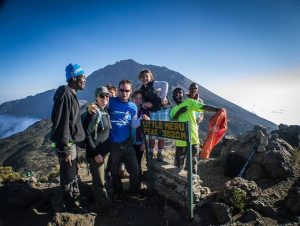
Mount Meru has a single trekking route, beginning at Momella Gate on the eastern edge of Arusha National Park at 1,500 metres. The mountain is a stratovolcano with a horseshoe-shaped crater open to the east — a catastrophic flank collapse around 8,000 years ago removed the entire eastern wall, leaving a dramatic inner crater with ash cones visible on the floor below and the knife-edge outer rim rising to Socialist Peak, the summit, at the western end. The route climbs the outer rim in a series of stages that take three to four days return.
Day one covers the ascent from Momella Gate through dense montane forest to Miriakamba Hut at 2,514 metres , a walk of three to four hours through forest holding elephant, giraffe and buffalo that are regularly encountered on the trail. The forest is the lushest and most biodiverse section of the climb: giant podocarpus trees, flowering shrubs, black-and-white colobus in the canopy, bushbuck in the undergrowth. Day two climbs from Miriakamba through the ericaceous heath zone to Saddle Hut at 3,566 metres, a harder four to five-hour ascent that emerges above the treeline into open moorland, with Kilimanjaro appearing on the eastern horizon as the cloud clears. An afternoon walk from Saddle Hut to Little Meru (3,820 m) is the standard acclimatisation outing and gives the first full view of the inner crater from the rim.
Summit Day: The Knife-Edge Ridge
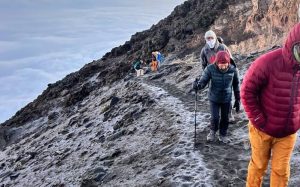
The summit push on Mount Meru hiking begins at midnight or 1 a.m. from Saddle Hut — the standard practice for arriving at Socialist Peak before sunrise. The ascent to the summit follows the crater rim, which narrows progressively to the famous knife-edge section: a ridge of volcanic ash and rock where the path is less than a metre wide, with a sheer drop into the inner crater on one side and the outer slope falling steeply away on the other. In daylight this section requires care and steady footing; in darkness, with headlamps only, it requires concentration and composure. It is not technically difficult in the mountaineering sense — no ropes or crampons needed — but it is not the kind of mountain walk that Kilimanjaro’s Marangu or Lemosho routes provide.
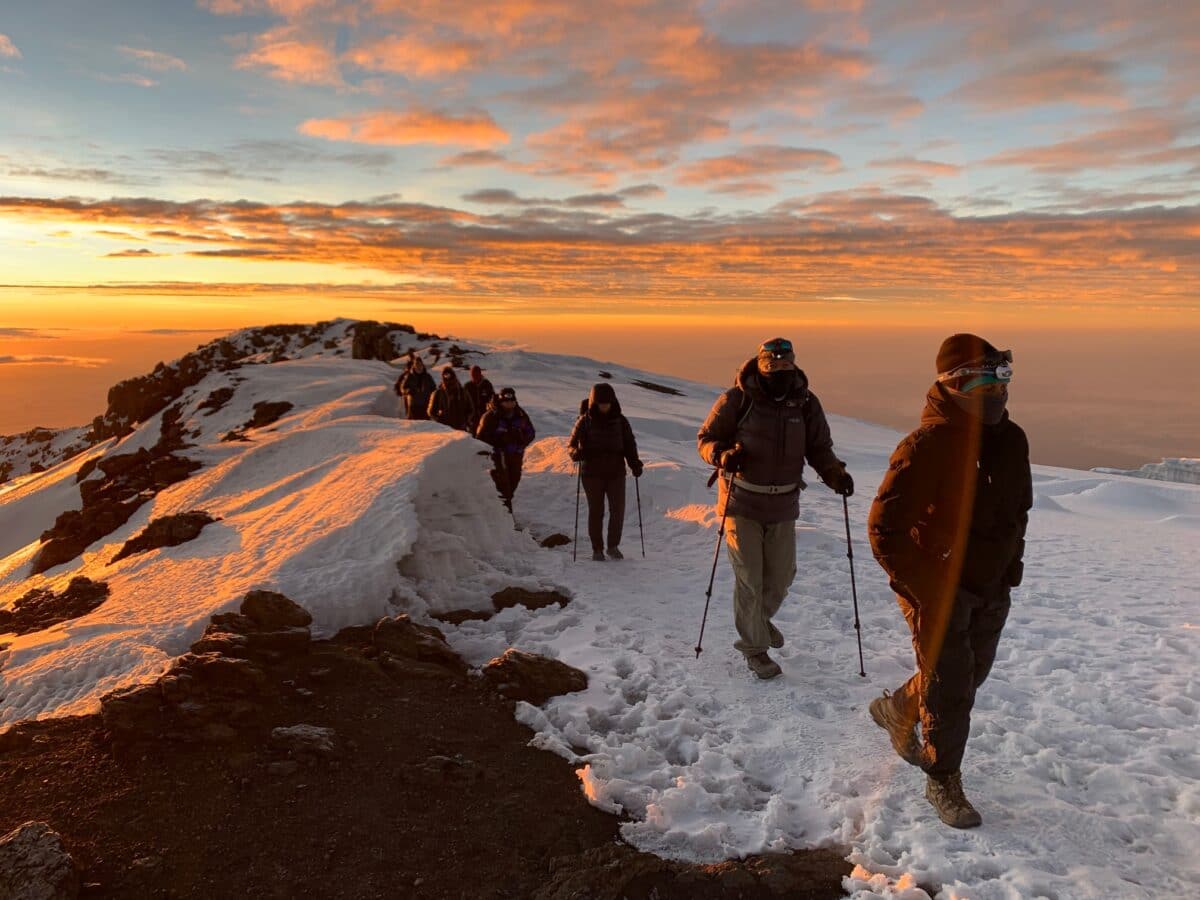
The summit arrives just before dawn on most schedules, and the view when the light comes up is extraordinary. Kilimanjaro hangs on the eastern horizon above the cloud layer, its Kibo crater white and enormous, apparently suspended in the sky rather than attached to the earth below. The Arusha National Park lakes, the Maasai steppe and the plains toward the Serengeti stretch south and west. Most climbers find this moment, watching Kilimanjaro from Africa’s fourth-highest peak as the sun rises over the summit snows — to be among the most striking things they have experienced in Africa. Descent returns via Saddle Hut to Miriakamba on the third day, and to Momella Gate on the fourth morning.
Wildlife on Mount Meru
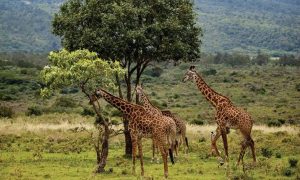
Mount Meru hiking differs from Kilimanjaro in one significant respect: the lower slopes of the mountain are inside Arusha National Park, and the wildlife is genuinely wild rather than habituated to trekkers. All groups are required to be accompanied by an armed ranger from the park from Momella Gate to the summit, this is not optional and is enforced for safety, because elephant, buffalo and giraffe all inhabit the forest between the gate and Miriakamba Hut. Encounters with these animals on the lower trail are common, particularly in the early morning when the forest is quiet and the animals are active. The ranger manages these encounters calmly and they rarely result in anything more than a detour, but the possibility of walking around a bend and finding an elephant feeding fifteen metres away is a reminder that this is a functioning wildlife park, not a dedicated climbing corridor.
Above Miriakamba the wildlife thins as the forest gives way to heath and then to open moorland, but the bird life remains rich throughout. The sunbird species change as you climb, malachite and scarlet-chested at lower altitudes, scarce mountain chat and Alpine swift at the crater rim. The inner crater, visible from the rim on the summit approach, holds its own microclimate: mist drifts across the ash cones on the floor and the vegetation in the sheltered base is dense and unusual. Access to the crater floor is restricted.
Best Time for Mount Meru Hiking
The dry seasons from June to October and from December to February are the best periods for Mount Meru hiking. The June to October window aligns with the main East Africa dry season and offers the clearest conditions on the upper mountain, the knife-edge ridge is significantly more challenging in rain or fog. December to February, the second dry period, is the best time for Kilimanjaro views from the summit because the air clarity after the short rains is exceptional.
March, April and May, the long rains, make the upper mountain cold, wet and foggy, and the knife-edge ridge section particularly demanding. Some operators close their Meru programmes in this period. November is transitional and can be productive if the rains are late, but conditions are unpredictable. For most travellers, combining a Mount Meru climb with a Serengeti safari during the July to October dry season makes the most logistical sense.
Permits, Costs and Logistics
Mount Meru climbing is managed through Arusha National Park (TANAPA). The park entry fee is USD 45 per person per day for foreign visitors; the hut fees at Miriakamba and Saddle Hut cost USD 50 per person per night. The mandatory armed ranger fee is around USD 20 per day. A certified mountain guide is required separately from the ranger — the ranger provides safety in the wildlife zone, the guide provides technical route knowledge and emergency support. Together with porter fees, the total cost for a three-night Meru climb for one person runs to around USD 400 to USD 600 in government and park fees, before the operator’s guiding and logistics fee is added.
Most Arusha-based operators arrange Mount Meru climbs as a straightforward product alongside Kilimanjaro, with the standard package including airport transfer, park fees, guide, ranger, porters and three nights of hut accommodation. The availability of a guide who knows both Meru and Kilimanjaro is an advantage if you are doing the acclimatisation combination — they carry useful context about the physiological adjustment between the two mountains.
Mount Meru vs Kilimanjaro: Which Should You Climb?
The question comes up on almost every enquiry for Meru, and the honest answer is that they are different experiences rather than competing ones. Kilimanjaro is higher, more demanding at altitude, carries more status as an objective and takes five to eight days depending on route. Mount Meru hiking is more interesting in its lower sections (the wildlife, the forest, the crater geography), more technically engaging at the summit (the knife-edge ridge), and can be completed in three to four days, making it practical as either a standalone climb or the first half of a Kilimanjaro trip. The combination — three days on Meru followed by five to six days on Kilimanjaro — takes nine to ten days total and gives a quality of acclimatisation and mountain experience that either peak alone cannot match.
Frequently Asked Questions about Mount Meru Hiking
Is Mount Meru harder than Kilimanjaro?
In terms of altitude sickness risk, no — Meru’s summit at 4,566 m is significantly lower than Kilimanjaro’s 5,895 m and the acclimatisation demand is correspondingly less. In terms of technical difficulty on the summit section, Meru’s knife-edge ridge is more demanding than any section on Kilimanjaro’s standard routes. Physically, the two mountains are comparable for a fit walker over their respective durations.
Do I need special equipment for Mount Meru hiking?
No specialist mountaineering equipment is required. Trekking poles, warm layers (temperatures at Saddle Hut drop below zero at night), a head torch with spare batteries, and solid ankle-supporting boots are the essentials. A sleeping bag rated to −10°C and a waterproof outer layer are both necessary. Your operator or guide will provide a full gear list and most items can be hired in Arusha if you prefer not to bring them from home.
Can I do a day hike in Arusha National Park without climbing to the summit?
Yes. Arusha National Park offers guided day walks on the lower slopes of Mount Meru that cover the forest zone and the Momella Lakes circuit without committing to the summit climb. These walks take two to four hours and provide excellent wildlife viewing — the only national park in Tanzania’s northern circuit where walking among giraffe and buffalo is permitted. Day hike entry is USD 45 per person.
Ready to climb Mount Meru?
Superfine Safaris arranges Mount Meru hiking packages, Meru–Kilimanjaro combination climbs and Arusha National Park day walks. Contact us or WhatsApp our team to discuss your dates.
Plan Your Mount Meru Climb
- ✓ Mount Meru guided climb packages
- ✓ Arusha National Park day walks
- ✓ Meru & Kilimanjaro combination
- ✓ Tanzania northern circuit add-ons
- ✓ Transparent all-in pricing
Mount Meru at a Glance
| Summit | 4,566 m (Africa’s 4th highest) |
| Location | Arusha National Park, Tanzania |
| Duration | 3–4 days return |
| Best months | Jun–Feb (dry seasons) |
| Route | Momella Gate (only route) |
| Park fee | USD 45 per person per day |
| From Arusha | 30 km / 40 min drive |