
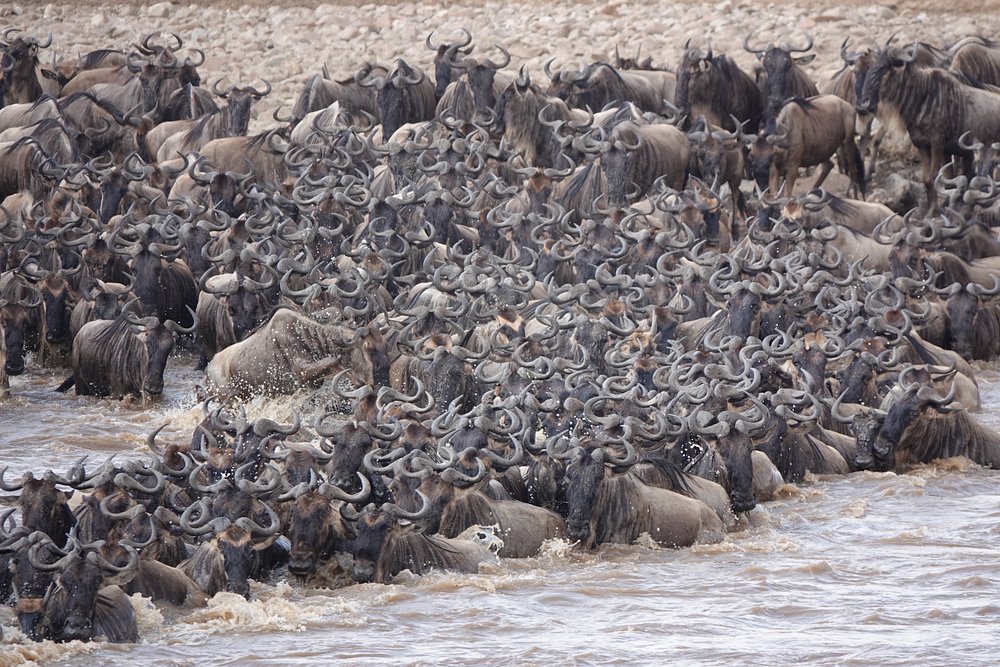
The wildebeest migration in the Masai Mara is one of the worlds natural wonders which attract Millions of travelers from all over the world. Between July and October each year, approximately 1.5 million wildebeest and 200,000 zebra arrive in Kenya’s Masai Mara National Reserve after crossing hundreds of kilometres of Tanzanian savannah, and the river crossings they make at the Mara and Talek rivers — plunging into crocodile-filled water in massive, chaotic surges — produce scenes of raw natural drama that no documentary fully prepares you for.
Understanding the migration’s timing, its geography and what to expect at a crossing makes the difference between experiencing it fully and merely watching it from a distance.
What Is the Great Wildebeest Migration?
The Great Wildebeest Migration is the largest overland animal movement on earth, a continuous, year-round circuit of approximately 1.5 million wildebeest, 200,000 zebra and 500,000 Thomson’s gazelle moving clockwise through the Serengeti–Mara ecosystem that spans southern Kenya and northern Tanzania. The animals follow a single environmental driver: rainfall and the fresh grass it produces. The migration has no true beginning or end, it is a permanent loop that has been running for at least a million years.
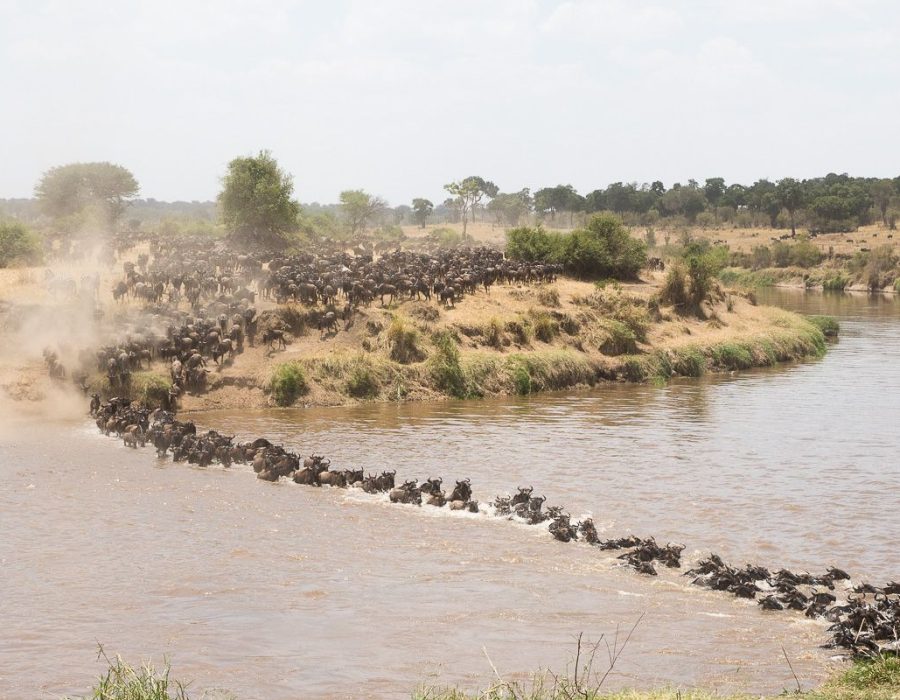
The full circuit covers approximately 1,800 kilometres. The herds spend the dry season in the north, in Kenya’s Masai Mara and the wet season in the south , in Tanzania’s southern and central Serengeti. The crossings of the Mara and Talek rivers as the herds move north into Kenya in July and August, and the return crossings as they head back south in October and November, are the most dramatic and most photographed moments of the migration cycle. For a direct comparison of the Tanzania and Kenya stages of the migration, see our Tanzania vs Kenya wildebeest migration guide.
The Annual Migration Calendar
January and February — Calving Season, Southern Serengeti
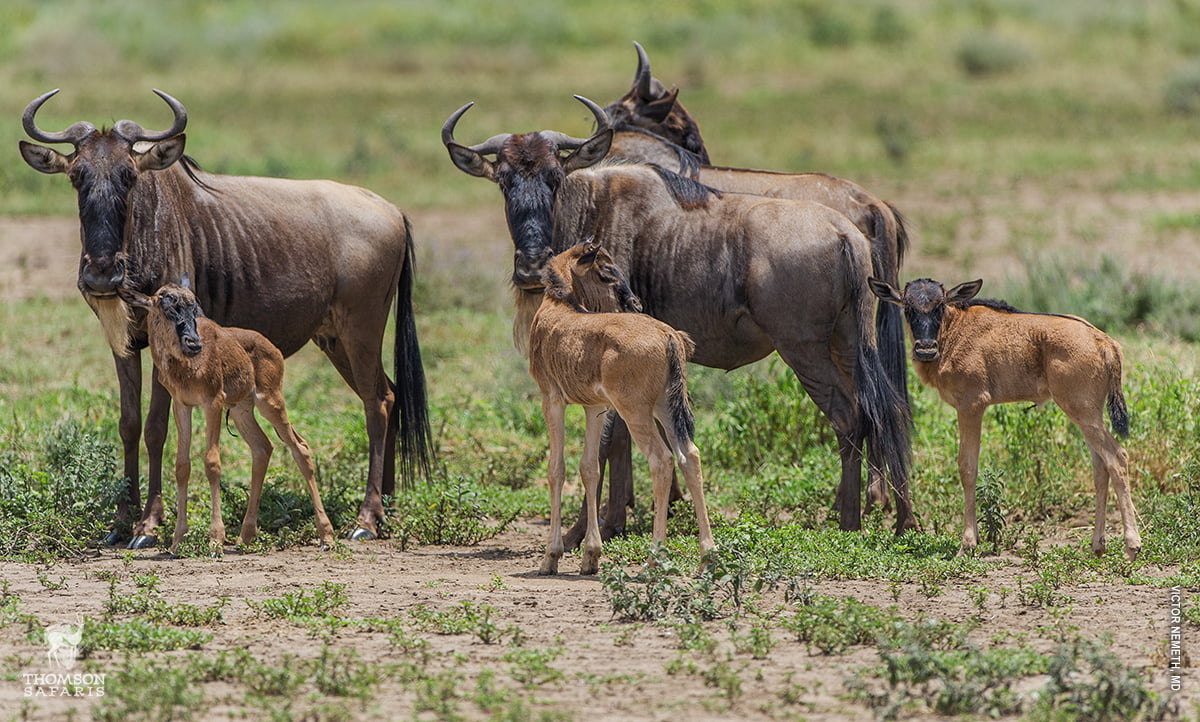
The herds concentrate in the short-grass plains of the southern Serengeti and Ngorongoro Conservation Area for calving season. Around 500,000 wildebeest calves are born within a compressed six-week window — a survival strategy that overwhelms predators with sheer numbers. The calving season is spectacular in its own right, with cheetah, lion, hyena and wild dog all concentrated in the calving grounds pursuing the vulnerable newborns. This is one of the best periods in the entire Serengeti ecosystem for predator viewing.
March to May — Central Serengeti
As the long rains begin in March, the herds start moving northwest toward the central and western Serengeti. The Grumeti River crossings in the western Serengeti — less famous than the Mara crossings but dramatic in their own right — occur around May and June as the herds push toward the Mara. The western Serengeti camps position guests well for these crossings.
June and July — Moving North Toward Kenya
By June the herds are in the northern Serengeti, moving toward the Kenyan border. The first animals typically cross into the Masai Mara in late June or early July, though exact timing varies year to year depending on rainfall. The first crossings of the Mara River in July are often the most dramatic of the season — the herds have built up pressure on the southern bank and the crossings when they come can involve enormous numbers of animals in a very short time.

July to October — Peak Season in the Masai Mara
This is the core migration season in Kenya. The herds are at their most numerous in the Masai Mara between August and September, and river crossings at the main Mara River crossing points — Lookout Hill, Fig Tree, Serena and several others — can occur daily during peak weeks. The crossings are unpredictable: a group of wildebeest may gather at the riverbank for hours before finally plunging in, or may turn back at the last moment and wait for another day. Reading the animals’ behaviour and positioning at the right crossing point at the right moment is the skill of an experienced Masai Mara guide.
November and December — Return South
By late October and November the short rains arrive in the Serengeti, drawing the herds back south. The return crossings of the Mara River as the animals move back into Tanzania are less predictable and less concentrated than the northward crossings, but still dramatic. By December the cycle has begun again in the southern Serengeti.
The Mara River Crossings — What Actually Happens
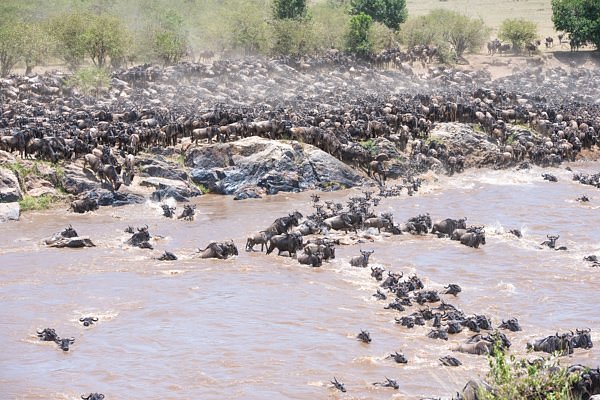
A Mara River crossing is the defining image of the wildebeest migration and the moment every visitor to the Masai Mara is trying to witness. Understanding what happens — and how unpredictable it is — manages expectations and makes the actual experience more rewarding. For a dedicated guide to the crossing points, timing and what to look for, read our full Mara River crossing guide.
Crossings occur at specific points along the Mara and Talek rivers where the banks are accessible. The wildebeest gather on the upstream bank in groups that can number in the tens of thousands, milling nervously at the water’s edge, testing the bank, retreating, pushing forward again. This build-up can last minutes or hours. When a critical mass of animals finally commits and the first wildebeest leaps into the water, the rest follow in a surge — a stampede of thousands of animals hitting the water almost simultaneously. The noise is extraordinary. Nile crocodiles — some reaching five metres in length and living specifically at migration crossing points — launch from the shallows and pull animals under in the chaos. The survivors scramble up the far bank and continue north.
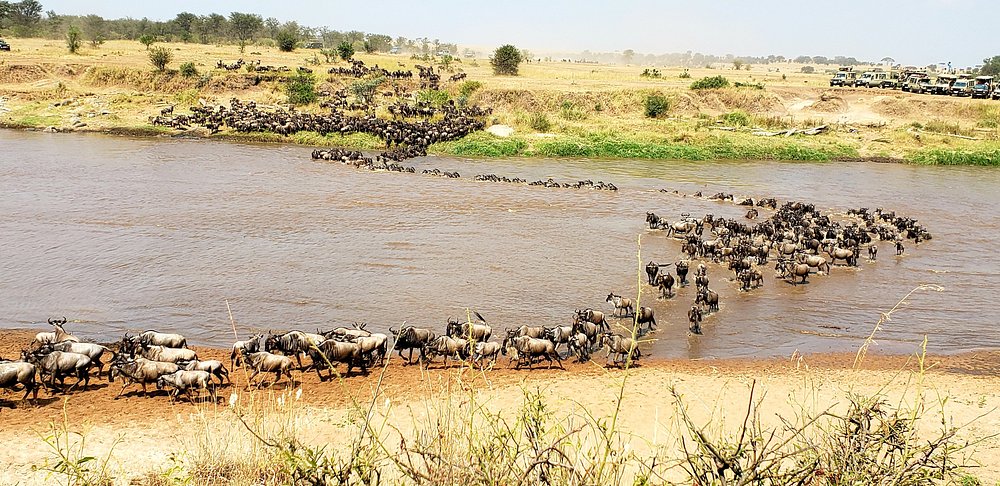
A crossing can be over in 20 minutes or extend for two hours depending on the size of the group and the number of waves that follow. A single morning session at a productive crossing point in August can produce three or four separate crossing events. Experienced guides position vehicles downstream of the crossing point to maximise the view as animals enter the water, staying far enough back that the herd is not disturbed by vehicle presence.
The unpredictability is real and unavoidable. Wildebeest have been observed gathering for an entire day at a crossing point and then dispersing without crossing at all. Building two or three days of Masai Mara time into a migration itinerary — rather than a single day — significantly increases the probability of witnessing a major crossing event. Most guests who spend three or more days in the Mara during peak season (August–September) see at least one substantial crossing.
Best Time for the Wildebeest Migration in the Masai Mara

July brings the first herds into the Masai Mara from Tanzania and the first Mara River crossings of the season. Early July crossings can be the most dramatic — the herds have been building up pressure for weeks and the first crossings can be massive. However, the exact timing of the first crossing varies year to year, and early July carries the risk of arriving before the main event.
August is the peak month for both crossing activity and visitor numbers. The largest concentrations of wildebeest in the Mara occur in August, crossings are most frequent, and the big cat activity that accompanies the migration reaches its annual high. August is also the busiest and most expensive period — advance booking at Masai Mara camps is essential months in advance for August dates.
September is an excellent alternative to August — herds are still present in large numbers, crossings continue, predator activity remains high and visitor numbers and prices begin to fall from the August peak. Late September is one of the best-value windows for the migration experience.
October sees the herds beginning to thin as the first animals start moving south. Crossings continue in early October and can still be substantial, but by mid-to-late October the Mara population is diminishing. October is a good option for guests who want the migration at a lower price and with fewer vehicles.
Wildlife Beyond the Migration

The Masai Mara supports one of the highest densities of resident wildlife in Africa year-round, and the migration season amplifies this further. The influx of 1.5 million prey animals draws predators in from across the ecosystem and concentrates predator activity within the reserve.
The Masai Mara has the highest density of lions of any park in East Africa. Multiple prides occupy the reserve year-round, and during migration season they are in near-constant hunting mode — wildebeest and zebra calves are particularly vulnerable and lion kills are frequent. Cheetah — present in the Mara throughout the year — concentrate on the open plains where wildebeest herds graze, and cheetah hunts during migration season are reliably observed. Leopard are present but less visible, hunting in the riverine woodland along the Mara and its tributaries.
Elephant, buffalo and Masai giraffe are resident in the Mara year-round. The river system holds hippos and Nile crocodiles at every crossing point. The birdlife of the Mara is excellent throughout the year — over 450 species have been recorded in the reserve, with raptors particularly well represented during migration season when the carrion left by predator kills and the trauma of river crossings provides abundant food.
Best Viewing Spots for the Mara River Crossings
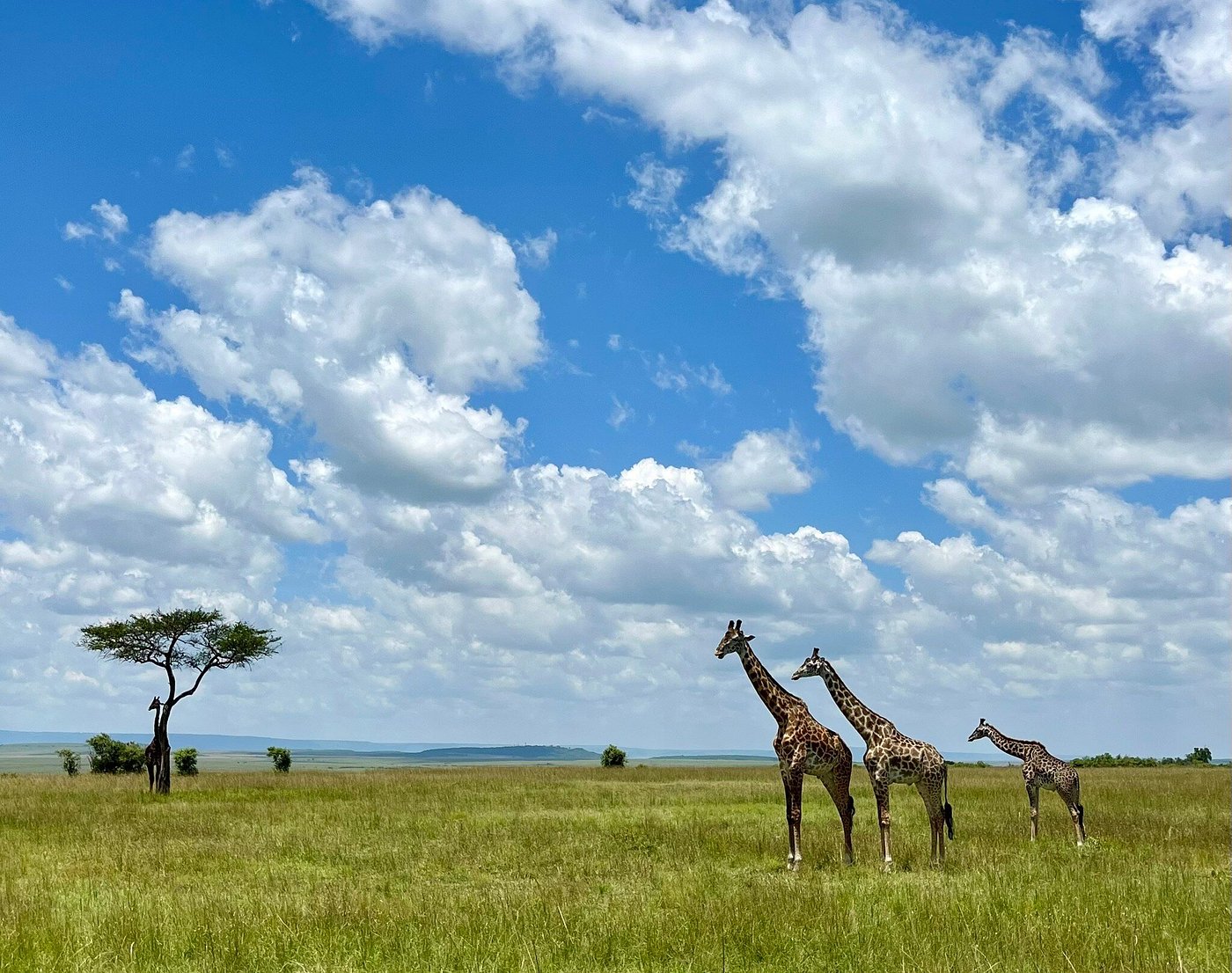
The Mara River runs for approximately 50 kilometres through the reserve, but the most productive crossing points are concentrated in a relatively short stretch. The main crossing zones — known by names such as Lookout Hill, Fig Tree Crossing, Governor’s Camp crossing and the Serena crossing — are where experienced guides position vehicles when crossing behaviour is expected.
Staying at a camp close to the most active crossing points gives a decisive advantage. Governor’s Camp and Governors’ Il Moran are positioned directly beside the river at historically productive crossing locations. Fig Tree Camp, Mara Serena Safari Lodge and Angama Mara all offer proximity to key crossing sites. Camps on the Musiara Marsh — one of the Mara’s most wildlife-rich habitats and a year-round lion territory — offer the best combination of crossing access and resident predator viewing.
Private conservancies bordering the Masai Mara — Olare Motorogi, Mara North, Naboisho and Ol Kinyei — allow off-road driving and night game drives not permitted in the national reserve, and their proximity to the Mara ecosystem means migration herds pass through them regularly. Camps in these conservancies offer a more exclusive experience with fewer vehicles and better flexibility in activity timing.
Wildebeest Migration Safari Itineraries

Superfine Safaris Limited offers several itineraries built around the wildebeest migration in the Masai Mara, from a focused four-day Mara experience to extended multi-country combinations that add gorilla trekking in Rwanda and game drives in Tanzania’s Serengeti.
- 4 Days Mara River Crossing Safari — The most focused migration itinerary: four days in the Masai Mara timed to the peak July–October crossing season, with expert guides positioned at the most active crossing points. Ideal for travellers who want the migration experience without extending into a longer East Africa trip.
- 14 Days Tanzania and Kenya Great Wildebeest Migration Safari — The definitive migration circuit. This itinerary follows the herds through both countries — the Serengeti in Tanzania and the Masai Mara in Kenya — covering the full northern migration route with multiple crossing opportunities at both the Grumeti and Mara rivers.
- 8 Days Kenya and Rwanda Gorilla Trekking Safari — Combines the Masai Mara wildlife and migration with mountain gorilla trekking in Rwanda’s Volcanoes National Park. Eight days covering two of East Africa’s top wildlife experiences.
- 10 Days Kenya Safari and Rwanda Gorilla Trekking — An extended version of the Kenya–Rwanda combination with additional time in the Masai Mara and the option to add Amboseli National Park for elephant viewing with Kilimanjaro as a backdrop.
- 17 Days Kenya and Rwanda Safari — A comprehensive exploration of Kenya and Rwanda covering the Masai Mara migration, Lake Nakuru flamingos, Amboseli, gorilla trekking and Rwanda’s Nyungwe Forest for chimpanzees and colobus monkeys.
All migration itineraries are timed to your specific travel dates to maximise crossing opportunity. Contact Superfine Safaris Limited to discuss the best itinerary for your travel window.
How to Get to the Masai Mara
The Masai Mara is approximately 270 kilometres from Nairobi by road — a five to six hour drive via the B3 highway through the Great Rift Valley. Most safari guests fly from Nairobi’s Wilson Airport to one of the Mara’s four airstrips — Keekorok, Ol Kiombo, Musiara and Serena — on daily scheduled flights with operators including Air Kenya, Safarilink and Fly540. Flight time is approximately 45 minutes and the combination of Nairobi international arrival and a direct connecting domestic flight to the Mara can get guests on game drive the same afternoon as international arrival.
For guests combining the wildebeest migration with a Uganda primate safari — gorilla trekking in Bwindi or Mgahinga, chimpanzee trekking in Kibale Forest — the standard routing is Uganda first, then Kenya. Uganda and Kenya share a border and daily flights connect Entebbe to Nairobi, making a combined itinerary logistically straightforward. For a detailed comparison of what each destination offers, see our Uganda safari vs Kenya safari guide. For general planning, the Kenya safari travel tips guide covers visas, health requirements and what to pack. Contact us to discuss your travel dates.
Frequently Asked Questions
When is the best time to see the wildebeest migration in the Masai Mara?
The peak period for the Mara River crossings is August and September, when the largest concentrations of wildebeest are in the Masai Mara and crossings are most frequent. July brings the first crossings of the season and October sees the herds beginning their return south. For the most reliable crossing experience with slightly lower crowds than August, late September is an excellent choice.
How long does the wildebeest migration last in the Masai Mara?
The herds are typically in the Masai Mara from late June or early July until late October or early November — approximately four to five months. The peak Mara River crossing activity is concentrated in August and September. The migration continues as a year-round circuit in Tanzania’s Serengeti, with calving season in January–February being the other major highlight of the annual cycle.
Is the wildebeest migration guaranteed to be seen?
The presence of large wildebeest herds in the Masai Mara between July and October is highly reliable — the migration arrives every year without exception. Individual river crossings, however, are unpredictable and cannot be guaranteed on any given day or at any specific time. Spending three or more days in the Mara during peak season (August–September) significantly increases the probability of witnessing a major crossing. Our 4 Days Mara River Crossing Safari is designed with this in mind — the four-day structure gives multiple crossing attempts across peak season.
Can you combine the Masai Mara migration with a Uganda safari?
Yes, and this is one of East Africa’s most rewarding combined itineraries. A typical structure is gorilla trekking in Uganda’s Bwindi Impenetrable Forest or Mgahinga Gorilla National Park, combined with chimpanzee trekking in Kibale Forest, followed by the Masai Mara for the migration crossings. Uganda and Kenya share a border and daily flights connect Entebbe to Nairobi. Superfine Safaris Limited specialises in building these combined East Africa itineraries — get in touch to start planning.
Do I need a visa for Kenya?
Kenya operates an e-visa system — visitors from most countries apply online at evisa.go.ke before travel and receive a single-entry or East Africa Tourist Visa (covering Kenya, Uganda and Rwanda) valid for 90 days. The East Africa Tourist Visa is the most cost-effective option for guests combining Uganda and Kenya on a single trip. Visa requirements vary by nationality — check current requirements with your travel agent or the Kenya Immigration Service website before booking.
See the Migration
We build custom Kenya and Uganda itineraries timed to the river crossings.
Migration Calendar
- Jan–Feb: Serengeti (calving)
- Mar–May: Central Serengeti
- Jun–Jul: Moving north
- Jul–Oct: ⭐ Masai Mara crossings
- Nov–Dec: Return south