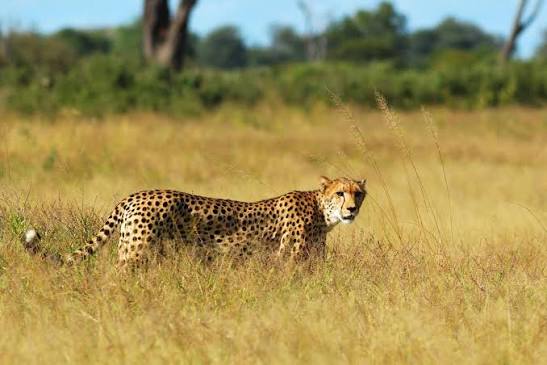
A cheetah safari in Africa offers something no other wildlife encounter can replicate, watching the fastest land animal on Earth launch into a full-speed hunt across open savannah. The cheetah accelerates from 0 to 100 km/h in just three seconds, yet it is a fragile, highly specialised predator whose survival depends on wide open landscapes and the absence of heavier rivals. This guide covers everything you need to know to plan an unforgettable cheetah safari in Africa.
Cheetah Facts
The cheetah (Acinonyx jubatus) is the most distinctive of Africa’s large cats — slender, deep-chested, and built entirely for speed. Adult cheetahs weigh just 35–65 kg, far lighter than leopards or lions, with a flexible spine that acts as a spring mechanism during the gallop. Their semi-retractable claws — unique among cats — function like running spikes, gripping the ground during acceleration. The black “tear marks” running from the inner corners of the eyes to the mouth reduce sun glare and are thought to sharpen focus during daytime hunts.
Speed and the Hunt
 A cheetah’s top speed of 110–120 km/h is the fastest recorded for any land animal, but it can only be maintained for 200–300 metres before the cheetah overheats and must rest. The entire hunt — stalk, sprint, and kill — typically takes under a minute. After a successful kill, the cheetah must rest for 15–30 minutes to recover its breath and body temperature before it can eat, during which time it is vulnerable to kleptoparasitism by lions, hyenas, and even large groups of vultures.
A Daytime Hunter
Unlike leopards and lions, cheetahs are predominantly diurnal — active during daylight hours, particularly in the cooler early morning and late afternoon. This makes the cheetah safari in Africa the most accessible big cat experience of all: no need for night drives, no guesswork about nocturnal movement. Cheetahs hunt by sight, scanning the plains from termite mounds and low kopjes, and can be located by scanning elevated points across open grassland.
Cheetah Social Structure
Female cheetahs are solitary except when raising cubs. A female raises 3–5 cubs largely alone, with no assistance from the father, over an 18-month period in which she teaches them progressively more complex hunting skills. Cubs accompany the mother on hunts from about 6 weeks of age and begin attempting kills independently from around 6 months.
Males are more social. Brothers from the same litter often remain together for life as a “coalition” of 2–3 males, sharing a territory and cooperating to bring down larger prey such as wildebeest and topi. Seeing a male coalition hunting cooperatively on a cheetah safari in Africa is one of the most remarkable predator displays on the savannah.
Best Parks for a Cheetah Safari in Africa
Masai Mara National Reserve, Kenya
The Masai Mara is Kenya’s best destination for a cheetah safari in Africa. The reserve’s open grasslands give the cheetah’s visual hunting strategy maximum range, and the Mara’s habituated cheetah families — including several famous coalition males — are regularly located by experienced guides. During the wildebeest migration, cheetahs switch to hunting calves and Thomson’s gazelle driven out of the tall grass by the migrating herds.
Serengeti National Park, Tanzania
The southern Serengeti — particularly the Ndutu and Ngorongoro Conservation Area borderlands — is East Africa’s most reliable cheetah safari Africa zone. During the calving season (January–March), when wildebeest give birth on the short-grass plains, cheetah activity peaks and encounters with mothers teaching cubs to hunt are common. The Serengeti also supports the highest cheetah density of any protected area in East Africa.
Amboseli National Park, Kenya
Amboseli’s open plains offer excellent cheetah visibility, and the park’s cheetah population benefits from the same open habitat that makes it such outstanding elephant country. Watching a cheetah hunt across Amboseli’s short grass with Kilimanjaro in the background is one of the most cinematic scenes in African wildlife photography.
Kidepo Valley National Park, Uganda
Uganda’s Kidepo Valley National Park hosts one of the country’s few cheetah populations in its remote savannah valleys. Sightings here are less frequent than in Kenya or Tanzania but carry the special weight of extreme rarity — encountering a cheetah in Kidepo is a genuinely exceptional cheetah safari in Africa moment.
Best Time for a Cheetah Safari in Africa
- January–March (Serengeti calving season): The finest time for a cheetah safari in Africa across the southern Serengeti and Ndutu. Prey is abundant, cheetahs are active, and sightings of mothers teaching cubs to hunt are frequent.
- June–October (dry season): Short grass in the Masai Mara and Serengeti makes cheetahs far easier to spot. The migration brings prey and predators into close proximity.
- Year-round for resident individuals: Well-known individual cheetahs in habituated areas like the Masai Mara can be located any month if their territories are known to guides — making the Mara a reliable cheetah safari Africa destination regardless of season.
Cheetah Safari Tips
- Scan termite mounds and kopjes: Cheetahs use elevated platforms to scan for prey. A cheetah sitting upright on a termite mound at first light is a classic and easily spotted scene.
- Be ready for a sprint: When a cheetah is crouching in a focused stalk, alert your guide and ensure cameras are ready. The chase can begin in seconds and lasts under a minute — preparation is everything.
- Give space after a kill: Disturbing a cheetah on a fresh kill causes it to abandon the prey before eating — a critical energy loss. Responsible guides maintain distance and ask other vehicles to do the same.
- Drive slowly through open grassland at dawn: Cheetahs beginning their active period can be missed easily at speed. Slow driving in open areas during the first two hours of daylight is the most reliable cheetah safari Africa strategy.
Cheetah Conservation
The cheetah is classified as Vulnerable on the IUCN Red List, with an estimated 7,000 individuals remaining — fewer than half the population of 20 years ago. Cheetahs are exceptionally sensitive to competition from lions and spotted hyenas, which kill cheetah cubs and steal kills. As a result, they are rarely found in areas with high lion densities. The expansion of human agriculture has pushed cheetahs out of protected areas onto farmland, where they come into direct conflict with livestock herders. Supporting community conservation initiatives through responsible safari tourism is the most direct way travellers can contribute to cheetah survival.
Plan Your Cheetah Safari in Africa
From the coalition males of the Masai Mara to the cub-raising mothers of the Serengeti’s Ndutu plains, East Africa offers some of the world’s finest cheetah safari in Africa experiences. Contact our team to design an itinerary that puts you in the right place at the right season for the best possible cheetah encounters.