Gishwati-Mukura National Park is Rwanda’s newest and smallest national park, gazetted in 2015 from two previously separate forest fragments, Gishwati Forest and Mukura Forest located in the northwest and central-west of the country. Despite its modest size of roughly 34 square kilometres, Gishwati-Mukura National Park punches well above its weight as a biodiversity hotspot. The park harbours chimpanzees, golden monkeys, L’Hoest’s monkeys, black-and-white colobus, and over 232 bird species, making it a rewarding addition to any Rwanda safari itinerary.
Location and How to Get There
Gishwati Forest lies about 90 kilometres west of Kigali in the Rubavu District, while Mukura Forest is situated further south near Karongi District on the shores of Lake Kivu. The two forests are connected by a wildlife corridor established during the park’s creation, allowing wildlife to move freely between them. The drive from Kigali to Gishwati takes approximately two to two-and-a-half hours via the paved road through Muhanga towards Musanze, then turning south towards Rubavu.
Many visitors combine Gishwati-Mukura National Park with gorilla trekking in Volcanoes National Park, which is roughly 40 kilometres to the north. The two parks can easily be paired on a five-day Rwanda itinerary. Some visitors also combine a Gishwati visit with a Lake Kivu extension, overnighting at one of the lakeside lodges near Gisenyi or Kibuye before continuing south to Mukura Forest.
Wildlife in Gishwati-Mukura
 The park’s flagship species are its chimpanzees. A habituated community of chimpanzees lives in Gishwati Forest, and guided chimpanzee trekking is offered on a limited basis. Numbers are still modest compared to Nyungwe Forest, where over 500 chimpanzees inhabit a much larger forest, but Gishwati’s treks tend to be more intimate with smaller group sizes.
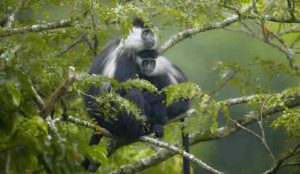
Golden monkeys, also found in Volcanoes National Park, are present in Gishwati and can be tracked on guided walks. Rwanda’s golden monkey population is shared between the bamboo forests of the Virunga Massif and the mid-altitude forests of Gishwati. Other primates include L’Hoest’s monkey, the olive baboon, black-and-white colobus, and vervet monkey.
Birdlife is exceptional. The park’s Albertine Rift location means it hosts a high proportion of endemic and range-restricted species. Albertine Rift endemics recorded here include the Rwenzori turaco, Handsome francolin, Regal sunbird, and Grauer’s warbler. The park is relatively compact, so birding can be very productive even on a half-day walk, with many species concentrated in a small area.
Activities in Gishwati-Mukura National Park
- Chimpanzee trekking: Daily treks depart from the Gishwati Forest sector with an accredited guide. Groups are kept small and time with the chimps is limited to one hour per the Rwanda Development Board guidelines. Trekking here is more affordable than in Nyungwe Forest.
- Golden monkey tracking: Guided walks to find and observe habituated golden monkey groups in both Gishwati and the bamboo zones. Golden monkeys are fast-moving and playful, making for exciting photography.
- Nature walks and forest hikes: Guided forest walks exploring the park’s biodiversity, medicinal plants, and birdlife. Trails vary in difficulty. The mossy forest interior is atmospheric and richly layered with epiphytes and orchids.
- Birding safaris: Dedicated birding walks with specialist guides can be arranged for birders targeting Albertine Rift endemics. The park’s 232-plus recorded species make it one of Rwanda’s most rewarding birding destinations outside Nyungwe.
- Community visits: The buffer zone around the park is home to farming communities, and guided community walks provide insight into local agriculture, traditional practices, and the conservation initiatives that support forest restoration around the park’s edges.
Best Time to Visit Gishwati-Mukura
The best time to visit Gishwati-Mukura National Park is during Rwanda’s dry seasons: June to September and December to February. During these months the forest trails are less muddy, chimpanzee tracking is easier, and birding is excellent as resident species are most active and migratory species arrive. Rwanda’s highlands receive rainfall year-round, so even in the dry season light showers are possible. The park can be visited in the wet seasons (March to May and October to November), though trail conditions are more challenging and trekking can be more strenuous.
Mornings are the best time for chimpanzee trekking and birdwatching, as both chimps and birds are most active in the early hours. Most treks depart between 7:00 and 8:00 am. The forest can be cool and misty in the mornings bringing a light fleece and waterproof jacket is advisable year-round.
Accommodation Near Gishwati-Mukura
Accommodation options in and around Gishwati-Mukura are more limited than near Rwanda’s more-visited parks, but the choice is growing as the park attracts more visitors. Options range from simple guesthouses in the nearby villages of Rutsiro and Rubavu to more comfortable lodges overlooking Lake Kivu near Gisenyi. For visitors combining Gishwati with Volcanoes National Park, the full range of lodges around Musanze — from budget to ultra-luxury — provides a convenient base, as the drive between parks takes around an hour.
Several eco-lodges have opened in recent years specifically to serve visitors to Gishwati, with simple but comfortable rooms, forest views, and guided activities included. Staying near the park helps early morning starts for chimp trekking and reduces drive time on forest roads that can be slow after rain.
Combining Gishwati-Mukura with Other Rwanda Parks
Gishwati-Mukura fits naturally into several Rwanda safari combinations. The most popular pairing is with Volcanoes National Park for gorilla and golden monkey trekking — both parks lie in northwest Rwanda and can be covered on a four-to-five-day itinerary. A Lake Kivu extension adds two to three days of relaxation, kayaking, or island excursions to the schedule and provides a convenient midpoint between Gishwati and Nyungwe Forest in the southwest.
A complete Rwanda circuit covering Volcanoes, Gishwati-Mukura, Lake Kivu, Nyungwe Forest, and Akagera National Park takes nine to twelve days and showcases the country’s full ecological range — from volcanic montane forest and chimpanzee habitat to savannah and open water. Superfine Safaris can design a custom Rwanda itinerary that incorporates Gishwati-Mukura as part of a broader primate and birding safari.