Walking Safaris in Lake Mburo National Park offer something genuinely rare in Uganda: the chance to move through wild African bush on foot, at ground level, with no glass between you and the animals. Lake Mburo is the only national park in Uganda’s southwest that permits walking safaris without special authorisation — and because the park has no lions or elephants, Uganda Wildlife Authority rangers can bring you within metres of buffalo, zebra, impala, eland, and hippo in a way that no vehicle can replicate. Whether you join a guided bush walk at dawn, walk the lakeshore at dusk, or venture out with a spotlight after dark, walking safaris in Lake Mburo National Park consistently rank among travellers’ most memorable East Africa experiences. This guide covers every type of walk available, what wildlife to expect, costs, safety, and how to fit Lake Mburo into your Uganda itinerary.
Why Lake Mburo National Park Is Uganda’s Best Walking Safari Destination
Walking safaris are restricted in most of Uganda’s national parks because the presence of lions, elephants, and hippos makes unescorted foot travel genuinely dangerous. Lake Mburo’s wildlife composition is different. The park has no lions — they were not re-introduced after historical extirpation — and no elephants. This means Uganda Wildlife Authority rangers can safely lead small groups on foot through the park’s open acacia woodland and along the lakeshore, reading animal behaviour and managing encounters in real time.
The result is one of the most accessible walking safari experiences in East Africa. You do not need special fitness, specialist gear, or any prior walking safari experience. Walking safaris in Lake Mburo National Park are open to all fitness levels, offered daily, and included in most lodge packages. The park’s mosaic of acacia savannah, wetland edges, and lake shoreline creates varied terrain that holds different species in different zones — which is why even a short 2-hour walk rarely disappoints.
Types of Walking Safaris in Lake Mburo National Park
1. Guided Morning Bush Walk (2–3 Hours)
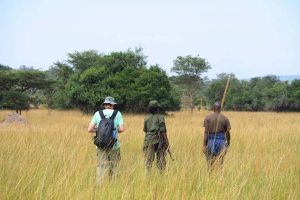 The morning guided bush walk is the flagship walking safari in Lake Mburo National Park and the one most visitors book. Groups depart at 06:30 with a UWA ranger guide — just as the light turns golden and the animals are most active after the cool night. The route takes you through open acacia woodland and across grassy clearings toward the water. Groups are small: a maximum of 8 people keeps the walk intimate and allows the ranger to manage close animal encounters safely.
A typical morning walk brings you within 20–50 metres of zebra, impala, and often buffalo. The ranger reads animal body language throughout — adjusting the approach angle to stay downwind, pausing when an animal raises its head, positioning the group on elevated ground for safety near buffalo. The combination of silence, proximity, and the tracker’s running commentary on tracks, dung, and animal behaviour turns a walk through familiar-looking bush into a completely new experience.
Duration: 2–3 hours | Departure: 06:30 am | Group size: 2–8 | Cost: USD 15–25 per person (payable at the UWA gate)
2. Afternoon Bush Walk (2–3 Hours)
An afternoon version of the guided bush walk departs at around 16:00 and is timed for the golden hour before sunset. Animals begin to move again after the midday heat, and the low light makes for excellent photographs. The afternoon walk follows slightly different terrain, often moving along the lakeshore edges where hippo feeding paths and waterbuck grazing grounds create different encounters from the morning route. The walk ends at dusk — occasionally with the sound of hippos emerging from the water as the last light fades.
Duration: 2–3 hours | Departure: 16:00 | Cost: USD 15–25 per person
3. Lakeshore Walk
The lakeshore walk is a gentler alternative that follows Lake Mburo’s shoreline through papyrus beds, grassy banks, and elevated viewpoints. This route is particularly rewarding for birding — Lake Mburo holds over 350 species including African fish eagle, grey crowned crane, papyrus yellow warbler, African jacana, and great white pelican. From elevated shoreline points, hippos can be watched at safe distance in the shallows. The wetland edge also harbours sitatunga, the semi-aquatic antelope that is almost never seen from a vehicle.
The lakeshore walk pairs well with a boat trip: walk out in the morning, take the boat back, or vice versa. For birders, this morning combination is arguably the best few hours Lake Mburo offers.
4. Night Walk
The night walk is one of the most atmospheric experiences on offer at Lake Mburo — and one of the most unusual options available in any Uganda national park. Led by a ranger with a spotlight, the walk departs after dinner and moves through the bush in darkness, picking up eyeshine and following sounds. The nocturnal cast is completely different from the daytime: porcupine, bushbaby (galago), civet, genet, serval cat, and various nightjars replace the zebra and impala of the daylight hours. Leopard signs — pug marks and vocalisation — are more commonly recorded at night, though sightings remain rare.
The night walk is not suitable for young children and requires a basic level of comfort in darkness and uneven terrain. Most lodges that offer it organise a private guide rather than a group walk. Duration is typically 1.5–2 hours.
5. Horseback Safari
Lake Mburo is one of the only national parks in Uganda where horseback safaris are available — a completely different way to move through the bush. Nshara Ranch and a small number of specialist operators run guided rides through the park. Horses are non-threatening to most wildlife, which means you can get significantly closer to plains animals — zebra and antelope especially — than even on foot. Horseback safaris require prior riding experience (trot and canter level) and are not suitable for beginners. Available in half-day and full-day formats.
6. Guided Cycling
Several lodges at Lake Mburo offer guided cycling tours through the park on the main vehicle tracks. Like horseback riding, cycling gives you access to a different spatial and sensory experience than either driving or walking — you move quietly and cover more ground than on foot. Bikes are mountain bike standard and paths are generally flat to mildly undulating. Cycling is available from most lodges as a half-day activity, typically in the morning.
Wildlife You Will Encounter on Walking Safaris in Lake Mburo National Park
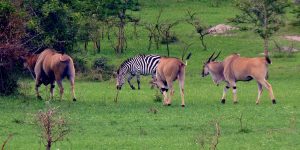 The wildlife on foot at Lake Mburo is different in character from a vehicle game drive, even when you are looking at the same species. Proximity changes everything, a buffalo herd at 25 metres, wind in your face, ranger next to you watching the lead cow, is an entirely different emotional experience from watching the same animals from a vehicle at 80 metres. Here is what you are most likely to encounter:
- Plains zebra — Lake Mburo has Uganda’s highest concentration of Burchell’s zebra. They habituate to guided walkers quickly and allow very close approach. A herd of 30 zebra at 20–30 metres, with no vehicle noise, is extraordinary
- Impala — Lake Mburo is the only Ugandan national park where impala are found. They are elegant at close range; a rutting male herding his females during the rut (July–August) is a highlight
- African buffalo — Rangers manage buffalo encounters carefully. Bachelor herds and small family groups are regularly approached; large mobs of 100+ animals are observed from distance. Close buffalo encounters at 20–40 metres require reading the animals precisely and trusting your ranger completely
- Eland — Africa’s largest antelope stands 1.8 metres at the shoulder. What many walkers remember most is not the size but the sound: eland tendons click with every step, producing a hollow, rolling percussion that carries across the bush
- Topi and reedbuck — Often seen in open grassland areas; both allow reasonably close approach on foot
- Oribi and bushbuck — Smaller antelope found in thick vegetation; oribi alarm calls are a useful wildlife indicator during a walk
- Hippo — Encountered from elevated shoreline positions or when you find a hippo out of water in early morning. Rangers manage hippo encounters very carefully — hippo on land are dangerous and highly unpredictable
- Leopard — Rarely seen but regularly tracked; pug marks, scratch posts, and cached kills on fig trees are common signs. The possibility of a leopard encounter adds an edge to every walk in Lake Mburo
- Birds (350+ species) — African fish eagle, grey crowned crane, African finfoot, papyrus yellow warbler, long-tailed cormorant, African skimmer on the lake, and numerous raptors in the acacia canopy
Safety on Walking Safaris in Lake Mburo National Park
Uganda Wildlife Authority rangers who lead walking safaris in Lake Mburo National Park are trained in wildlife behaviour, first aid, and group management. Every guided walk is led by at least one armed ranger — not as a sign of danger, but as a final safety measure that is standard practice across all walking safari operations in East Africa. In over a decade of guided walks at Lake Mburo, serious incidents have been extremely rare.
Before the walk begins, your ranger will give a briefing covering: how to move (slowly, without sudden movements), where to stand in the group, what happens if an animal charges (almost never a real charge — most are mock charges or bluffs), and how to communicate quietly during the walk. Following these instructions precisely is the most important thing you can do to ensure a safe and rewarding walking safari in Lake Mburo National Park.
Practical safety notes: wear neutral or earth-toned clothing (avoid bright colours and white); closed shoes or boots are recommended for rough terrain; avoid strong perfume or insect repellent with a heavy scent. Carry water for a 2–3 hour walk in tropical heat.
Walking Safari Costs at Lake Mburo National Park
| Activity | Cost per Person (USD) | Duration |
|---|---|---|
| Guided morning/afternoon bush walk | 15–25 | 2–3 hours |
| Lakeshore walk | 15–25 | 1.5–2 hours |
| Night walk | 20–30 | 1.5–2 hours |
| Horseback safari (half day) | 60–80 | 3–4 hours |
| Guided cycling | 15–20 | 2–3 hours |
| Boat trip (complements lakeshore walk) | 30–40 | 1.5–2 hours |
Walk fees are paid at the UWA gate or via your lodge when pre-booked. For lodges that include walking safaris in their rates, confirm this at booking — several Lake Mburo properties include one guided walk per night in their full-board rate. For full Uganda safari cost planning, see our Uganda safari cost guide.
Best Time for Walking Safaris in Lake Mburo National Park
Walking safaris in Lake Mburo National Park are available year-round, but conditions vary by season:
- June to October (dry season) — The best overall conditions for walking safaris. Vegetation is lower, visibility through the acacia woodland is excellent, and animal concentrations around the lake are high as surface water elsewhere in the park dries up. Dust is present on some tracks but manageable. This is Lake Mburo’s peak walking season
- December to February (short dry season) — Also excellent. Green vegetation after the November rains makes the park lush and attractive; zebra foaling (December–January) adds a spectacle to morning walks; temperatures are comfortable
- March to May (long rains) — The park is accessible but long grass reduces ground-level visibility. Muddy tracks make some routes impractical. Morning walks are still rewarding, particularly for birding, which peaks during the rains when migrant species are present. Expect wet boots after early morning walks
- October to November (short rains) — Variable. Rain is usually intermittent rather than all-day; most lodges continue offering walks throughout. Some afternoon walks are delayed due to afternoon showers
For the full Uganda seasonal guide, read our best time to visit Uganda guide.
Where to Stay for Walking Safaris in Lake Mburo
Lake Mburo’s lodges are clustered near the lakeshore and the park’s eastern boundary, all within easy walking distance of the park’s most productive bush walk routes. When choosing accommodation for walking safaris in Lake Mburo National Park, look for properties that are inside or immediately adjacent to the park boundary — this means you can start your morning walk directly from the lodge rather than driving to a trailhead.
- Mihingo Lodge — Hillside tented lodge inside the park boundary; offers guided walks, horseback safaris, and has its own small herd of zebra habitually in the grounds
- Kigambira Safari Lodge — Well-positioned inside the park; runs morning and afternoon walks with resident UWA guides; good value midrange option
- Rwakobo Rock — Small lodge on a rocky outcrop above the park; excellent views and gentle walking access to the surrounding savannah
- Lake Mburo Safari Lodge — Lakeshore property with direct boat trip access and shoreline walking
- Eagle’s Nest at Lake Mburo — Budget camp option with access to UWA-guided walks from the public campsite
Combining Walking Safaris in Lake Mburo with a Gorilla Trekking Itinerary
Lake Mburo National Park sits on the main road between Kampala and Bwindi Impenetrable Forest — the road all gorilla trekking itineraries travel. At 228 km from Kampala and 170 km from Bwindi, it is a natural one-night or two-night stop that transforms a transfer day into one of the Uganda trip’s highlights.
The typical pattern: arrive at Lake Mburo in the afternoon (3.5 hours from Kampala), check into your lodge, join the afternoon bush walk or lakeshore walk, then do a full morning walking safari before continuing to Bwindi after breakfast. This adds an entirely different wildlife experience — open savannah, plains animals, walking — to a gorilla trip that might otherwise be all forest and primates. Travellers consistently report that the Lake Mburo walking safari is one of the Uganda trip’s most memorable individual experiences, often as surprising as the gorillas themselves.
Superfine Safaris includes walking safaris in Lake Mburo National Park in our gorilla trekking packages on request. See our Uganda safari itinerary guide for sample plans, or contact us to design a 2027 Uganda itinerary that includes Lake Mburo walking safaris and Bwindi gorilla trekking. For packing for a walking safari, read our Uganda safari packing list.