Photography safaris in East Africa is the ultimate goal for any wildlife photographer, amateur or professional. The region’s combination of extraordinary wildlife density, spectacular landscapes, golden light, and world-class guiding creates photographic opportunities that simply do not exist anywhere else on Earth. From the great wildebeest river crossings of the Masai Mara to mountain gorillas in the mist of Bwindi Forest, East Africa delivers the images that define wildlife photography. This guide covers the best destinations, essential equipment, lighting and technique advice, and everything you need to plan a photography safari in East Africa.
Why Photography Safaris in East Africa?
East Africa’s advantage as a photography safari destination is its combination of factors that individually exist elsewhere but nowhere else converge: exceptional wildlife density, habituated animals that allow vehicle approach to within metres, open grassland habitats giving unobstructed sightlines, dramatic scenery providing compelling backgrounds, and professional guides with the experience to position vehicles for the best light and angles. The photography safari East Africa opportunity is unmatched globally for the volume and variety of publishable wildlife images achievable in a single trip.
Best Destinations for Photography Safaris in East Africa
Masai Mara National Reserve & Conservancies, Kenya
The Masai Mara is East Africa’s most photographed wildlife destination for good reason. The reserve’s open grassland gives unobstructed sightlines to predators in action, and the conservancy buffer zones allow off-road driving and vehicle positioning for optimal light angles impossible inside the national reserve itself. The wildebeest river crossings at the Mara River (July–October) are the most photographed wildlife events in Africa. Leopards and cheetahs are well-habituated to vehicles and permit extraordinarily close approach. The Mara’s private conservancy camps often include a vehicle exclusively allocated to photography safari East Africa guests, with roof hatches rather than side windows for better shooting angles.
Serengeti National Park, Tanzania
The Serengeti National Park is unmatched for the sheer scale of wildlife photography opportunity. The calving season (January–March) in the southern Serengeti fills the Ndutu plains with thousands of wildebeest calves, cheetah kills in full daylight, and lion prides at their most active. The Seronera Valley’s kopjes produce outstanding photography safari East Africa leopard encounters year-round. The Serengeti’s epic landscapes — flat plains stretching to the horizon, termite mound silhouettes, acacia canopies at sunset provide backdrops for environmental portraits of a quality unmatched anywhere in Africa.
Amboseli National Park, Kenya
Amboseli is the definitive elephant photography safari East Africa destination. The park’s habituated elephant families allow approach to within 20–30 metres, and the combination of elephants against the snow-capped backdrop of Kilimanjaro (clearest in the morning before cloud builds) is the most iconic wildlife photography image in East Africa. The park’s swamps attract large concentrations of waterbirds and provide dramatic reflections at dawn.
Ngorongoro Crater, Tanzania
The Ngorongoro Crater’s enclosed ecosystem concentrates wildlife in a relatively small area, giving photography safari East Africa guests extraordinary access to multiple species within a single day. The crater’s black-maned lions — among the most photogenic in Africa — are habituated and approachable. The rim at dawn, with the crater floor swathed in mist and the first light gilding the escarpment, is one of the great landscape photography safari East Africa moments.
Bwindi Impenetrable Forest, Uganda
Bwindi is the finest primate photography safari East Africa destination. The habituated mountain gorilla families of Bwindi allow one hour at close range typically 5–15 metres — in complex forest light that challenges every photographer’s technique. Capturing the depth of a silverback’s gaze, the tender interaction of a mother and infant, or the playful energy of juvenile gorillas in filtered forest light requires specific equipment and technique. For many wildlife photographers, a single morning in Bwindi produces their most powerful images.
Lake Nakuru & Bogoria, Kenya
Lake Nakuru and nearby Lake Bogoria offer the finest flamingo photography safari East Africa opportunity. When conditions are right typically July–September — over a million lesser flamingos carpet the shoreline in a solid band of pink extending to the horizon. Photographing this spectacle from the lakeside viewpoints, particularly at dawn when the sky reflects in the still lake surface, creates images of extraordinary colour and scale.
Essential Equipment For Photography Safaris East Africa
Camera Bodies
A DSLR or mirrorless camera with fast continuous autofocus is essential for action photography on photography safaris in East Africa. Full-frame bodies (Canon R5/R6, Nikon Z6/Z9, Sony A7R V) deliver the best low-light performance for dawn and dusk shooting. APS-C bodies offer an effective focal length multiplier that extends reach with telephoto lenses — useful for bird photography. Bring a minimum of two camera bodies — dust, vibration, and the possibility of a mechanical failure mean redundancy is essential.
Lenses
Lens selection is the single most important decision for a photography safari in East Africa:
- 400–600mm telephoto: The core wildlife photography lens. A 500mm f/4 or 600mm f/4 delivers exceptional reach and low-light performance for predator action and birds in flight. The 100–500mm zoom is a more versatile, more affordable alternative used by many photography safari East Africa guests.
- 70–200mm: Ideal for large animals at close range (elephants, lions at a kill), environmental portraits, and portrait-orientation images where a 500mm would be too tight. Essential on a photography safari East Africa for capturing the landscape context around wildlife.
- Wide-angle (16–35mm): For landscape photography, dawn and dusk skies, and the dramatic environmental images that contextualise East Africa’s wilderness. Essential in the Serengeti and Ngorongoro for the landscape scale these parks demand.
Camera Support
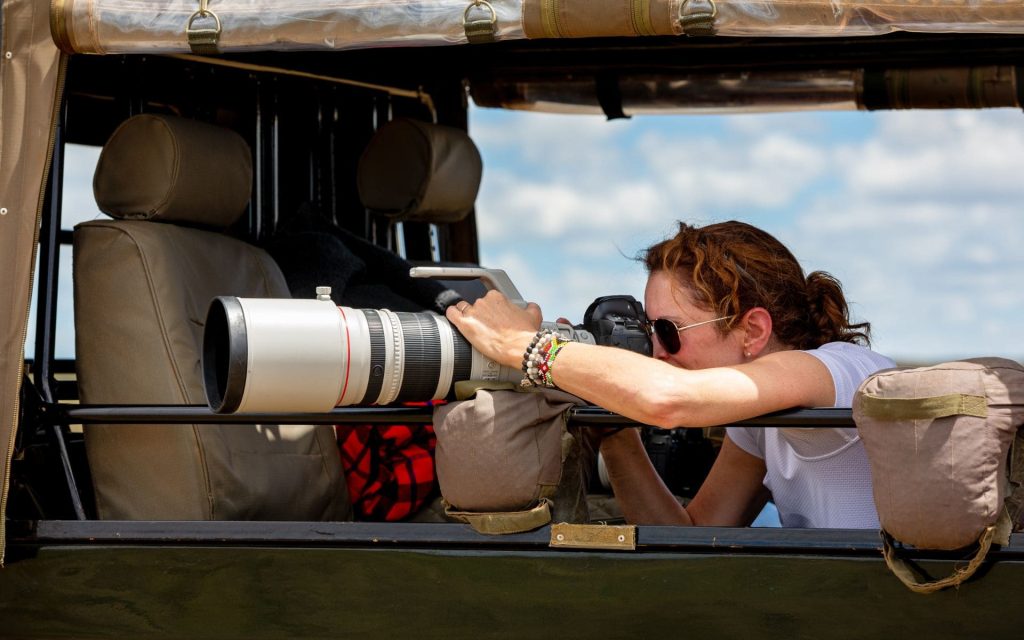
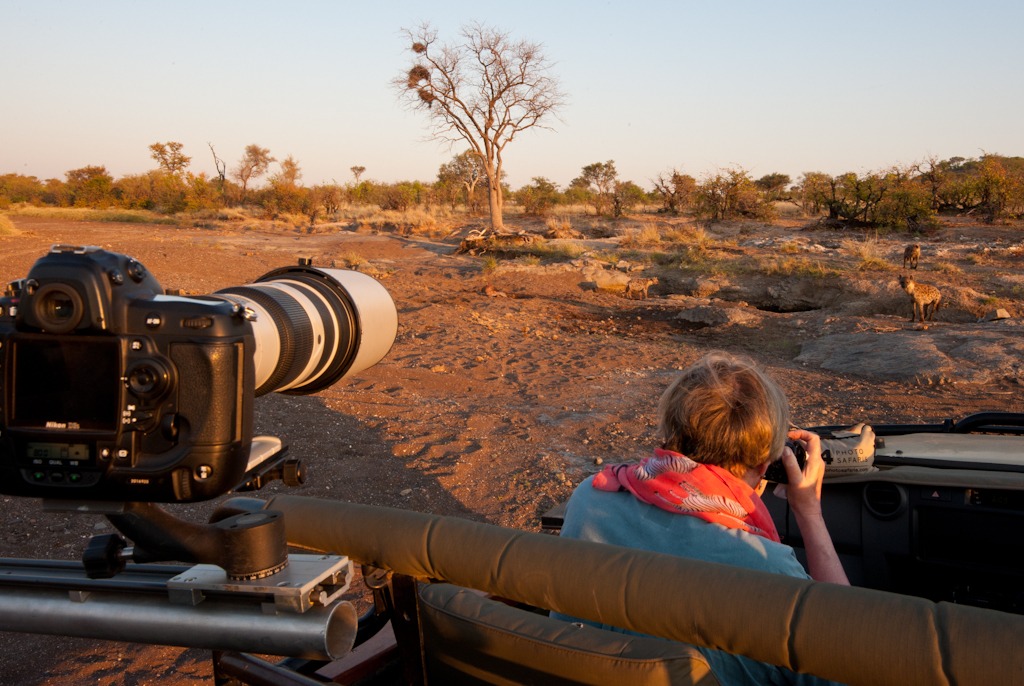
A beanbag resting on the vehicle window is the standard support for photography safari East Africa shooting — more stable than a tripod in a moving vehicle and faster to deploy. Bring a large, well-filled beanbag. Some photography-specialist vehicles are fitted with roof hatches and camera mounts — ask your operator about this option.
Photography Safari Light and Timing
Light is the defining variable in wildlife photography, and managing your time around the best light is the most important technique on a photography safari in East Africa:
- Golden hour (first 60–90 minutes after sunrise): The finest light of the entire photography safari East Africa day. Low-angle, warm-toned light produces three-dimensional modelling on animal coats, golden backlit grass, and dramatic shadow patterns. Arrive at known predator locations before sunrise to be ready.
- Blue hour (pre-dawn and post-sunset): Exceptional for atmospheric landscape images and silhouettes. Elephants and giraffes against a deep-blue pre-dawn sky produce minimalist compositions of striking power.
- Midday (avoid 10:00–15:00): Harsh overhead light flattens animal coats and produces unflattering shadows under facial features. Use midday for equipment maintenance, reviewing images, and resting at camp.
- Overcast days: Soft, directionless overcast light is excellent for close-up portraits of habituated animals — the even illumination prevents blown highlights on pale fur and reveals fine detail in gorilla, chimpanzee, and lion faces.
Specialist Photography Safari East Africa Vehicles
Standard safari vehicles are adapted for photography with beanbags and open roof hatches. Dedicated photography safari East Africa vehicles go further — specially modified Land Cruisers with low-profile rooflines, individual swivel seats for each photographer, padded camera rests along the roof edge, and power sockets for charging batteries in the field. Some operators maintain photography-specific vehicles exclusively for small groups of 2–4 photographers. If photography is your primary focus, requesting a dedicated photography vehicle from your operator significantly elevates the technical quality and shooting flexibility of the experience.
Best Time for Photography Safaris in East Africa
The dry season (June–October) is considered the best time for a photography safari East Africa overall — short grass, concentrated wildlife, clear skies, and the wildebeest migration (July–October) all peak simultaneously. The January–March calving season in the southern Serengeti is outstanding for action photography. For gorilla and primate photography in Uganda and Rwanda, the dry seasons (June–September, December–February) give the best forest light and easiest trekking conditions.
Plan Your Photography Safari in East Africa
A photography safari in East Africa built around optimal light, specialist vehicles, and expert guiding produces images that define a photographer’s portfolio. Contact our team to design a dedicated photography safari East Africa itinerary — we know which camps provide photography-specialist vehicles, which guides have the best eye for positioning, and exactly which parks deliver the finest light conditions for your target subjects.