Lake Naivasha is one of Kenya’s most rewarding and accessible safari destinations, a beautiful freshwater lake sitting at 1,884 metres above sea level in the floor of the Great Rift Valley, roughly 90 kilometres northwest of Nairobi. Unlike the arid savannah parks of the Rift Valley floor, Lake Naivasha is lush and green year-round, ringed by yellow fever acacias and papyrus beds and fed by the Malewa and Gilgil rivers.
The lake is a Ramsar-listed wetland of international importance, renowned for its extraordinary birdlife, over 400 species recorded, its large hippo population, and the unique experience of walking freely among wildlife on Crescent Island. Lake Naivasha is a natural stop on any Kenya safari, ideal as a one- or two-night addition to a Masai Mara itinerary or as a standalone weekend escape from Nairobi.
Why Visit Lake Naivasha?
- Outstanding birding: Lake Naivasha is one of Kenya’s premier birding destinations, with over 400 recorded species including the African fish eagle — whose haunting cry is the defining sound of the lake — great white pelican, goliath heron, yellow-billed stork, malachite kingfisher, long-tailed cormorant, and large concentrations of lesser and greater flamingo when water conditions attract them
- Hippo boat safaris: The lake supports one of Kenya’s largest hippo populations, most easily viewed from open boats during morning and late afternoon cruises when the animals are active near the surface. Early morning mist rising off the water with hippo pods surfacing around the boat is one of the most atmospheric experiences in Kenya.
- Crescent Island walking safari: A privately managed peninsula (often called an island) where you can walk on foot among giraffes, zebras, wildebeest, waterbuck, and Thomson’s gazelle — no vehicle, no fence between you and the animals. One of the most unique wildlife experiences in Kenya.
- Hell’s Gate National Park: Immediately adjacent to Lake Naivasha, Hell’s Gate National Park is Kenya’s only park where you can walk and cycle freely among wildlife. The dramatic gorge, geothermal steam vents, towering Fischer’s Tower rock column, and roaming buffalo, zebra, and giraffe make it one of the most distinctive parks in Africa.
- Elsamere Conservation Centre: The former lakeside home of Joy Adamson, author of Born Free and the conservationist who raised Elsa the lioness, now operates as a conservation centre and guesthouse with a small museum and resident black-and-white colobus monkeys in the garden.
- Proximity to Nairobi: At roughly 90 km from the capital — about 1.5 to 2 hours by road — Lake Naivasha is the most accessible major wildlife destination from Nairobi and an ideal first or last night stop on a Kenya safari itinerary.
Wildlife at Lake Naivasha
Hippos
Lake Naivasha supports one of the largest and most accessible hippo populations in Kenya. The hippos spend their days submerged in the shallower papyrus-fringed areas of the lake and emerge at dusk to graze on the lakeshore grass through the night. Boat trips at dawn or in the late afternoon offer the best viewing — the boats move quietly among groups of hippos surfacing, yawning, and socialising, sometimes with a dozen animals within a few metres of the boat. The experience is particularly atmospheric at first light when mist lies low over the water and fish eagles call from the yellow fever acacias.
Important note: hippos are responsible for more human fatalities in Africa than almost any other large mammal. Walking on the lakeshore at night when hippos are grazing is very dangerous. All lakeside lodges advise against unsupervised walking after dark, and guided night walks should only be undertaken with an experienced ranger.
Birds
Lake Naivasha is one of the finest birding sites in the whole of East Africa. The diversity of habitats — open water, papyrus beds, yellow fever acacia woodland, flower farm hedgerows, and rocky hillsides on the lake’s margins — supports an extraordinary range of species. Key birds to look for at Lake Naivasha include:
- African fish eagle: Abundant around the lake, frequently seen perched in acacia trees above the water and making aerial fishing dives. Their call — a loud, wild yelping cry — is the most iconic sound in African wildlife and is heard constantly at Naivasha
- Great white pelican: Large flocks roost on the lake’s islands and fish communally in impressive formations
- Goliath heron: Africa’s largest heron, standing over 1.5 metres tall, frequently seen stalking the shallows
- African jacana: The “Jesus bird” that walks across floating lily pads on its enormous feet, common in the papyrus margins
- Malachite kingfisher: A tiny jewel of electric blue and orange that perches on papyrus stems at the water’s edge
- Yellow-billed stork: Wades in the shallows using tactile hunting, commonly seen near hippo pools
- African darter: Swims with only its long snaky neck above water, then spreads its wings to dry like a cormorant on exposed branches
- Lesser and greater flamingo: Seasonally present in large flocks when water chemistry is right, turning sections of the shoreline pink
- Osprey and African marsh harrier: Regularly seen hunting over the open water and reed beds
Papyrus-specialist birds including the papyrus yellow warbler, lesser swamp warbler, and white-winged warbler are present in the dense papyrus beds and are targets for dedicated birders. The acacia woodland supports a range of sunbirds, weavers, starlings, and raptors. Early morning birding by boat, moving quietly through the papyrus channels, is the most productive approach.
Large Mammals
Beyond hippos, the Lake Naivasha area supports a good range of large mammals across its various habitats. Crescent Island is the most reliable location for game viewing, but several lakeshore properties have resident wildlife on their grounds. Species present in the broader Lake Naivasha ecosystem include:
- Giraffe: Masai giraffe are common on Crescent Island and around several lakeshore properties, often grazing right up to the water’s edge
- Plains zebra: Large herds on Crescent Island and in the grasslands between the lake and Hell’s Gate
- Waterbuck: Always close to water, commonly seen on the lakeshore and on Crescent Island
- Wildebeest: Blue wildebeest on Crescent Island in reasonable numbers
- Thomson’s and Grant’s gazelle: Common on the grasslands around the lake
- African buffalo: Present in Hell’s Gate National Park and occasionally on the lakeshore; treat with caution
- Black-and-white colobus monkey: Found in the yellow fever acacia forest around Elsamere and several lakeshore lodges; troops are often resident in the gardens
- Olive baboon: Common throughout the area, often bold around lodge grounds
Top Activities at Lake Naivasha
Boat Safari on the Lake
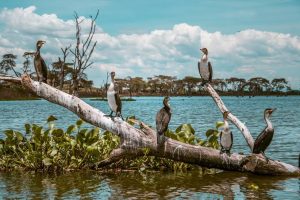
A boat safari on Lake Naivasha is the essential activity for every visitor. Open motorboats (and occasionally rowing boats or pontoons) depart from various launch points along the southern lakeshore and move out across the open water and into the papyrus-fringed channels, visiting hippo pools, bird colonies, and the floating papyrus islands that shift position with the wind. The best sessions are at dawn — when the lake is still, the light is golden, fish eagles are calling, and hippos are most active near the surface — and in the late afternoon when the light again becomes warm and the birds are actively fishing. Boat trips typically last one to two hours and can be extended for dedicated birding sessions.
Crescent Island Walking Safari
Crescent Island is the most distinctive wildlife experience at Lake Naivasha and one of the most unusual in Kenya. It is not an island in the strict sense but a privately managed peninsula — the remnant crater rim of an ancient volcanic caldera — that extends into the eastern end of the lake. The surrounding water creates the effect of an island. Crescent Island is a private conservancy with no predators, which allows visitors to walk freely on foot among giraffes, zebras, wildebeest, waterbuck, and gazelle — animals that have become entirely habituated to human walkers and go about their business entirely undisturbed.
The walk itself is managed as a guided experience with a local ranger, but the sensation of moving on foot among wild animals, a giraffe browsing a few metres away, a zebra herd parting slowly around you — is entirely different from a vehicle-based game drive and deeply memorable. The views across the lake from the high points of the island are excellent, particularly in early morning when mist lies on the water. Access to Crescent Island is by boat from the main lakeshore, with the crossing taking about 10 minutes. Entry fees are charged separately.
Hell’s Gate National Park
Hell’s Gate National Park lies immediately south of Lake Naivasha and is a natural pairing with a Naivasha visit. The park’s dramatic landscape, a narrow gorge carved through layers of volcanic rock, with towering basalt cliffs, geothermal steam vents, Fischer’s Tower (a 25-metre free-standing volcanic plug), and the red-walled Hell’s Gate gorge itself — is unlike anything else in Kenya. It is one of the only national parks in Africa where visitors can walk and cycle freely among wildlife without a vehicle, and the experience of cycling past grazing zebras and giraffes with the gorge walls rising on both sides is extraordinary.
Hell’s Gate is a full-day activity that complements a Lake Naivasha boat safari perfectly, morning on the lake for hippos and birds, afternoon in Hell’s Gate on foot or by bicycle. The park entry gate is about 2 km south of the main Naivasha lakeshore road. Bicycle hire is available at the park gate.
Elsamere Conservation Centre
Elsamere is the former lakeside home of Joy Adamson, the Austrian-born conservationist and author of Born Free (1960), the story of Elsa the lioness, raised by Joy and her husband George Adamson and subsequently released back into the wild in Meru National Park. The property sits directly on the lakeshore under large yellow fever acacias and has been preserved largely as it was during Joy’s lifetime, with a small museum displaying her paintings of Kenyan peoples and wildlife, personal photographs, and memorabilia from the Born Free years. The surrounding garden is home to a resident troop of black-and-white colobus monkeys that move through the trees around the guesthouse and can be observed at close range.
Elsamere operates as a guesthouse for overnight guests and is open during the day for non-residents on a tea-and-museum basis. The afternoon tea at Elsamere — served on the lawn with colobus monkeys in the trees overhead and hippos grunting from the nearby lake — is one of the more civilised wildlife experiences in Kenya.
Cycling and Horse Riding
The area around Lake Naivasha — particularly the network of tracks between the southern lakeshore, the flower farms, and the Hell’s Gate park boundary — is excellent cycling territory. Several lakeshore lodges offer bicycles for hire and guided cycling excursions into Hell’s Gate. Horse riding is available through a small number of operators and provides an alternative way to explore the lakeshore habitats and the adjacent Rift Valley escarpment.
Sport Fishing
Lake Naivasha has a substantial population of large-mouth bass (introduced) and several native fish species including tilapia. Sport fishing from boats is available through several lakeshore lodges, with catch-and-release the standard practice for bass. Fishing permits are required and are obtained through the lodges.
Best Time to Visit Lake Naivasha
Lake Naivasha can be visited year-round and, being only 90 km from Nairobi, is accessible regardless of season. However, the best conditions for different activities vary:
Dry Seasons: January–February and July–October (Best Overall)
The two dry seasons offer the best conditions for all activities. Boat safaris are most productive in clear weather, birding is excellent year-round but bird activity is highest in the dry season when water levels are lower and birds concentrate on the remaining open water, and Hell’s Gate is most accessible by bicycle when the tracks are dry. The long dry season of July to October coincides with the peak of the wildebeest migration in the Masai Mara, making this the ideal time for a combined Naivasha–Masai Mara itinerary.
Green Seasons: March–May and November–December
The two rainy seasons bring lush green vegetation and excellent birdlife as migratory species arrive. Birding is at its most diverse from November to March when European and northern African migrants swell the resident species list. The rains can make Hell’s Gate gorge tracks muddy and cycling more difficult, and some of the lakeside roads become waterlogged in heavy rainfall periods. Flamingo numbers tend to be highest in the wet season when alkaline conditions on other Rift Valley lakes (Nakuru, Bogoria) fluctuate and birds move to Naivasha.
Getting to Lake Naivasha
By Road from Nairobi
Lake Naivasha is approximately 90 km from Nairobi via the Nairobi–Nakuru highway (A104), a well-maintained dual carriageway for most of the route. The drive takes 1.5 to 2 hours depending on traffic leaving Nairobi. The road climbs steeply out of the Rift Valley on the escarpment section above Naivasha town, offering spectacular views of the valley floor and the lake below. Most lakeshore lodges are located along Moi South Lake Road, which runs for approximately 20 km along the southern lakeshore from Naivasha town.
By Road from the Masai Mara
Lake Naivasha sits almost exactly halfway between Nairobi and the Masai Mara on the standard road route via Narok, making it a natural overnight stop in both directions. The drive from the Mara to Naivasha takes approximately 3 to 4 hours depending on the Narok road conditions. Many Kenya safari itineraries use Naivasha as the first or last night, with a boat safari and Hell’s Gate visit before or after the main Masai Mara game drive days.
Lake Naivasha and the Rift Valley Lakes Circuit
Lake Naivasha is one of a chain of remarkable Rift Valley lakes running south to north through Kenya and into Ethiopia, each with its own character and wildlife. A Rift Valley lakes circuit from Nairobi can combine Lake Naivasha (hippos and birds), Lake Nakuru National Park (flamingos, rhinos, and tree-climbing lions — 60 km further north), and Lake Bogoria (hot springs and the highest concentration of flamingos in Kenya when conditions are right) into a rewarding 3–4 day itinerary before or after the main safari circuit.
Combining Lake Naivasha with a Kenya Safari
Lake Naivasha fits naturally into almost any Kenya safari itinerary as a one- or two-night addition. The most popular combinations are:
- Nairobi – Naivasha – Masai Mara: Drive from Nairobi to Naivasha for one night (afternoon boat safari and Hell’s Gate), then continue to the Mara the following day. This breaks up the long Nairobi–Mara drive and adds excellent content to what might otherwise be a transit day.
- Naivasha – Nakuru – Samburu: A northern Kenya circuit from Nairobi covering Rift Valley lakes and the northern savannah in 5–7 days. Lake Naivasha as the first night, Lake Nakuru (flamingos and rhinos) as the second, then fly or drive north to Samburu for the Special Five.
- Short break from Nairobi: Lake Naivasha is Kenya’s most popular weekend destination for Nairobi residents. A 2-night stay covering boat safari, Crescent Island walk, Hell’s Gate, and Elsamere makes a highly satisfying short trip that requires no flights and minimal planning.
Practical Information for Lake Naivasha
Park Fees and Entry
Lake Naivasha itself is not a gazetted national park, it is a Ramsar-designated wetland and the surrounding land is managed by a mix of private conservancies, Kenya Wildlife Service, and private landowners. There is no KWS park gate or standard entry fee for the lake itself. Hell’s Gate National Park is a gazetted KWS park with standard entry fees. Crescent Island charges its own entry fee, payable at the boat launch. Boat hire fees are charged per hour by the boat operators along the southern lakeshore.
Accommodation
Lake Naivasha has a wide range of accommodation along the southern lakeshore, from luxury lodges and tented camps directly on the water to mid-range guesthouses and budget campsites. The best properties are set directly on the lakeshore under yellow fever acacias, with private jetties for boat safaris, resident wildlife on the grounds, and views across the water to the Aberdare hills to the east. Elsamere Conservation Centre operates as a guesthouse for overnight guests and is one of the most atmospheric places to stay on the lake. Bookings are recommended at all times, and essential during Kenyan public holidays and long weekends when Naivasha receives heavy domestic tourism traffic.
Safety Notes
- Do not walk on the lakeshore after dark — hippos graze on the grass around lodges at night and are extremely dangerous if encountered at close range
- Keep a safe distance from hippos on boat safaris — a good operator will ensure the boat never cuts off a hippo from open water
- Buffalo in Hell’s Gate and on the lakeshore margins are wild and dangerous — always give them a wide berth
- The lakeshore road (Moi South Lake Road) is narrow and busy with flower farm truck traffic — drive carefully, particularly after dark
Lake Naivasha at a Glance
| Detail | Information |
|---|---|
| Location | Great Rift Valley, Kenya — 90 km northwest of Nairobi |
| Altitude | 1,884 m above sea level |
| Lake area | Approximately 139 km² (varies seasonally) |
| Designation | Ramsar Wetland of International Importance |
| Bird species | 400+ |
| Key wildlife | Hippo, giraffe, zebra, waterbuck, 400+ bird species |
| Top activities | Boat safari, Crescent Island walk, Hell’s Gate cycling, birding |
| Best time | Year-round; dry seasons (Jan–Feb, Jul–Oct) optimal |
| Drive from Nairobi | 1.5 – 2 hours via A104 highway |
| Nearest major park | Hell’s Gate NP (2 km), Lake Nakuru NP (60 km north) |