Lake Nakuru National Park is one of Kenya’s most compact yet most rewarding safari destinations. Set in the Great Rift Valley around an alkaline lake famous for its flamingos, the park punches well above its size: it is one of Africa’s best rhino sanctuaries, holds tree-climbing lions, leopard, large buffalo herds, and the striking combination of Rift Valley scenery and wildlife that makes it a natural addition to any central Kenya itinerary. At just 188 square kilometres, Nakuru can be explored thoroughly in 1 to 2 days, making it the ideal stop between Nairobi and the Masai Mara or Lake Naivasha.
Lake Nakuru’s Flamingos
Lake Nakuru was once home to the world’s largest single concentration of flamingos, up to two million lesser flamingos creating a solid pink band around the entire shore, described by David Attenborough as “one of the world’s greatest wildlife spectacles.” Flamingo numbers at Nakuru fluctuate significantly based on water levels and algae concentrations in the lake. When the lake’s alkalinity is favourable, the flamingo spectacle returns in force. When algae levels drop, the birds disperse to other Rift Valley lakes , particularly Lake Bogoria and Lake Natron in Tanzania.
Visit when conditions are right and you will see tens of thousands to hundreds of thousands of flamingos. The lake shore is accessible on foot in sections, and the view from Baboon Cliff above the lake is one of Kenya’s most dramatic vistas — a pink-fringed alkaline lake in the floor of the Great Rift Valley, rimmed by yellow fever acacia forest.
Rhino at Lake Nakuru
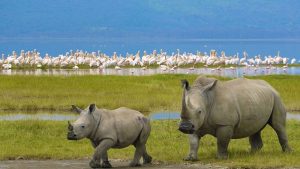 Lake Nakuru National Park is one of Kenya’s most important rhino sanctuaries, holding both white and black rhino behind a predator-proof fence that covers the entire park perimeter. Rhino sightings at Nakuru are among the most reliable in East Africa for both species.
- Southern white rhino — introduced from South Africa, a healthy breeding population is now well-established. White rhino are grazers and are commonly seen in the open grasslands around the southern shores of the lake
- Eastern black rhino — critically endangered, smaller and more aggressive than white rhino, with a pointed prehensile lip adapted for browsing. Sightings require patience but are more regular here than almost anywhere in Kenya
Lake Nakuru Wildlife Beyond Rhino and Flamingos
Lake Nakuru’s fully fenced perimeter means predators are contained and wildlife is resident year-round. This creates unusually high densities for a park of its size.
- Lion — several prides resident, including populations known to climb the yellow fever acacia trees around the lake shore — one of only a few lion populations in Africa known to do this regularly (the other well-known example is in Uganda’s Queen Elizabeth National Park)
- Leopard — the rocky escarpments and dense forest edges provide excellent leopard habitat. Sightings are regular, particularly in the early morning and late afternoon
- Buffalo — large herds throughout the park, particularly on the open grasslands to the south of the lake
- Rothschild’s giraffe — an endangered subspecies introduced to Nakuru. Distinguished from Masai giraffe by the absence of markings below the knee
- Waterbuck, reedbuck, impala, zebra — abundant throughout
- Hippo — present in the lake despite its alkalinity; visible from the hippo pool viewpoint on the lake’s eastern shore
- Pelicans and over 450 bird species — great white pelicans fish in large groups in the shallows; the bird life across the lake and surrounding forest is extraordinary
Best Time to Visit Lake Nakuru National Park
Lake Nakuru is a good year-round destination because the fenced park keeps resident wildlife in place regardless of season. However, conditions vary.
- June to October — the main dry season. Short grass makes wildlife viewing easier and the dust-free dry air creates clear photography conditions. Good flamingo numbers if lake levels are stable
- January and February — excellent conditions. Fewer visitors than peak season, lower prices, and good wildlife
- November to December and March to May — wetter periods. Vegetation thickens, game viewing is slightly harder. Flamingo numbers can be higher when algae blooms follow the rains. Lower prices
For broader Kenya timing advice, read our best time to visit Kenya guide.
How to Get to Lake Nakuru
Lake Nakuru lies 160 kilometres northwest of Nairobi in the Great Rift Valley, approximately 2 to 2.5 hours by road on good tarmac via the A104 highway. It is the most road-accessible of Kenya’s major parks after Nairobi National Park, and is comfortably done as a 1 to 2 night stop on a self-drive or guided road circuit. Charter flights are available from Wilson Airport to Nakuru airstrip for those on fly-in itineraries.
Combining Lake Nakuru with Other Destinations
Lake Nakuru sits at the heart of Kenya’s Rift Valley circuit. It is most naturally combined with:
- Lake Naivasha — 60 kilometres south of Nakuru. A freshwater lake with hippo, prolific birdlife, and boat safaris. Often combined as a one-night stop before or after Nakuru
- Masai Mara — a 4 to 5 hour drive west from Nakuru. Nakuru is a classic midpoint on the Nairobi–Mara road circuit: 2 nights Nakuru, then continue to the Mara for the migration
- Hell’s Gate National Park — adjacent to Lake Naivasha, famous for walking and cycling safaris and dramatic volcanic gorge scenery
Where to Stay at Lake Nakuru
- The Cliff — a luxury property perched on the Rift Valley escarpment above the park with extraordinary panoramic views over the lake. One of Kenya’s most spectacularly situated lodges
- Sarova Lion Hill Game Lodge — one of Nakuru’s best-established lodges, positioned on a hillside within the park with lake views and a strong wildlife-viewing programme. Reliable mid-to-upper range option
- Lake Nakuru Lodge — a classic mid-range lodge set in yellow fever acacia woodland inside the park. Good value and a central position for exploring both the lake shore and the park’s northern sectors
- Flamingo Hill Camp (Elewana) — a well-appointed tented camp in the park with a direct-to-lake view. Consistently high guiding standards
Plan Your Lake Nakuru Safari
Lake Nakuru is the most underrated of Kenya’s major parks, compact enough to cover thoroughly in a short visit, yet with a wildlife density and diversity that rivals parks five times its size. Its rhino population alone makes it essential for any Kenya itinerary. Contact Superfine Safaris to include Nakuru in your Kenya circuit. For practical preparation, see our Kenya safari travel tips and Kenya visa guide.