Birding safaris in Uganda offer one of the most extraordinary bird watching experiences anywhere in the world. With over 1,066 recorded bird species, the second highest total of any African country after the Democratic Republic of Congo, Uganda packs an astonishing diversity of birds into a relatively compact geography. From the papyrus swamps of Lake Victoria and the Nile delta where the prehistoric shoebill stork hunts alone in the reeds, to the ancient montane forests of Bwindi and Semuliki holding concentrations of Albertine Rift endemic species found nowhere else on Earth, Uganda bird watching delivers encounters that rank among the finest in Africa. Whether you are a dedicated birder targeting a specific list or a general safari traveller who wants outstanding wildlife beyond the primates, birding in Uganda will exceed any expectation.
Why Uganda is Africa’s Top Birding Safari Destination
Uganda’s exceptional bird species count results from an unusually fortunate combination of geography, climate, and habitat. The country sits at the intersection of several major African biomes — the Congo rainforest, the East African savannah, the Albertine Rift montane system, and the great Nile wetlands — and each contributes its own distinct bird communities. No other country in Africa of comparable size contains such habitat diversity, which is why birding safaris in Uganda consistently produce outstanding species counts.
- 1,066+ bird species: More bird species than the entire United States, in a country the size of Great Britain
- 24 Albertine Rift endemics: Species found only in the Albertine Rift highlands — the mountain chain running from Uganda south through Rwanda, Burundi, and eastern DRC — and nowhere else on Earth. Uganda holds more Albertine Rift endemic species than any other single country.
- The shoebill stork: One of the most sought-after birds in Africa, found reliably in Uganda’s papyrus swamps and Nile wetlands. Uganda is the best country in the world to see the shoebill stork.
- Congo biome specials: Uganda’s Semuliki Valley is the easternmost extension of the Congo rainforest, bringing Central African forest species well outside their normal range and accessible to East African birders for the first time.
- Year-round birding: Uganda can be birded in any month of the year. Unlike seasonal African destinations, Uganda’s bird watching is productive regardless of when you visit, with different seasons offering different highlights.
- Combined with primates: Gorilla trekking in Bwindi and chimpanzee trekking in Kibale Forest are among the world’s great wildlife experiences. Combining them with dedicated birding delivers a safari of exceptional breadth.
Top Birding Destinations in Uganda
Mabamba Swamp — Best Place to See the Shoebill Stork in Uganda
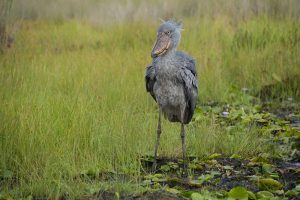 Mabamba Swamp, on the northern shore of Lake Victoria about 40 kilometres west of Entebbe, is the premier shoebill stork site in Uganda and arguably the most reliable place in the world to see this extraordinary bird. The shoebill (Balaeniceps rex) is a massive, grey, prehistoric-looking bird standing up to 1.5 metres tall with a huge shoe-shaped bill that it uses to ambush lungfish and other large prey in the shallow papyrus swamps. It is a Vulnerable species on the IUCN Red List and one of the most sought-after birds among visiting birders from around the world.
At Mabamba, local community guides pole traditional dugout canoes through narrow channels in the papyrus to known shoebill territories. The birds are habituated to canoes and allow close approach, often standing motionless for long periods before making a dramatic lunge at prey. A Mabamba shoebill encounter typically lasts 30 minutes to two hours and allows exceptional photography from water level. Early morning visits (departing before 7:00 am) are most productive. The swamp also holds papyrus yellow warbler, white-winged warbler, lesser jacana, African pygmy goose, and the elusive blue-headed coucal.
Mabamba is only an hour from Entebbe airport, making it an ideal first or last day birding addition to any Uganda safari itinerary. It is the most visited birding site in Uganda and easily paired with the Entebbe Botanical Gardens (see below) for a full day of productive birding immediately on arrival.
Entebbe Botanical Gardens — First-Day Birding in Uganda
The Entebbe Botanical Gardens on the Lake Victoria shoreline are one of Uganda’s most productive birding sites per hour spent, and the ideal location for birding on the day of arrival or departure. The gardens cover approximately 40 hectares of mature tropical forest, open lawn, and lakeshore vegetation and hold an extraordinary species list for such a small and accessible site. Key species include the great blue turaco — a spectacular metre-long bird of vivid blue-green and yellow, the largest turaco in Africa — grey parrot, chocolate-backed kingfisher, blue-throated roller, red-chested cuckoo, African paradise flycatcher, and a range of sunbirds, weavers, and raptors. The black-and-white casqued hornbill and grey-throated barbet are regularly seen. Birding the gardens for two to three hours on arrival while jet lag is still manageable is a highly recommended start to any birding safari in Uganda.
Kibale Forest National Park — Forest Birding Uganda
Kibale Forest National Park in western Uganda is best known as the premier chimpanzee trekking destination in East Africa, but it is simultaneously one of Uganda’s finest birding parks, with 375+ recorded species including several that are extremely difficult to find elsewhere. Kibale’s combination of moist evergreen forest, transitional forest, and wetland edge habitats creates exceptional diversity across a relatively small area.
The star bird at Kibale Forest for visiting birders is the green-breasted pitta (Pitta reichenowi) — a brilliantly coloured, ground-dwelling forest bird that is one of Africa’s most sought-after species. The pitta is present year-round but most reliably found during and after rain when it moves along forest paths. Other key target species for birding in Kibale Forest include:
- African pitta — a migratory pitta present November to April, overlapping with the resident green-breasted pitta for a rare double-pitta opportunity
- Nahan’s partridge — a secretive forest partridge restricted to a few forest patches in Uganda and Cameroon
- Red-chested owlet — a small, cryptic owlet detected mostly by its call; spotlight walks in Kibale can find this species
- Blue-headed sunbird — an Albertine Rift endemic, iridescent blue-headed male unmistakable in the forest canopy
- Purple-breasted sunbird — another Albertine Rift endemic, male with spectacular iridescent purple breast patch
- Black bee-eater — a stunning velvety black bee-eater with scarlet throat, perches conspicuously on forest edges
- African grey parrot — large flocks roost in Kibale Forest and can be seen flying over in spectacular numbers at dusk
- Yellow-spotted barbet, hairy-breasted barbet, black-collared apalis — among many forest interior specialists
Bigodi Wetland Sanctuary, a community-managed wetland immediately adjacent to Kibale Forest, adds further birding value to a Kibale visit. The wetland walk through papyrus and mixed forest holds papyrus yellow warbler, white-winged warbler, African fish eagle, blue-breasted kingfisher, and a range of forest-edge species. Bigodi is one of the best examples of community-based tourism in Uganda and an outstanding half-day birding addition to a Kibale Forest stay.
Bwindi Impenetrable Forest — Albertine Rift Endemic Birding
Bwindi Impenetrable Forest National Park is Uganda’s most celebrated wildlife destination for gorilla trekking, but it is also one of Africa’s most important birding sites. The park holds 350+ bird species, including 23 of the 24 Albertine Rift endemics recorded in Uganda, the highest concentration of Albertine Rift endemics in any single park in Uganda and one of the highest in any park in Africa. Bwindi’s ancient montane forest, ranging from 1,160 to 2,607 metres altitude, provides habitat for a remarkable range of forest specialists.
Top birding targets in Bwindi Impenetrable Forest:
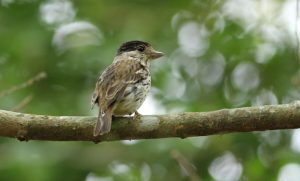
- African green broadbill (Pseudocalyptomena graueri) — arguably the most sought-after bird in Uganda for dedicated birders. This tiny, vivid green broadbill with its absurdly wide bill is restricted to a handful of Albertine Rift forest patches and is most reliably found in Bwindi’s Mubwindi Swamp area. It is one of Africa’s most difficult and rewarding birds to find.
- Shelley’s crimsonwing — a beautiful red-and-green finch of dense bamboo and forest edge, restricted to Albertine Rift montane forest
- Bar-tailed trogon — a stunning forest trogon with crimson belly, sits motionless in the mid-canopy and is easily missed by eye but found by its call
- Handsome francolin — a secretive partridge-like bird of the forest floor, an Albertine Rift endemic
- Rwenzori turaco — a spectacular crimson-and-green turaco of the high montane forest, calling loudly but sometimes difficult to see in the dense canopy
- Short-tailed warbler — a tiny, cryptic Albertine Rift endemic found in dense undergrowth
- Red-throated alethe — a shy forest thrush that follows army ant swarms to catch flushed insects
- White-starred robin, Chapin’s flycatcher, stripe-breasted tit — additional Albertine Rift endemics present in Bwindi
The best birding sectors in Bwindi are Ruhija (highest altitude, best for high-elevation endemics) and Buhoma (most accessible). Dedicated birding walks separate from gorilla trekking can be arranged with specialist birding guides at all four Bwindi sectors. A minimum of two full birding days is recommended at Bwindi for anyone targeting the endemic species list.
Semuliki National Park — Congo Forest Birding in Uganda
Semuliki National Park in the Semuliki Valley on the DRC border is Uganda’s most exciting birding destination for specialists and one of the most remarkable birding sites in Africa. The park protects the easternmost extension of the Congo Basin lowland rainforest — a forest type found in Uganda nowhere else — and this brings a suite of Central African Congo biome bird species well east of their normal range, making them accessible to East African birders without the logistical challenges of visiting the DRC.
Semuliki holds approximately 440 bird species, of which around 60 are birds of the Congo forest biome not found elsewhere in Uganda. The “Semuliki specials” are the most sought-after birds in Uganda for dedicated birders:
- African piculet — the world’s smallest woodpecker, restricted to Congo forest and found in Semuliki; a tiny, hyperactive bird of the forest interior
- Nkulengu rail — an extremely secretive Congo forest rail rarely seen; heard much more often than seen along forest streams
- White-crested hornbill — a spectacular long-tailed hornbill of the deep forest interior, moves noisily in family groups
- Yellow-throated cuckoo — a Congo forest cuckoo rarely found outside the DRC and Semuliki
- Black-faced rufous warbler — found along forest streams, nervous and difficult to see well
- Lemon-bellied crombec — a tiny, restless warbler of the forest interior
- Congo serpent eagle — a shy forest raptor of the deep Congo forest, very rarely seen
- Red-sided broadbill, African dwarf kingfisher, blue-headed bee-eater — additional Congo biome specialists present in Semuliki
Birding in Semuliki National Park requires patience and local knowledge. The forest interior birds are detected primarily by call, and moving slowly with an experienced guide who knows the calls is essential. The Semuliki River trail and the Sempaya hot springs trail are the most productive birding routes. Semuliki is typically combined with Kibale Forest for a western Uganda birding safari and is a full-day drive from Fort Portal.
Queen Elizabeth National Park — Savannah and Wetland Birding
Queen Elizabeth National Park is Uganda’s most visited wildlife park and one of the finest multi-habitat birding destinations in East Africa. With over 600 recorded bird species — the highest of any national park in Uganda — Queen Elizabeth offers savannah birding, wetland birding, forest edge birding, and Kazinga Channel waterbird spectacles within a single park. The diversity of habitats, from the Maramagambo Forest in the east to the Ishasha sector in the south, ensures a constantly changing bird list.
Key birding targets at Queen Elizabeth National Park:
- Shoebill stork: Queen Elizabeth’s Kazinga Channel and the papyrus swamps of Mweya Peninsula occasionally produce shoebill sightings. The Katunguru area on the channel is the most reliable Queen Elizabeth location for shoebill.
- Papyrus gonolek — a stunning boubou restricted to papyrus swamp edges, iridescent black above with vivid crimson below; best found along the Kazinga Channel papyrus margins
- White-winged warbler — a papyrus specialist and Albertine Rift endemic found in the channel’s papyrus beds
- African skimmer — a spectacular tern-like bird that skims the Kazinga Channel surface with its lower mandible cutting the water; breeds on sand bars in the channel
- Pink-backed pelican and great white pelican — large flocks roost and fish on the Kazinga Channel
- Malagasy pond heron — a Malagasy migrant that visits the channel in small numbers, easily confused with the resident squacco heron
- Shelley’s francolin — a grassland francolin of open savannah, most reliably found in the Kasenyi plains
- Martial eagle and bateleur — large raptors soaring over the Kasenyi plains and Mweya Peninsula
- African grey parrot — Maramagambo Forest in the eastern sector of the park holds a significant African grey parrot population
The Kazinga Channel boat cruise — a two-hour launch trip along the channel between Lake George and Lake Edward — is Queen Elizabeth’s most productive single birding activity, combining hippo and buffalo viewing with exceptional waterbird diversity. The Maramagambo Forest birding trail and the Ishasha sector (famous for tree-climbing lions) add forest and savannah birding respectively to the Queen Elizabeth tick list.
Murchison Falls National Park — Nile Birding Safari
Murchison Falls National Park is Uganda’s largest park and one of its finest birding destinations, with 450+ recorded bird species across a dramatic landscape dominated by the Nile. The park combines open savannah north of the Nile, riverine forest along the river banks, and the extraordinary Nile delta at Lake Albert — where the Nile fans out into a series of channels and papyrus swamps before entering the lake — creating habitat diversity that underpins the park’s exceptional bird list.
The delta of the Victoria Nile at Lake Albert is one of the best shoebill stork sites in Uganda. The shoebill haunts the papyrus channels at the river’s mouth and can be found on specialised boat trips from Paraa that move out through the delta channels. This is a longer and more immersive shoebill experience than Mabamba and combines with spectacular hippo pods, Nile crocodiles, and waterbird concentrations in a truly wild setting. Additional key birds at Murchison Falls include:
- African fish eagle: Abundant along the entire Nile, calling constantly and fishing spectacularly from riverside trees
- Goliath heron: Africa’s largest heron, common along the Nile banks and easily approached from boats
- Saddle-billed stork: A spectacular large stork with a vivid red-and-yellow saddle bill, regularly seen on the Nile banks and open flood plains
- Standard-winged nightjar: A remarkable nightjar in which breeding males develop extraordinary secondary flight feathers extending far beyond the wing tip as a display structure. Present November to March; best seen on spotlighting drives in the northern savannah.
- Black-headed gonolek, northern carmine bee-eater — northern savannah species found in Murchison but not in Uganda’s southern parks
- Abyssinian ground hornbill: A turkey-sized black hornbill with vivid red facial skin, walks slowly across the open savannah in family groups
- African skimmer: Breeds on the Nile’s sand bars within the park; best seen from the Paraa river launch cruises
- African quailfinch, Heuglin’s masked weaver — northern dry-country species reaching their southern limit in Murchison
Lake Mburo National Park — Birding Near Kampala
Lake Mburo National Park is the closest national park to Kampala , about 240 km or 3.5 hours by road and an excellent birding destination that is often overlooked in favour of the larger parks. The park holds 350+ bird species across acacia woodland, open savannah, lakeshore, and papyrus swamp habitats. For birders on a short Uganda itinerary or travelling between Kampala and Bwindi, Lake Mburo offers a full day of productive birding.
Key birding targets at Lake Mburo include the African finfoot — an elusive, retiring waterbird of shaded lakeside vegetation that is one of Africa’s most difficult birds to see well — the brown-chested lapwing (restricted to open grassland in this area), red-faced barbet (a range-restricted barbet of the acacia woodland), rufous-bellied heron, African papyrus warbler, and white-winged warbler. The lake itself holds good concentrations of waterbirds and the acacia woodland is excellent for a range of weavers, sunbirds, and raptors. Boat trips on Lake Mburo are an effective way to find the African finfoot and other shy waterbirds.
Budongo Forest Reserve — Chimpanzee Birding Uganda
Budongo Forest Reserve within Murchison Falls NP is one of Uganda’s largest and most important lowland forests and a superb birding destination in its own right. The forest holds 360+ bird species including several Congo biome specials that reach their northeastern limit here. Key birds include the chocolate-backed kingfisher — a secretive forest kingfisher that sits quietly in the mid-canopy — Puvel’s illadopsis, white-thighed hornbill, yellow-throated tinkerbird, Cassin’s spinetail, and a range of forest sunbirds and warblers. Budongo is also the site of Uganda’s most accessible habituated chimpanzee community, adding an excellent primate experience to a Murchison Falls birding safari.
Mgahinga Gorilla National Park — High-Altitude Birding Uganda
Mgahinga Gorilla National Park in the extreme southwest of Uganda, on the borders with Rwanda and the DRC, protects the Ugandan section of the Virunga Volcanoes. The park’s high-altitude bamboo and Hagenia-Hypericum forest habitats hold a distinct bird community from that of Bwindi, with several additional Albertine Rift endemics including the Rwenzori turaco, dusky crimsonwing, strange weaver, and high-altitude sunbirds including the regal sunbird and bronze sunbird. Mgahinga is most commonly visited for gorilla trekking or golden monkey tracking, but adding a morning birding walk to either activity is easy and productive.
Uganda’s Most Sought-After Birds: The Birding Bucket List
These are the birds that bring dedicated birders from around the world on birding safaris in Uganda — the species that cannot reliably be found anywhere else, or that Uganda holds in exceptional numbers or quality of experience.
| Bird | Best Location in Uganda | Status |
|---|---|---|
| Shoebill stork | Mabamba Swamp, Murchison Falls delta | Vulnerable; Uganda is the world’s best site |
| African green broadbill | Bwindi (Mubwindi Swamp), Semuliki | Endangered; one of Africa’s hardest birds |
| Green-breasted pitta | Kibale Forest NP | Near Threatened; iconic Kibale target |
| African pitta | Kibale Forest (Nov–Apr) | Migratory; often found with green-breasted pitta |
| Standard-winged nightjar | Murchison Falls (Nov–Mar) | Breeding males have extraordinary display feathers |
| African piculet | Semuliki NP | World’s smallest woodpecker; Congo biome special |
| Rwenzori turaco | Bwindi, Mgahinga, Rwenzori Mts | Albertine Rift endemic; spectacular crimson wings |
| Shelley’s crimsonwing | Bwindi Impenetrable Forest | Albertine Rift endemic; dense bamboo specialist |
| Papyrus gonolek | Queen Elizabeth NP, Kazinga Channel | Papyrus specialist; vivid crimson and black |
| African skimmer | Murchison Falls, Kazinga Channel | Breeds on Nile sand bars inside Murchison Falls NP |
| Great blue turaco | Entebbe Botanical Gardens, Kibale | Africa’s largest turaco; widespread in Uganda |
| African finfoot | Lake Mburo NP | Skulking waterbird; Lake Mburo is most reliable site |
Albertine Rift Endemics in Uganda
The Albertine Rift is the western branch of the East African Rift System, running from Uganda south through Rwanda, Burundi, and eastern DRC to northern Zambia. The Albertine Rift highlands — a chain of mountains, forest blocks, and lakes — have acted as a refugium for bird and animal life over millions of years of climate change, allowing species to evolve in isolation and producing a unique assemblage of endemics found nowhere else on Earth. Uganda holds 24 Albertine Rift endemic bird species, more than any other single country in the range.
The full list of Albertine Rift endemic birds found in Uganda includes:
- African green broadbill (Pseudocalyptomena graueri)
- Grauer’s broadbill (Pseudocalyptomena graueri)
- Handsome francolin (Pternistis nobilis)
- Rwenzori turaco (Gallirex johnstoni)
- Rwenzori nightjar (Caprimulgus ruwenzorii)
- Bar-tailed trogon (Apaloderma vittatum)
- Dwarf honeyguide (Indicator pumilio)
- Strange weaver (Ploceus alienus)
- Shelley’s crimsonwing (Cryptospiza shelleyi)
- Dusky crimsonwing (Cryptospiza jacksoni)
- White-winged warbler (Bradypterus carpalis)
- Short-tailed warbler (Hemitesia neumanni)
- Chapin’s flycatcher (Muscicapa lendu)
- Red-throated alethe (Chamaetylas poliophrys)
- White-starred robin (Pogonocichla stellata ruwenzorii)
- Montane sooty boubou (Laniarius poensis)
- Stripe-breasted tit (Melaniparus fasciiventer)
- Blue-headed sunbird (Cyanomitra alinae)
- Regal sunbird (Cinnyris regius)
- Purple-breasted sunbird (Nectarinia purpureiventris)
- Stuhlmann’s starling (Poeoptera stuhlmanni)
- African hill babbler (Sylvia abyssinica)
- Grauer’s warbler (Graueria vittata)
- Collared apalis (Oreolais pulchra)
The best single park for Albertine Rift endemics in Uganda is Bwindi Impenetrable Forest (23 species), followed by Semuliki NP, Mgahinga Gorilla NP, and the Rwenzori Mountains NP. A dedicated Albertine Rift endemic birding tour of Uganda typically combines Bwindi, Semuliki, and the Rwenzoris over 10–14 days and can produce 20+ Albertine Rift endemics for a serious birder.
Best Time for Birding Safaris in Uganda
Uganda can be birded in any month of the year — there is no “closed season” for bird watching in Uganda — but different periods offer different advantages.
November to April — Peak Birding Season
This period, covering the short dry season (December–February) and the long rains (March–April), is widely considered the best time for birding in Uganda by specialists. The principal reason is the presence of Palearctic and intra-African migrants: European and North African species (warblers, flycatchers, hirundines, waders, raptors) are present from November to April, dramatically increasing the total species count at every site. Murchison Falls in particular gains a large number of migrant raptors and waterbirds in this period. November to January also brings the African pitta to Kibale Forest, creating the rare double-pitta opportunity alongside the resident green-breasted pitta.
The long rains of March–May bring lush green vegetation and very active bird behaviour — breeding, territorial calling, and feeding activity all increase. Forest birding can be productive after rain when pittas, thrushes, and babblers become more active on the forest floor. The wet season also coincides with lower tourist numbers, which means quieter trails and more attentive guides.
June to October — Dry Season Birding
The long dry season (June–August) and short dry season (December–February) offer better road conditions, more comfortable weather, and easier access to all parks. Many resident species are in breeding plumage in June–August, making identification and photography more rewarding. Birding at Mabamba Swamp for the shoebill is productive year-round. Semuliki NP and Budongo Forest are accessible in drier conditions when forest tracks are not waterlogged. The dry season is the preferred period for general safari travellers combining birding with game drives and primate trekking.
How to Plan a Birding Safari in Uganda
Specialist Birding Guides
The quality of your birding guide makes an enormous difference to your bird count and the depth of your experience. Uganda has a small number of specialist birding guides with deep knowledge of local species, calls, and habitat preferences — these guides are different from general safari guides and are specifically trained in bird identification and behaviour. Superfine Safaris works with Uganda’s best specialist birding guides at each key site, ensuring that visiting birders are accompanied by someone who can find, identify, and interpret every species encountered.
Birding Itinerary Lengths
- 5–7 days (taster birding Uganda): Entebbe Botanical Gardens + Mabamba Swamp (shoebill) + Kibale Forest (green-breasted pitta, primates) + Queen Elizabeth NP (Kazinga Channel waterbirds, papyrus gonolek). Covers three major habitat types and the two most sought-after Uganda birds.
- 10–12 days (comprehensive birding Uganda): Adds Bwindi Impenetrable Forest (Albertine Rift endemics including African green broadbill) and Semuliki NP (Congo biome specials). The most productive itinerary for a serious birder targeting the Uganda endemic list.
- 14–21 days (specialist Uganda birding tour): Full endemic tour adding Murchison Falls (Nile delta shoebill, standard-winged nightjar), Budongo Forest (Congo forest species), Lake Mburo (African finfoot), and optionally the Rwenzori Mountains (high-altitude endemics). Targets 700+ species for an experienced birder.
Combining Birding with Primate Trekking
One of the great advantages of birding safaris in Uganda is that the finest birding sites are also Uganda’s finest primate destinations. Bwindi offers gorilla trekking alongside Albertine Rift endemic birding; Kibale offers chimpanzee trekking alongside green-breasted pitta and other forest birds; Murchison Falls combines chimpanzee tracking in Budongo with Nile delta shoebill birding. For non-birding companions travelling with a birder, Uganda’s primate experiences provide equally compelling alternatives, making Uganda ideal for mixed-interest groups.
What to Bring on a Uganda Birding Safari
- Binoculars: An 8×42 or 10×42 binocular is the standard for forest birding — the x42 objective lens gathers sufficient light for the low-light conditions of Uganda’s dense forest interiors. Avoid 10×50 or larger in the forest as they are heavy and slow to focus. A good quality porro or roof prism binocular from Swarovski, Zeiss, Leica, or Vortex makes a significant difference to the quality of views in difficult conditions.
- Field guides: Birds of East Africa by Stevenson and Fanshawe covers Uganda comprehensively. Birds of the African East Coast and Handbook of the Birds of the World (HBW) are supplementary references for specialists. The Merlin Bird ID app (Cornell Lab) covers Uganda and is an invaluable playback and identification tool in the field.
- Camera and telephoto lens: Forest birds are often in poor light and partially obscured by vegetation. A 500mm or 600mm telephoto on a mirrorless body, or a bridge camera with a long zoom (Sony RX10 IV is a popular choice for birding photographers), gives acceptable results. A sturdy monopod is useful in Mabamba’s dugout canoe.
- Clothing: Dark, neutral-coloured clothing (olive, grey, brown) in the forest. Bright colours flush birds. Long trousers and long-sleeved shirts protect against nettles and insects in Bwindi and Semuliki. A waterproof jacket is essential — rain can come suddenly in Uganda’s forests at any time of year.
- Footwear: Waterproof hiking boots with ankle support for Bwindi, Semuliki, and the Rwenzoris. Lightweight trail shoes are adequate for Kibale and Murchison. Rubber boots (gumboots) can be hired at Mabamba Swamp for canoe birding in the wet season.
- Insect repellent: DEET-based repellent is essential for all Uganda birding sites, particularly in the Semuliki Valley, Mabamba Swamp, and Queen Elizabeth’s wetland margins.
Uganda Birding Safari Practical Information
Getting to Uganda for Birding
Entebbe International Airport is Uganda’s main international gateway, served by direct flights from London (Heathrow), Amsterdam, Dubai, Nairobi, Addis Ababa, Johannesburg, and other African hubs. Flying time from London is approximately 8–9 hours. The Entebbe Botanical Gardens and Mabamba Swamp are both within an hour of the airport, allowing birding to begin on the day of arrival. Uganda visas are available on arrival for most nationalities and can also be applied for in advance online.
Health Precautions
- Malaria: Uganda is a malaria-endemic country. Malaria prophylaxis is strongly recommended for all visitors. Consult your doctor or travel health clinic at least 4–6 weeks before departure.
- Yellow fever vaccination: Strongly recommended and may be required if arriving from certain countries. A yellow fever vaccination certificate is required for entry if arriving from a yellow fever risk country.
- Typhoid, hepatitis A: Recommended for all Uganda visitors.
For detailed itinerary planning, guide booking, and logistics for a Uganda birding safari, contact Superfine Safaris. We build tailored Uganda safari itineraries combining specialist birding with gorilla trekking, chimpanzee trekking, and game drives for both dedicated birders and general wildlife travellers.