Bird migration in Africa is one of the continent’s most spectacular and least-celebrated wildlife phenomena. Each year, more than 2 billion birds make the journey between Europe and Africa alone, while dozens of species complete equally epic intra-African migrations across the continent’s changing seasonal zones.
East Africa sits at the crossroads of three major migratory flyways and hosts a staggering diversity of resident and migratory species. Whether you are a dedicated birder or a first-time safari traveller, understanding bird migration in Africa transforms every game drive into a richer wildlife experience.
Types of Bird Migration in Africa
Palearctic Migrants
The largest category of bird migration in Africa involves Palearctic migrants, birds breeding in Europe, the Middle East, and Central Asia that fly south to Africa for the northern winter. Over 180 species make this journey, including swallows, swifts, storks, eagles, falcons, warblers, and flycatchers
These birds arrive in East Africa between October and November and depart northward in March and April. Palearctic migrants can be identified by their unfamiliar plumage on arrival — most are in non-breeding, dull winter plumage — and their tendency to associate with feeding flocks of resident species.
Intra-African Migrants
Many African bird species are themselves migrants moving across the continent in response to the seasonal shift of rainfall, insect emergence, and fruiting cycles. The carmine bee-eater, Abdim’s stork, lesser striped swallow, and Eurasian roller are among the most dramatic intra-African migrants seen across East Africa. These intra-African movements of bird migration mean that the bird life at any given location changes month by month.
Altitudinal Migration
Several mountain-associated species in East Africa perform short-distance altitudinal migrations — moving between highland forests and lowland areas with seasonal food availability. Sunbirds, bulbuls, and some raptors move up and down the slopes of Mount Kenya, the Virunga Volcanoes, and the Rwenzori Mountains through the year, adding to the bird migration Africa spectacle across the region’s montane zones.
Key Migratory Species to Look For
White Stork
One of the most iconic Palearctic migrants of East Africa bird migration, the white stork (Ciconia ciconia) arrives in enormous numbers between October and April. Stork concentrations in Amboseli, the Serengeti, and the Rift Valley lakes can reach tens of thousands of individuals, spiralling on thermals and feeding on insects flushed by grass fires. Watching stork columns rising on afternoon thermals above the Serengeti plains is one of the most striking bird migration Africa spectacles.
Carmine Bee-Eater
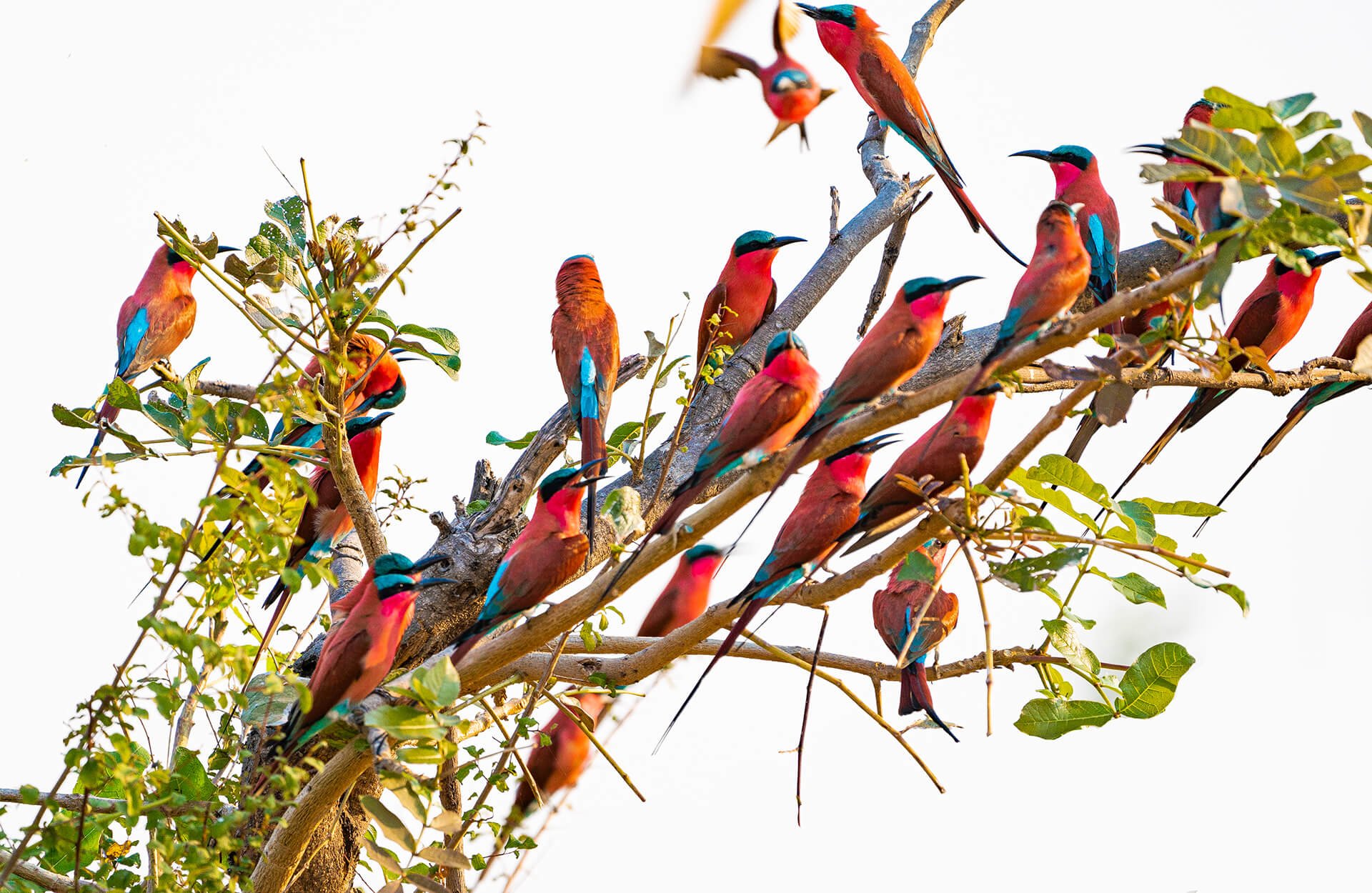
Among the most beautiful birds involved in intra-African migration, the carmine bee-eater (Merops nubicoides) arrives in Uganda and northern Tanzania between October and April. Colonies of hundreds nesting in riverbanks along the Nile corridor in Murchison Falls National Park are a highlight of any East Africa birding safari and coincide precisely with the bird migration Africa peak.
Eurasian Roller
The Eurasian roller arrives in East Africa between October and March, adding brilliant blue-chestnut colour to savannah bird migration Africa spectacles. These migrants perch conspicuously on telegraph wires and dead trees alongside resident lilac-breasted rollers — the colour contrast between the two makes for exceptional photography across Tanzania, Kenya, and Uganda.
Raptors and Vultures
Several raptor species are strongly migratory across East Africa, including the steppe eagle, lesser kestrel, western marsh harrier, and Montagu’s harrier. These birds concentrate over the same savannah areas as the large mammal aggregations, feeding on insects disturbed by migrating herds and carrion from predator kills. Steppe eagle concentrations in the Masai Mara and Amboseli during October–November are particularly impressive examples of raptor bird migration in Africa.
Flamingos at the Rift Valley Lakes
While flamingos are largely resident in East Africa, their movements between the soda lakes of the Rift Valley are a form of local migration in response to water levels and food availability. When conditions are right, Lake Nakuru and Lake Bogoria in Kenya host over a million lesser and greater flamingos simultaneously — creating one of the greatest bird spectacles on the planet and a defining bird migration Africa experience.
Best Birding Destinations for Bird Migration in Africa
 Lake Nakuru National Park, Kenya
 Lake Nakuru National Park, Kenya
Lake Nakuru is synonymous with bird migration Africa spectacle. Beyond flamingos, the park’s varied habitats, acacia woodland, grassland, rocky cliffs — support over 400 bird species including significant numbers of Palearctic migrants. The pelican colonies and yellow-billed stork concentrations on the lake shore are breathtaking from October onwards.
Lake Manyara National Park, Tanzania
Lake Manyara is one of Tanzania’s premier bird migration Africa destinations. The park’s alkaline lake attracts flamingos, pelicans, and thousands of waders, while the groundwater forest holds a concentration of forest species unmatched elsewhere in northern Tanzania. Over 400 species have been recorded, with migratory warblers, flycatchers, and raptors adding significantly to this list between October and April.
Murchison Falls National Park, Uganda
The White Nile corridor through Murchison Falls is a major bird migration Africa highway. The river itself draws enormous concentrations of waterbirds year-round, while the savannah north of the Nile hosts several migratory raptor species between November and March. The Nile’s banks are also one of the best places in Uganda to see the prehistoric-looking shoebill stork — not a migrant, but one of Africa’s most sought-after resident birds.
Queen Elizabeth National Park, Uganda
Queen Elizabeth National Park has recorded over 600 bird species — more than any other protected area in Uganda — making it one of the finest bird migration Africa destinations on the continent. The Kazinga Channel boat safari produces extraordinary concentrations of waterbirds, while the Maramagambo Forest is excellent for forest migrants and specials including the African green broadbill.
Bwindi Impenetrable Forest, Uganda
Bwindi Impenetrable Forest hosts 23 Albertine Rift endemic bird species — found nowhere else on Earth — alongside significant numbers of Afrotropical migrants. Combining gorilla trekking with specialist forest birding in Bwindi creates the most biodiverse single-park experience in East Africa. The African green broadbill, Shelley’s crimsonwing, and Grauer’s warbler are among the globally rare species on every serious birder’s East Africa bird migration Africa target list.
Bird Migration in Africa: Month-by-Month Calendar
Understanding the seasonality of bird migration in Africa helps you plan your birding safari around peak activity:
- October–November: Peak Palearctic migrant arrival. Stork and raptor concentrations highest. Best month for migratory wader numbers at Rift Valley lakes.
- December–February: Maximum bird diversity across East Africa. All Palearctic migrants present alongside resident species. Many migrants in transitional plumage beginning to show breeding colours by February.
- March–April: Palearctic migrants begin departing northward, often showing full breeding plumage. This is the best time to photograph warblers, flycatchers, and other small migrants before they leave.
- May–September: Resident breeding season. Fewer species overall but many resident birds in full breeding plumage and courtship behaviour. Intra-African migrants present in some areas.
Birding Safari Tips for Bird Migration in Africa
- Bring a quality field guide: Birds of East Africa by Terry Stevenson and John Fanshawe is the standard reference. The Merlin Bird ID app (from Cornell Lab) also covers East African species and allows audio identification.
- Use binoculars with 8×42 or 10×42 magnification: Compact binos work for game viewing but miss the detail needed for confident bird migration Africa identification at distance.
- Request a specialist birding guide: A dedicated ornithologist guide, rather than a standard game guide, will identify far more species and know the specific habitats where migratory species concentrate. Ask your operator about specialist guides when booking.
- Be at wetlands at dawn: Waterbird activity is highest in the first two hours after sunrise. Lake shores, channel banks, and marsh edges produce the greatest bird migration Africa diversity during this window.
- Combine birding with game drives: The best bird migration Africa experiences happen organically on game drives — a steppe eagle perched on a wildebeest carcass, carmine bee-eaters hawking insects disturbed by a buffalo herd, or a marsh harrier quartering the papyrus. The two pursuits are entirely complementary.
Plan Your Bird Migration Africa Safari
East Africa’s position at the intersection of three continental flyways makes it one of the world’s great birding destinations — and the October–March window, when bird migration in Africa peaks, coincides with some of the finest wildlife viewing conditions of the year. Whether you are a dedicated lister targeting Albertine Rift endemics in Bwindi, a photographer chasing flamingo spectacles at Lake Nakuru, or a first-time birder on a combined safari and birding holiday, we can build an itinerary around your species targets and travel dates. Contact our team to start planning your bird migration Africa adventure.