A 7 day Kenya safari itinerary covers the country’s three most celebrated wildlife areas in a single loop: the Masai Mara for big cats and the wildebeest migration, Amboseli for elephant herds against Kilimanjaro, and Lake Nakuru for flamingos, rhino and tree-climbing lions. The 7 Day Kenya safari gives two full days in the Masai Mara, two days in Amboseli, and a full day at Lake Nakuru, with comfortable internal flights and no rushed transfers. This guide covers the day-by-day plan, lodging at every budget, costs and what to book in advance.
7-Day Kenya Safari Itinerary: Overview
| Day | Location | Activity |
|---|---|---|
| Day 1 | Nairobi → Masai Mara | Arrive Nairobi, fly to Mara, afternoon game drive |
| Day 2 | Masai Mara | Full day game drives, optional balloon safari |
| Day 3 | Masai Mara | Full day in the Mara, sundowner on the plains |
| Day 4 | Masai Mara → Lake Nakuru | Morning drive, fly to Lake Nakuru, afternoon drive |
| Day 5 | Lake Nakuru → Amboseli | Morning Nakuru drive, fly to Amboseli |
| Day 6 | Amboseli National Park | Full day, elephants and Kilimanjaro views |
| Day 7 | Amboseli → Nairobi | Morning drive, return to Nairobi, depart |
7-Day Kenya Safari Day by Day
Day 1: Nairobi to the Masai Mara
Arrive at Jomo Kenyatta International Airport (NBO). Fly from Wilson Airport to the Masai Mara — 40–45 minutes, multiple daily departures on AirKenya, Safarilink and Fly540. Afternoon game drive on arrival (3:30–6:30pm). The Mara delivers from the first drive: open grassland, excellent visibility, abundant predators. Sundowner stop on the plains before returning to camp.
Overnight near the Masai Mara. Budget: Mara Simba Lodge. Mid-range: Ol Seki Hemingways ($350–550), Mara Serena Safari Lodge ($250–400). Luxury: Angama Mara ($1,200–1,800), Mahali Mzuri ($1,000–1,600), andBeyond Bateleur Camp ($900–1,400).
Day 2: Full Day in the Masai Mara
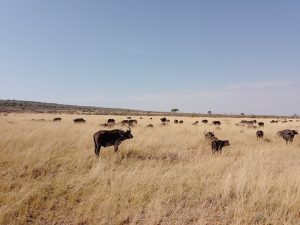 Two game drives in the Masai Mara National Reserve. Morning (6:00–10:00am) is prime time for lion, cheetah and leopard activity. The Mara Triangle the western section managed by the Mara Conservancy typically has better lion sightings and lower vehicle densities. Afternoon drive (3:30–6:30pm) extends to sunset.
The Masai Mara holds one of the highest lion densities in Africa. Multiple prides with large territories across the reserve give frequent sightings. The Mara’s cheetah population is among the most studied in the world — several named individuals and their offspring are well known to guides, allowing for predictable sightings. Optional hot air balloon ($450, departs 5:30am) slots easily into a Day 2 schedule.
Overnight: same Masai Mara lodge.
Day 3: Full Day in the Masai Mara
A second full day in the Mara. With two full days you can explore different areas of the reserve: the Mara River banks for hippo, crocodile and potential river crossings (July–October migration season), the Musiara Marsh in the north for large elephant herds and marsh lion, and the Ol Kinyei or Naboisho conservancies bordering the reserve for off-road drives and lower vehicle density.
The private conservancies adjoining the Masai Mara — Olare Motorogi, Naboisho, Ol Kinyei, Mara North are open to guests staying in partner camps and allow off-road driving, which is not permitted inside the National Reserve. Off-road tracking of lion or cheetah in the conservancies gives significantly closer approaches and longer, uninterrupted observations.
Overnight: same Masai Mara lodge (or move to a conservancy camp for different access).
Day 4: Morning Drive, Fly to Lake Nakuru
Final morning in the Mara (6:00–9:00am), then fly to Lake Nakuru via Wilson Airport. Lake Nakuru is in the Rift Valley, 157km northwest of Nairobi; the flight from Wilson takes 25 minutes. Arrive mid-morning and begin an afternoon game drive (3–4 hours) in Lake Nakuru National Park.
Lake Nakuru is one of Kenya’s most varied parks. The alkaline soda lake attracts enormous concentrations of flamingos up to two million lesser flamingoes have been recorded, turning the lakeshore pink. Pelicans, spoonbills and other waterbirds are abundant. The surrounding woodland holds white and black rhino (Nakuru is a rhino sanctuary with consistent sightings), Rothschild giraffe (a rare subspecies), waterbuck, baboon and the unusual tree-climbing lions that rest in the large fig and acacia trees near the lake.
Overnight near Lake Nakuru. Budget: Sarova Lion Hill Game Lodge ($120–180). Mid-range: Lake Nakuru Sopa Lodge ($180–280), Flamingo Hill Tented Camp ($150–240). Luxury: Mbweha Camp ($350–550).
Day 5: Morning in Lake Nakuru, Fly to Amboseli
Morning game drive in Lake Nakuru (6:00–9:30am), focused on rhino tracking and the lakeshore flamingos. Lake Nakuru is one of the most reliable places in Kenya to see both black and white rhino at close range — the sanctuary fence and active ranger presence have allowed the population to recover strongly. After breakfast, fly to Amboseli via Wilson Airport (25 minutes to Wilson, 40 minutes Wilson to Amboseli). Arrive mid-afternoon for a first Amboseli game drive before sunset.
Overnight in Amboseli. Budget: Kibo Safari Camp, Amboseli Sentrim Camp. Mid-range: Ol Tukai Lodge ($180–290), Amboseli Serena Safari Lodge ($200–340). Luxury: Tortilis Camp ($600–950), andBeyond Kichwa Tembo Amboseli ($700–1,100).
Day 6: Full Day in Amboseli
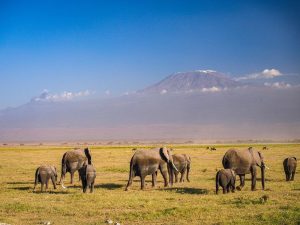 Amboseli National Park at the foot of Kilimanjaro. The park holds the most photogenic elephant herds in Africa , large families habituated to vehicles after decades of research by the Amboseli Elephant Research Project (the world’s longest-running elephant study). Morning drives deliver elephant at the swamp edges with Kilimanjaro clear behind them. The summit is typically visible from first light until 9–10am before clouds build; plan your swamp drive for the earliest possible start.
Amboseli also has good lion (smaller pride than the Mara but present), cheetah on the open grass plains, large herds of zebra and wildebeest in the dry season, and superb waterbird activity in the Enkongo Narok and Olokenya swamps. The park’s Observation Hill gives a panoramic view across the entire park and Kilimanjaro.
Overnight: same Amboseli lodge.
Day 7: Return to Nairobi
Final morning in Amboseli (6:00–9:00am): last elephant encounter at the swamp edges and a final scan for Kilimanjaro before cloud. After breakfast, fly or drive back to Nairobi for international departures. The flight takes 40 minutes to Wilson Airport; the drive takes 3.5–4 hours via Namanga. Most international flights from Nairobi JKIA depart in the late afternoon or evening, giving comfortable time for the return.
Optional last-stop before the airport: Nairobi National Park (15 minutes from Wilson Airport) for a 2–3 hour game drive. One of the world’s most unusual wildlife experiences — lion, cheetah, giraffe and black rhino with the Nairobi skyline in the background.
7-Day Kenya Safari Cost Breakdown
| Cost Item | Budget | Mid-Range | Luxury |
|---|---|---|---|
| Masai Mara park fees (3 days) | $300 | $300 | $300 |
| Lake Nakuru fees (1 day) | $60 | $60 | $60 |
| Amboseli park fees (2 days) | $120 | $120 | $120 |
| Internal flights (4 legs) | $0 (drive) | $700–1,000 | $700–1,000 |
| Lodging (6 nights) | $900–1,350 | $2,400–3,780 | $7,800–12,000 |
| Private vehicle + driver-guide (7 days) | $450–650 | $0 (included at most camps) | $0 (included) |
| Meals where not included | $150–200 | $0 (full-board) | $0 (all-inclusive) |
| Total per person | ~$1,980–$2,680 | ~$3,580–$5,260 | ~$8,980–$13,480 |
Best Time for a 7-Day Kenya Safari
July–October: Peak season for the wildebeest migration in the Mara. River crossings peak August–September. All three parks are in excellent condition. Book lodges and internal flights six months or more in advance.
January–March: Best value peak. Excellent game across all three parks. Kilimanjaro views from Amboseli are at their clearest. January and February have the short dry season conditions with far lower visitor numbers than July–October.
June and November: Shoulder months. Very good game, lodges 20–30% cheaper than peak, good availability. Recommended for this itinerary if migration crossings are not the priority.
April–May: Green season. Lowest prices (40–50% off peak). Lush landscapes and excellent bird activity. Lake Nakuru flamingos and waterbirds are particularly good after the rains. Game viewing is perfectly adequate — all the animals are still there, just harder to spot in taller grass.
How a 7-Day Kenya Safari Compares
5 days vs 7 days: The 5-day Kenya safari covers the Masai Mara and Amboseli. Seven days adds Lake Nakuru — rhino, flamingos and tree-climbing lions — and a second full day in the Masai Mara. If the Big Five complete set matters and you want rhino, extend to seven days (Nakuru is Kenya’s most reliable rhino destination).
7 days vs 10 days: Ten days allows for Samburu National Reserve in the north — Kenya’s northern frontier is a completely different ecosystem with species not found in the south: Grevy’s zebra, Somali ostrich, reticulated giraffe, gerenuk and Beisa oryx. It also allows a beach extension at Diani or Watamu on the Indian Ocean coast.
Frequently Asked Questions
What are the must-see parks on a 7-day Kenya safari? Masai Mara (big cats, migration), Amboseli (elephants, Kilimanjaro views) and Lake Nakuru (rhino, flamingos) are the classic three-park combination for this duration. Samburu replaces Nakuru for visitors who prioritise unique northern species over rhino.
Can I do a 7-day Kenya safari without flying? Yes, but it involves significant driving. Nairobi to Masai Mara is 5–6 hours, Mara to Nakuru is 4–5 hours via Nairobi, Nakuru to Amboseli is 5 hours. The driving days reduce game time noticeably. Internal flights ($150–250 per leg) are strongly recommended for this itinerary.
Is the Masai Mara worth 3 days vs 2 days? Yes — with three days in the Mara you can explore different zones of the reserve (Mara Triangle, Talek, northern conservancies) and have a second chance at any specific sighting from Day 2. Predator sightings improve with more time. The balloon safari also slots in without eating into drive time.
What is the difference between the Masai Mara National Reserve and the conservancies? The National Reserve is managed by Narok County, charges $100/day fees, and requires vehicles to stay on tracks. The adjacent private conservancies (Olare Motorogi, Naboisho, Mara North, etc.) charge higher nightly lodge rates but allow off-road driving, night drives and walking. Most luxury camps in the Mara are in the conservancies, not inside the reserve itself.
Can I combine a 7-day Kenya safari with Rwanda or Uganda? Yes — Nairobi to Kigali is 45 minutes, Nairobi to Entebbe is 1 hour. A popular East Africa combination: 7 days Kenya circuit + 3 days Rwanda gorilla trekking + optional 2 nights Zanzibar beach. See our Kenya safari guide for combination options.