Golden cat tracking in Uganda is one of the most exclusive and rarely offered wildlife encounters in East Africa, a specialised, research-led experience that takes you deep into Kibale Forest National Park in search of the African golden cat (Caracal aurata), one of Africa’s most elusive and least-studied wild felids. While Kibale Forest is best known as a world-class destination for chimpanzee trekking, the park’s intact equatorial rainforest is also one of the most important known habitats for the African golden cat in Uganda — making it the premier location in the country for anyone determined to track this secretive nocturnal predator.
About the African Golden Cat
The African golden cat (Caracal aurata) is a medium-sized wild cat found exclusively in the rainforests of equatorial Africa, from Senegal in the west to Kenya and Uganda in the east. It is roughly twice the size of a domestic cat — males weigh between 11 and 18 kilograms, females between 5 and 10 kilograms — and is one of the most visually variable cats in the world. Despite its name, the coat colour ranges from rich reddish-gold or chestnut through grey-brown to dark melanistic forms, and spotting patterns vary from heavily spotted to almost completely plain. No two individuals look quite the same, which is one of the features that makes it so fascinating to researchers.
The African golden cat is listed as Vulnerable on the IUCN Red List. Its population is declining due to deforestation, bushmeat hunting (which eliminates prey species), and direct trapping and snaring. It is primarily crepuscular and nocturnal, spending most daylight hours resting in dense vegetation or high in the forest canopy. Its prey includes forest duikers, hyraxes, rodents, small monkeys, and birds. Despite sharing its forest with leopards, the golden cat occupies a distinct ecological niche as a mid-sized mesopredator, hunting primarily on the forest floor and in the understorey.
Why Kibale Forest is Uganda’s Best Location for Golden Cat Tracking
Kibale Forest National Park covers 795 square kilometres of moist evergreen and transitional forest in western Uganda near Fort Portal. The park holds the highest confirmed primate diversity in Africa — 13 species including chimpanzees, red colobus, grey-cheeked mangabeys, and L’Hoest’s monkeys — and this rich prey base, combined with the forest’s intact canopy and low human disturbance, makes it ideal habitat for the African golden cat. Camera trap studies conducted in Kibale since the early 2010s have documented a resident golden cat population throughout the park, with individuals photographed across a range of forest types and elevations.
The research infrastructure built up over years of camera trap monitoring — including mapped movement corridors, identified individuals, and known activity zones — means that guided golden cat tracking in Kibale is grounded in real scientific data rather than guesswork. Guides and trackers know where to look, which increases the already-low probability of a direct encounter and ensures the experience is rich in ecological insight even when the cat itself stays hidden.
What Happens During Golden Cat Tracking in Kibale
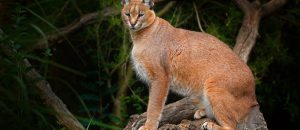 Golden cat tracking in Kibale Forest is a specialised add-on activity offered through Uganda Wildlife Authority rangers and research partners. Groups are extremely small — typically two to four participants — to ensure the experience remains intimate and low-impact. Because the golden cat is crepuscular and nocturnal, tracking sessions depart in the late afternoon (around 4:00–5:00 pm) and may extend into the early evening hours when the cat is naturally most active.
- Pre-trek briefing: Your guide introduces the African golden cat — its biology, distribution, behaviour, diet, and conservation status — and explains the tracking methodology used by the Kibale research team. You learn how camera traps are placed and how individual cats are identified from their unique coat patterns.
- Track and sign reading: In the forest your guide interprets physical evidence of golden cat activity — pug marks (footprints) in soft mud, territorial scratch marks on trees, scat deposits, and kill sites. These signs build a picture of the cat’s range and recent movements.
- Camera trap review: The trek visits active camera trap stations placed along known movement corridors. Where recent footage is available, your guide shares images and video clips of golden cats recorded at that specific location — often showing the cat at night, its eyes bright in the infrared flash, moving with characteristic fluid stealth.
- Direct sighting opportunity: At known resting spots, hunting grounds, or along travel corridors identified by recent camera trap activity, the group moves quietly and slowly in hope of a direct encounter. Sightings are possible but not guaranteed — the golden cat is one of Africa’s most secretive animals. When a sighting does occur, it is widely regarded as one of Uganda’s greatest wildlife moments.
- Forest ecology interpretation: Throughout the session your guide interprets the broader ecosystem — predator-prey dynamics, the golden cat’s role as a mesopredator, and the other nocturnal and crepuscular wildlife encountered including civets, pottos, and forest genets.
Cost of Golden Cat Tracking in Uganda
Golden cat tracking in Kibale Forest is offered as a specialised research-linked activity coordinated through Uganda Wildlife Authority. Because it is a low-volume, expert-guided conservation experience, it is priced accordingly.
| Activity | Location | Cost Per Person | Group Size |
|---|---|---|---|
| Golden Cat Tracking | Kibale Forest NP | USD 350 | Max 4 |
| Chimpanzee Trekking | Kibale Forest NP | USD 300 | Max 8 |
| Chimp Habituation Experience | Kibale Forest NP | USD 400 | Max 4 |
The golden cat tracking fee covers the guided tracking session, ranger fees, and access to camera trap data and research materials. It does not include Kibale Forest park entry fees ($40 per person per day for non-East African residents), accommodation, meals, or guide gratuities. Permits are booked through Uganda Wildlife Authority or through a licensed tour operator. Contact Superfine Safaris for current permit availability and to incorporate golden cat tracking into a broader Uganda safari itinerary.
Best Time for Golden Cat Tracking in Kibale Forest
Golden cat tracking in Kibale is available year-round, but the best conditions are during Uganda’s dry seasons — June to August and December to February. During these months the forest floor is firmer, tracks and signs are better preserved, and the walks are less physically demanding. The cat is crepuscular and nocturnal, so sessions depart in the late afternoon regardless of season.
The wet seasons (March to May and September to November) can also be productive — prey animals concentrate near water sources and forest edges, which attracts the golden cat. The forest is lush and atmospheric in the rains, and visitor numbers are lower, making for very private experiences. Waterproof boots and a rain jacket are essential year-round in Kibale’s forest microclimate.
Combining Golden Cat Tracking with Other Kibale Forest Activities
The ideal Kibale Forest itinerary pairs golden cat tracking with the park’s other outstanding wildlife activities for a complete two-to-three day experience in the Fort Portal area.
- Chimpanzee trekking in Kibale Forest: Uganda’s most popular primate experience. Kibale’s habituated Kanyanchu community offers near-guaranteed close encounters with wild chimpanzees. A morning chimpanzee trek pairs perfectly with an afternoon golden cat tracking session.
- Chimpanzee habituation experience: A full-day immersion with researchers habituating a wild chimpanzee community. One of Uganda’s most unique wildlife experiences, available in Kibale for $250 per person.
- Bigodi Wetland Sanctuary: A community-managed wetland walk on the edge of Kibale Forest offering superb birding, primates (including red colobus), and swamp wildlife. One of Uganda’s best community tourism experiences and an excellent half-day complement to forest activities.
- Birding in Kibale Forest: Kibale holds over 375 bird species including 6 Albertine Rift endemics. Dedicated birding walks with expert guides can target the green-breasted pitta, Nahan’s partridge, and African pitta among many others.
What to Bring for Golden Cat Tracking
- Clothing: Long trousers and long-sleeved shirt to protect against nettles and insects in the dense understorey
- Footwear: Sturdy waterproof hiking boots with ankle support — the forest floor is often muddy and uneven
- Waterproof jacket: Lightweight and packable for Kibale’s frequent evening showers
- Torch/headlamp: Essential — the session extends into low-light evening conditions
- Camera: A camera with good low-light performance and a fast lens is ideal. No flash photography is permitted near the cat. A telephoto zoom is useful for distance shots.
- Binoculars: Helpful for spotting animals in the forest canopy and understorey
- Insect repellent: Apply before entering the forest, particularly for evening sessions
- Water: Carry at least 1.5 litres of water for the session
Getting to Kibale Forest
Kibale Forest National Park is located near Fort Portal in western Uganda, approximately 300 kilometres from Kampala. The drive from Kampala to Fort Portal takes around four to five hours on a good road. Scheduled and charter flights from Entebbe or Kampala to Kasese Airstrip or Mweya Airstrip in Queen Elizabeth National Park provide an alternative for travellers combining Kibale with a game drive safari.
A popular western Uganda circuit combines Kibale Forest with Queen Elizabeth National Park for game drives, Kazinga Channel boat cruises, and tree-climbing lion sightings in the Ishasha sector. For visitors with more time, extending south to Bwindi Impenetrable Forest for gorilla trekking creates one of Uganda’s most rewarding and varied safari circuits. Superfine Safaris builds fully customised itineraries incorporating golden cat tracking in Kibale as part of any Uganda safari package.