The East Africa entry points you choose — which airports to fly into, which land borders to cross, and where to begin and end your circuit — shape the entire structure of a combined safari. With five countries, six major international airports, and several key overland crossings, selecting the right East Africa entry points can save you days of backtracking and significantly reduce internal travel costs. This guide covers every airport and land border used on safari circuits across Uganda, Rwanda, Kenya, and Tanzania, with recommended open-jaw flight combinations and the best routing structure for each itinerary type.
Why East Africa Entry Points Matter for Your Safari Route
East Africa spans over 4,000 kilometres from Uganda’s Albertine Rift in the northwest to Tanzania’s Indian Ocean coastline in the southeast. A multi-country itinerary covering gorilla trekking in Uganda or Rwanda, the Masai Mara, and the Serengeti spans a geography roughly the size of Western Europe. The wrong entry point adds unnecessary backtracking; the right one makes the entire trip flow in a single geographic arc. Most experienced safari planners use open-jaw flights — flying into one city and out of another, as the foundation of any efficient routing.
The Five Main East Africa Entry Points: International Airports
Nairobi, Kenya (IATA: NBO — Jomo Kenyatta International)
Nairobi is the most connected international hub in East Africa and the most connected international hub in East Africa. Jomo Kenyatta International Airport (JKIA) has direct connections from London, Amsterdam, Dubai, Addis Ababa, Johannesburg, and dozens of other major hubs, with more airline options and competitive fares than any other airport in the region. For travellers combining Kenya, Uganda, and Rwanda, flying into Nairobi allows you to begin with the Masai Mara before connecting onward to Entebbe or Kigali. For Kenya and Tanzania combinations, Nairobi is the natural start before heading south to the Serengeti.
Entebbe, Uganda (IATA: EBB — Entebbe International)
Entebbe International Airport is Uganda’s main gateway and the logical entry point for a combined East Africa safari that prioritises gorilla trekking in Bwindi Impenetrable Forest. Flying into Entebbe and beginning in Uganda means you reach gorillas first — often the most logistically demanding part of the itinerary, requiring permits booked months in advance — before moving eastward through Kenya or south through Rwanda. Entebbe is served by Kenya Airways, Ethiopian Airlines, Qatar Airways, Turkish Airlines, and RwandAir, with connections from all major international hubs. Many Uganda–Rwanda itineraries fly into Entebbe and exit via Kigali, avoiding the need to retrace the same road.
Kigali, Rwanda (IATA: KGL — Kigali International)
Kigali International Airport has become an increasingly gateway since RwandAir’s expansion of direct routes from London Heathrow, Brussels, New York, and multiple African cities. For travellers combining Volcanoes National Park gorilla trekking with Uganda or Kenya, Kigali is an efficient entry or exit point — the airport sits just two hours by road from the gorilla trailheads. Many safari operators structure Uganda–Rwanda itineraries as Entebbe in / Kigali out (or the reverse), creating a clean geographic arc without doubling back.
Kilimanjaro, Tanzania (IATA: JRO — Kilimanjaro International)
Kilimanjaro International Airport (JRO), situated between Arusha and Moshi, is the best gateway for Tanzania’s northern circuit — the Serengeti, Ngorongoro Crater, Tarangire, and Lake Manyara. Direct and one-stop services reach JRO from Amsterdam (KLM), Addis Ababa (Ethiopian), Nairobi (Kenya Airways daily connection), and Johannesburg. For a Kenya–Tanzania itinerary, flying into Nairobi and out of Kilimanjaro — or the reverse — is the most geographically logical structure, allowing a south-to-north or north-to-south circuit without backtracking.
Dar es Salaam / Zanzibar (IATA: DAR / ZNZ)
Dar es Salaam Julius Nyerere International Airport is Tanzania’s largest international airport and the best gateway for southern Tanzania (Ruaha, Selous/Nyerere) or for a beach extension to Zanzibar. For itineraries that end with a Zanzibar beach stay, flying out of Zanzibar International Airport (ZNZ) rather than backtracking to Nairobi saves a full day’s travel. Zanzibar has direct connections to Nairobi, Dar es Salaam, and Middle East hubs including Dubai and Doha. A popular routing uses Nairobi or Entebbe as the entry point and Zanzibar as the exit after completing the Tanzania circuit.
Best Entry and Exit Combinations for a Combined East Africa Safari
The following open-jaw combinations are what Superfine Safaris most commonly uses:
| In | Out | Countries covered | Why it works |
|---|---|---|---|
| Entebbe (EBB) | Kigali (KGL) | Uganda + Rwanda | Gorillas in Bwindi, then cross into Rwanda for Volcanoes NP — no backtracking |
| Nairobi (NBO) | Entebbe (EBB) | Kenya + Uganda | Masai Mara first, then fly Nairobi–Entebbe for gorillas and Kibale |
| Nairobi (NBO) | Kilimanjaro (JRO) | Kenya + Tanzania | Mara in the north, circuit south through Amboseli and into Serengeti |
| Nairobi (NBO) | Zanzibar (ZNZ) | Kenya + Tanzania + beach | Wildlife circuit ending on the Indian Ocean — most popular finish |
| Entebbe (EBB) | Nairobi (NBO) | Uganda + Rwanda + Kenya | Full three-country arc: gorillas first, then Kenya wildlife as the finale |
| Kigali (KGL) | Kilimanjaro (JRO) | Rwanda + Tanzania | Gorillas and Nyungwe, then connect via Nairobi into the Tanzania northern circuit |
The East Africa Tourist Visa: One Visa for Three Countries
For itineraries covering Kenya, Uganda, and Rwanda, the East Africa Tourist Visa is one of the most useful planning tools available. A single USD 100 visa covers multiple entries into all three countries for 90 days, eliminating the need for three separate visas. It is available on arrival at Nairobi, Entebbe, and Kigali airports. Tanzania is not included in the East Africa Tourist Visa, a separate Tanzania visa (USD 50 for most nationalities) is required if your combined East Africa safari extends south to the Serengeti or Zanzibar.
Internal Connections Between East Africa Entry Points
Once you have selected your East Africa entry points, connecting between destinations is straightforward:
- Nairobi – Entebbe: Multiple daily Kenya Airways flights, approximately 1 hour.
- Nairobi – Kigali: Kenya Airways and RwandAir daily, approximately 1.5 hours.
- Nairobi – Kilimanjaro: Kenya Airways daily connection, approximately 1 hour.
- Entebbe – Kigali: RwandAir and Kenya Airways, approximately 1 hour. Many itineraries use an overland crossing via Kabale instead — a 4–5 hour drive that avoids airport transfers entirely.
- Kigali – Nairobi: RwandAir and Kenya Airways daily, approximately 1.5 hours.
Land Border Crossings for a Combined East Africa Safari
Flying between countries is not the only option on a combined East Africa safari. Many of the most popular itinerary combinations use overland border crossings — faster than airport transfers, far cheaper than internal flights, and in several cases the only practical way to move between adjacent national parks without a long detour. The key land borders for safari travellers are well-managed, straightforward for tourists, and open daily.
Katuna / Gatuna (Uganda – Rwanda)
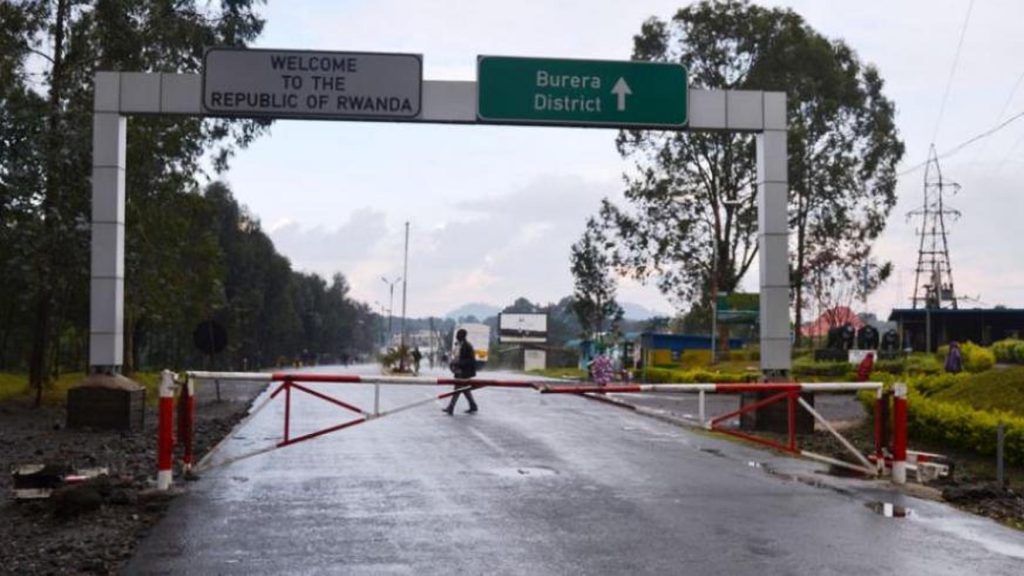
The Katuna–Gatuna border post on the Kabale–Kigali road is the busiest and most important land crossing for safari travellers combining Uganda and Rwanda. It sits midway between Kabale (Uganda) and Kigali (Rwanda), with a drive time of roughly 4–5 hours from Entebbe and 2.5 hours from Kigali. The vast majority of Uganda–Rwanda gorilla circuits use this crossing: arriving by road from Bwindi Impenetrable Forest (3–4 hours north) and entering Rwanda to continue to Volcanoes National Park (2 hours south of Kigali). The crossing is open 24 hours and processes tourist vehicles quickly. Both Uganda and Rwanda immigration offices are on-site. The East Africa Tourist Visa is accepted at this crossing.
Cyanika (Uganda – Rwanda, via Kisoro)
The Cyanika border post, 13 kilometres south of Kisoro town in Uganda, is the second Uganda–Rwanda crossing used by safari travellers — specifically those visiting Mgahinga Gorilla National Park. Mgahinga sits in the Virunga foothills 10 kilometres from Cyanika; Volcanoes National Park’s headquarters at Kinigi is just 25 kilometres on the Rwanda side. For itineraries combining Mgahinga gorilla trekking with Rwanda’s Volcanoes National Park, Cyanika is a more direct crossing than Katuna. The road between Kisoro and Cyanika is tarmacked and the crossing is straightforward for tourist vehicles.
Namanga (Kenya – Tanzania)
The Namanga border post on the A104 highway between Nairobi and Arusha is the main overland crossing for Kenya–Tanzania safari itineraries. Namanga is 165 kilometres south of Nairobi and 270 kilometres north of Arusha, making it the natural midpoint for safaris moving between the Masai Mara and the Serengeti. The drive from Nairobi to Arusha via Namanga takes 4–5 hours total. The border is open daily and handles high volumes of tourist traffic, particularly from overland safari vehicles. Both single-entry and multi-entry visas for Kenya and Tanzania are issued here, though it is faster to hold a pre-arranged visa or e-visa before arrival.
Isebania / Sirari (Kenya – Tanzania, Mara Corridor)
The Isebania (Kenya side) — Sirari (Tanzania side) border post is the crossing used by safari vehicles operating between the Masai Mara National Reserve and the northern Serengeti — the most direct route between the two parks without returning to Nairobi. It sits roughly 60 kilometres west of the Mara reserve boundary. The road from the Mara to Isebania passes through Migori and takes 2–3 hours; from Sirari to the Serengeti’s Ikoma Gate takes a further 2–3 hours. This crossing is used mainly by fly-in–drive and overland combination safaris specifically designed around the Wildebeest Migration corridor.
Busia / Malaba (Kenya – Uganda)
The Busia and Malaba border crossings on the western Kenya–Uganda border connect Kisumu (Kenya) with Jinja and Kampala (Uganda). They are less commonly used by fly-in safari travellers — most Uganda–Kenya itineraries route via Entebbe and Nairobi by air — but Busia is relevant for self-drive travellers and overland tours that combine Uganda wildlife with Kenya’s western destinations. The crossing is well-established and processes both passenger vehicles and commercial traffic.
Rusumo (Rwanda – Tanzania)
The Rusumo border post in southeastern Rwanda connects Kigali with the Tanzanian town of Ngara and onward to the Serengeti, though the drive to the Serengeti from Rusumo is long (10–12 hours) and the road quality variable. Rusumo is used mainly by overland travellers on extended East Africa circuits rather than by standard fly-in safari itineraries. For most combined Rwanda–Tanzania safaris, flying Kigali–Kilimanjaro or Kigali–Nairobi connecting to Kilimanjaro is a faster option.
Practical Tips for Land Border Crossings
- Carry originals: Always carry your passport original, not a copy. Border officials require the physical document.
- East Africa Tourist Visa: Valid at Katuna–Gatuna and all major border posts between Kenya, Uganda, and Rwanda. Present it at each crossing; it allows multiple entries.
- Vehicle permits: If crossing in a safari vehicle (whether a hired 4×4 or a tour operator’s vehicle), the driver will need temporary import permits and vehicle insurance valid in each country. Reputable operators handle this in advance.
- Currency: USD cash is useful at all border posts for any fees. Local currency exchangers operate at every main crossing.
- Time of day: Cross before 4pm where possible. Some border posts slow significantly in the late afternoon as commercial traffic builds up.
Plan Your Combined East Africa Safari
Superfine Safaris builds fully customized combined East Africa safari itineraries designed around the most efficient entry and exit points for your specific destinations and travel dates. We handle open-jaw flight advice, visa coordination, overland crossing logistics, gorilla permit applications, and all in-country arrangements across Uganda, Rwanda, Kenya, and Tanzania. Contact us to begin planning your East Africa safari.