Tsavo National Park is Africa’s largest national park, spanning over 21,000 square kilometres across two adjoining reserves which are Tsavo East and Tsavo West. Together they cover an area larger than Wales, yet they receive a fraction of the visitors that crowd into the Masai Mara. That means genuine wilderness, uncrowded game drives, and a raw, untouched quality that has made Tsavo one of Kenya’s most atmospheric safari destinations. This guide covers everything you need to know: about Tsavo National Parks, the difference between Tsavo East and Tsavo West, what wildlife to expect, the best time to visit, and which lodges deliver the best experience.
Tsavo East vs Tsavo West: What Is the Difference?
The Nairobi–Mombasa highway and railway divide Tsavo into its two distinct halves. Each has a very different character.
Tsavo East National Park
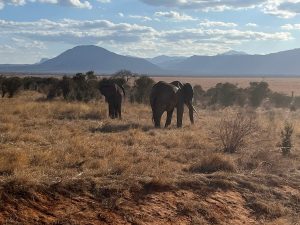
Tsavo East is the larger and drier of the two. Its landscape is classic semi-arid savannah, flat plains of red laterite soil, open thornbush, doum palms along river courses, and the Galana River cutting through its heart. The defining image of Tsavo East is its elephants: enormous herds that roll in the rust-red dust until their skin takes on the same vivid ochre colour, known locally as the “red elephants.” Herds of 50, 100, or more are common — Tsavo East has one of Africa’s largest elephant populations.
Other wildlife in Tsavo East includes lion, leopard, cheetah, wild dog, large buffalo herds, hippo, crocodile along the Galana, oryx, lesser kudu, and gerenuk. The Mudanda Rock viewpoint is a natural water catchment that attracts extraordinary concentrations of wildlife, particularly during the dry season. Lugard’s Falls — a series of rapids and cascades on the Galana — is one of the park’s scenic highlights.
Tsavo West National Park
Tsavo West is the more dramatic of the two, with a landscape shaped by ancient volcanic activity. Shattered lava fields, volcanic cones, and rocky outcrops break up the woodland and savannah. The Chyulu Hills form the western boundary — a series of young volcanic hills blanketed in cloud forest. Tsavo West is lusher, greener, and more varied in terrain than its eastern counterpart.
The centrepiece of Tsavo West is Mzima Springs — a series of crystal-clear freshwater pools fed by underground lava aquifers from the Chyulu Hills. The springs pump 50 million gallons of water per day, creating an oasis in the dry bush that supports hippo, crocodile, and abundant birdlife. An underwater viewing tank lets you watch hippos moving on the riverbed — one of East Africa’s most unusual wildlife experiences.
Wildlife in Tsavo West includes all of Tsavo East’s species plus black rhino (one of Kenya’s strongholds, primarily around Ngulia Rhino Sanctuary), and the lush vegetation supports higher densities of leopard and smaller cats. The birdlife across Tsavo West is exceptional — over 600 species recorded.
Tsavo National Park Wildlife
- Elephant — Tsavo holds Kenya’s largest elephant population. The red dust-bathing behaviour is unique and spectacular
- Lion — Tsavo’s lions have a long history (the Man-Eaters of Tsavo). Modern prides are visible across both parks; male lions in Tsavo East are famously maneless
- Leopard — present throughout; Tsavo West’s rocky terrain and dense vegetation makes it a particularly good leopard habitat
- Black rhino — Tsavo West’s Ngulia Rhino Sanctuary holds a breeding population of critically endangered eastern black rhino. Sightings require a guide and are not guaranteed
- Cheetah and wild dog — both present, especially in Tsavo East’s open plains. Wild dog sightings are relatively more reliable here than in many Kenyan parks
- Buffalo — large herds, particularly around water sources
- Hippo and crocodile — Galana River (Tsavo East) and Mzima Springs (Tsavo West)
Best Time to Visit Tsavo National Park
 Tsavo is a year-round destination. The dry seasons deliver the best overall wildlife viewing as animals concentrate around permanent water sources.
- June to October (long dry season) — the best time for wildlife viewing. Vegetation is low, water sources are scarce outside rivers, and large elephant herds gather at the Galana. Coincides with the peak safari season and is the most popular period
- January and February (short dry season) — excellent wildlife, fewer visitors than June–October, lower prices. A very good alternative window
- March to May (long rains) — lowest season. Wildlife is present but harder to spot. Some tracks become impassable. Lowest prices
- November to December (short rains) — manageable, largely afternoon showers. Wildlife remains good and prices moderate
For overall Kenya safari timing, read our best time to visit Kenya guide.
How to Get to Tsavo National Park
Tsavo is located between Nairobi and Mombasa, making it one of Kenya’s most accessible parks by road.
- From Nairobi: Approximately 3.5 to 4 hours by road to Tsavo West (Mtito Andei gate) or 4 to 5 hours to Tsavo East (Voi gate). The A109 Mombasa highway runs directly through the park
- From Mombasa: Approximately 2.5 to 3 hours to Voi (Tsavo East) or 3.5 hours to Mtito Andei (Tsavo West)
- By air: Chartered and scheduled flights to Voi airstrip (Tsavo East) and Finch Hattons/Kamboyo airstrip (Tsavo West) from Wilson Airport, Nairobi. Flight time approximately 45 minutes
Combining Tsavo with the Kenya Coast or Amboseli
Tsavo’s position between Nairobi and Mombasa makes it a natural addition to a Kenya coast holiday. A standard combination: fly into Nairobi, safari in Tsavo for 3 nights, drive or fly on to Mombasa or Diani Beach for beach days. This “bush and beach” combination is one of Kenya’s most popular itineraries.
Tsavo West also connects directly with Amboseli National Park via the Chyulu Hills — a natural circuit combining Amboseli’s Kilimanjaro views and elephant herds with Tsavo West’s volcanic landscapes and Mzima Springs. For broader Kenya safari planning, see our Kenya safari travel tips.
Where to Stay in Tsavo National Park
Tsavo East Lodges
- Satao Camp — a classic tented camp overlooking a waterhole that attracts some of Tsavo East’s largest elephant herds. Excellent value mid-range. The waterhole viewing at night is one of Tsavo’s best experiences
- Ashnil Aruba Lodge — well-positioned near Aruba Dam, a permanent water source that draws abundant wildlife. Good mid-range option with a swimming pool
- Voi Safari Lodge — built into a rocky hillside overlooking a waterhole. Budget to mid-range, convenient for arrivals through Voi gate
- Severin Safari Camp — one of Tsavo East’s better mid-range camps, offering good guiding and a waterhole in front of the main area
Tsavo West Lodges
- Finch Hattons Luxury Camp — one of Kenya’s most celebrated luxury camps, overlooking a natural hippo pool. An iconic property with outstanding food and guiding. Has hosted royalty and heads of state
- Sarova Salt Lick Game Lodge — an extraordinary stilted structure built over a waterhole in the Taita Hills Wildlife Sanctuary adjacent to Tsavo West. Unique architecture and good wildlife viewing
- Kilaguni Serena Safari Lodge — Kenya’s oldest lodge, opened in 1962. Classic safari atmosphere, good waterhole, solid mid-range experience
- Ngulia Safari Lodge — famous for its bird ringing station, active during the November migration when thousands of Palearctic migrants are caught, ringed, and released
Plan Your Tsavo Safari
Tsavo National Park rewards travellers who want space, scale, and a less-curated Africa than the Mara’s well-worn game drive circuits. Its sheer size means you can drive for an hour without seeing another vehicle. For a full Kenya itinerary that combines Tsavo with the Masai Mara, Amboseli, or the coast, contact Superfine Safaris. For practical preparation, see our Kenya safari travel tips and Kenya visa guide.