Explore one of Rwanda,s old mountain gorilla The Karisimbi Gorilla Family is one of the historically fascinating mountain gorilla groups associated with Volcanoes National Park in Rwanda. Explore one of Rwanda’s old mountain gorilla families in Volcanoes National Park. The family has a strong connection with Mount Karisimbi, one of the spectacular volcanoes of the Virunga Mountains, and its story is closely linked to the famous Susa Gorilla Family.
For travelers planning a Rwanda gorilla trekking safari, learning about the different gorilla families adds meaning to the experience. Mountain gorillas do not live as isolated individuals. They form closely connected social groups with their own leaders, relationships, territories and histories.
The Karisimbi family is particularly interesting because it was created through the division of the original Susa group and later experienced another major split that resulted in the formation of the Isimbi family.
Quick Facts About the Karisimbi Gorilla Family
- Location: Volcanoes National Park, Rwanda
- Former name: Susa B
- Origin: Split from the original Susa Gorilla Family
- Formation: 2009
- Original leader: Silverback Nyagakangaga
- Named after: Mount Karisimbi
- Habitat: Higher slopes and surrounding forests of Mount Karisimbi
- Related family: Susa Gorilla Family
- Later split: Part of the family separated to establish the Isimbi group
- Gorilla species: Mountain gorilla
- Main activity: Gorilla trekking and conservation research
Gorilla family membership, location and tourism availability can change over time. Travelers should confirm the current status of the Karisimbi group when planning a specific gorilla trek.
Where Is the Karisimbi Gorilla Family Found?
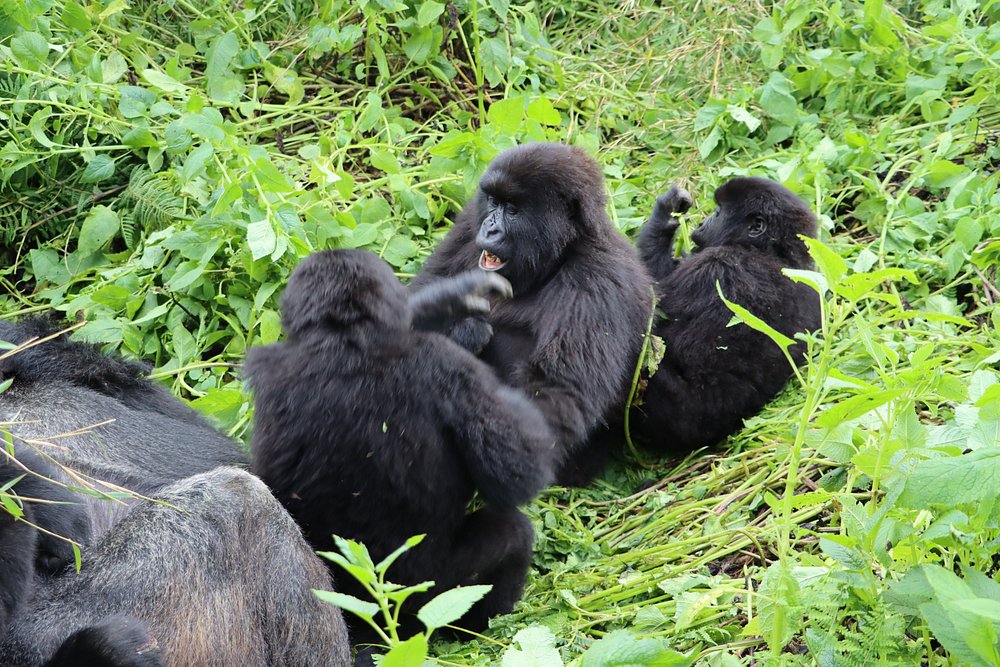 The Karisimbi Gorilla Family is associated with Volcanoes National Park, in northern Rwanda. The park protects part of the Virunga Mountains, a chain of volcanic mountains extending across Rwanda, Uganda and the Democratic Republic of Congo.
Karisimbi’s name comes from Mount Karisimbi, the highest mountain in Rwanda, rising to approximately 4,507 metres above sea level.
The mountain creates a dramatic backdrop for Rwanda’s gorilla habitat. Its slopes contain different vegetation zones, providing mountain gorillas with food, shelter and suitable areas for movement.
The higher elevations can also make trekking more demanding because of steep slopes, dense vegetation, slippery trails and changes in altitude.
How the Karisimbi Gorilla Family Was Formed
The history of the Karisimbi Gorilla Family begins with the famous Susa Gorilla Family.
The original Susa group became exceptionally large over time. As the family grew, social changes eventually resulted in some members separating from the main group.
On 28 June 2009, a silverback named Nyagakangaga left the main Susa family with a number of gorillas and established an independent group. The new family was initially known as Susa B.
Because the group established its home range around Mount Karisimbi, it was later given the name Karisimbi Gorilla Family during Rwanda’s gorilla naming ceremony, Kwita Izina.
This separation is an important example of the natural social development of mountain gorilla communities.
Who Was Nyagakangaga?
Nyagakangaga was the dominant silverback associated with the formation of the Karisimbi family. When Nyagakangaga separated from the original Susa group, he established a new social unit that eventually became known as the Karisimbi family.
His role remains an important part of the group’s history. Silverbacks are extremely important within mountain gorilla communities. They help protect the family, maintain order, lead movements and defend the group when necessary.
Why Was It Originally Called Susa B?
If you research the history of Rwanda’s gorilla families, you may come across two names: Susa B and Karisimbi. They refer to the same historical group.
The name Susa B was used after the group separated from the original Susa family. It distinguished the breakaway group from the main Susa group.
After the group became established around Mount Karisimbi, it was renamed the Karisimbi Gorilla Family. Therefore, travellers may encounter references to Susa B = Karisimbi Gorilla Family
This connection is particularly important when researching the history of Rwanda’s mountain gorillas.
The Connection Between Karisimbi and the Susa Gorilla Family
The relationship between Karisimbi and Susa is one of the most interesting aspects of the group’s history. The original Susa family was one of the most famous mountain gorilla groups in the Virunga Mountains. It became particularly well known through the research work of Dian Fossey.
At one point, the Susa family became extremely large. Its growth eventually contributed to social divisions and the creation of new gorilla families. Karisimbi was one of the major groups that emerged from this process.
This means that the history of Karisimbi cannot be fully understood without looking at the wider history of Susa.
The Formation of the Isimbi Gorilla Family
The Karisimbi family did not remain unchanged. On 10 April 2012, another section separated from Karisimbi and established what became known as the Isimbi Gorilla Family.
This second split demonstrates how mountain gorilla groups naturally change over time.
A gorilla family can experience changes because of growth in population, competition between males, changes in leadership, formation of new social relationships, movement of individual gorillas, births and deaths and dispersal of mature gorillas
Consequently, a gorilla family described in a safari guide several years ago may have a very different composition today.
Why Is the Karisimbi Gorilla Family Special?
- It has a fascinating history
The Karisimbi family has a direct connection with one of Rwanda’s best-known historical gorilla families, Susa. Its formation provides an interesting example of how mountain gorilla societies develop.
- It is associated with Mount Karisimbi
The family takes its name from one of Rwanda’s most impressive volcanic mountains.
Mount Karisimbi dominates the surrounding landscape and forms part of the spectacular Virunga ecosystem.
- It is associated with higher-altitude habitat
The Karisimbi area contains rugged mountainous terrain. For trekkers, this can make the experience more adventurous and physically demanding.
- Its story demonstrates gorilla social dynamics
The formation of Karisimbi and the later creation of Isimbi show that mountain gorilla families are constantly evolving.
- It forms part of the wider Virunga conservation story
The gorillas of Rwanda are part of a larger population distributed across the Virunga Mountains.
Their conservation therefore requires cooperation between protected areas and conservation organizations across national borders.
What Is the Karisimbi Gorilla Trek Like?
Gorilla trekking is not a normal wildlife drive. Visitors walk through the mountain forest accompanied by experienced trackers and guides.
The trekking conditions can vary considerably taking you through steep climbs, narrow forest trails, thick vegetation, muddy ground, slippery slopes, dense bamboo, uneven volcanic terrain and changes in altitude. The location of the gorillas also changes.
They may spend one night in an area that is several kilometers from where they are found the following morning.
Because of this, there is no guaranteed trekking duration.
Is Karisimbi Gorilla Trekking Difficult?
Historically, the Karisimbi group has been associated with some of the more demanding terrain in Volcanoes National Park because of its relationship with the higher slopes of Mount Karisimbi.
However, it is important not to assume that every trek involving the Karisimbi area will have exactly the same difficulty.
Gorillas move naturally through the forest, and trekking conditions depend on where the animals are located on the day of your visit.
Travelers should therefore prepare for several hours of walking and be comfortable hiking over uneven terrain.
Who Can Go Gorilla Trekking?
Gorilla trekking is suitable for many travelers, but a reasonable level of physical fitness is helpful.
Before your trek, consider preparing through:
- Regular walking
- Hill walking
- Hiking
- Cardiovascular exercise
- Stair climbing
- Long-distance walking
If you have concerns about your ability to complete a long trek, discuss them with your safari operator before the trekking day.
Porters can also be hired to assist with carrying luggage and provide support during the hike.
What Should You Wear for a Karisimbi Gorilla Trek?
The mountain environment can be wet and unpredictable, so appropriate clothing is essential.
Recommended clothing includes:
Hiking boots: Choose waterproof boots with good grip.
Long trousers: These provide protection from vegetation, mud and insects.
Long-sleeved shirt: A lightweight long-sleeved top offers additional protection.
Rain jacket: Rain can occur even during periods traditionally considered dry.
Gardening or hiking gloves: Gloves are useful when moving through thick vegetation or holding onto branches.
Warm layers: Temperatures can change with elevation and weather.
Hat: Useful for protection from sun and light rain.
Comfort should take priority over fashion. A gorilla trek is an outdoor adventure, and your clothing should be able to handle mud and changing weather.
What Else Should You Carry?
A small daypack is useful for carrying essential items.
Consider packing:
- Drinking water
- Energy snacks
- Camera
- Extra batteries
- Power bank
- Insect repellent
- Sunscreen
- Waterproof bags
- Tissues
- Personal medication
- Walking stick if required
Avoid carrying unnecessary heavy items because you may spend several hours walking through mountainous terrain.
Best Time for Gorilla Trekking in Rwanda
Mountain gorilla trekking takes place throughout the year.
However, some travellers prefer the relatively drier periods because trails can be easier to navigate.
June to September
These months are generally popular for gorilla trekking because conditions are often more favourable for hiking.
December to February
This period can also provide good opportunities for trekking, although mountain weather remains unpredictable.
March to May
The rainy season can make trails wetter and muddier. However, the forest is lush and beautiful, and travellers who do not mind rain can still enjoy excellent gorilla experiences.
October to November
These months can also bring rainfall and muddy trails, but they remain suitable for gorilla trekking.
Ultimately, there is no completely guaranteed weather window in the Virunga Mountains.
Karisimbi Gorilla Family and Responsible Tourism
Gorilla trekking is carefully managed because mountain gorillas are endangered wild animals.
Visitors are expected to follow instructions from guides and park authorities.
Responsible travellers should:
- Keep a respectful distance from the gorillas
- Avoid making unnecessary noise
- Never feed the gorillas
- Never attempt to touch them
- Follow the instructions of rangers
- Avoid trekking when seriously ill
- Dispose of waste responsibly
- Avoid disturbing the forest
- Respect other trekkers
Responsible behaviour helps protect both the gorillas and the people who work with them.
Why Gorilla Families Matter to Conservation
A mountain gorilla family is more than a tourist attraction. Each group provides researchers with valuable information about gorilla behavior, reproduction, social relationships and population changes.
Tourism also contributes to the wider conservation economy. Gorilla trekking creates employment for rangers, guides, trackers, porters, drivers, lodge staff, local tourism businesses and community-based tourism operators
The communities surrounding Volcanoes National Park therefore form an important part of the broader conservation story.
Can You Specifically Trek the Karisimbi Gorilla Family?
This is an important consideration when planning a Rwanda gorilla safari.
Gorilla families are not permanently fixed in one location. Their membership, movements and tourism status can change.
Historical conservation records have documented periods when the Karisimbi group moved beyond Rwanda’s Volcanoes National Park into the Democratic Republic of Congo.
For this reason, travelers should not assume that a particular Karisimbi family trek can always be guaranteed.
If you specifically want to learn about or trek a particular gorilla family, your safari operator should confirm the current family status and tourism arrangements before your trip.
Combining Gorilla Trekking with Other Rwanda Experiences
A visit to Volcanoes National Park can be incorporated into a much larger Rwanda safari itinerary.
After your gorilla trek, you can explore other parts of the country, including:
Kigali
Explore Rwanda’s capital, its cultural attractions, markets and historical sites.
Akagera National Park
Enjoy traditional wildlife safaris and search for elephants, lions, buffaloes, giraffes, antelopes and other wildlife.
Nyungwe Forest
Explore one of Rwanda’s great forest ecosystems and experience chimpanzee trekking and forest walks.
Lake Kivu
Relax along the scenic shores of Lake Kivu after your gorilla trekking adventure.
Dian Fossey-related experiences
Travellers interested in gorilla conservation and research can learn more about the history of gorilla research in the Virunga Mountains.
Karisimbi Gorilla Family FAQs
What is the Karisimbi Gorilla Family?
The Karisimbi Gorilla Family is a mountain gorilla group historically associated with Volcanoes National Park in Rwanda. It originated from the original Susa family and was initially known as Susa B.
Why was the family called Susa B?
It was called Susa B after separating from the original Susa Gorilla Family.
Who founded the Karisimbi family?
The group was established under the leadership of the silverback Nyagakangaga after he separated from the original Susa group.
Why is it called Karisimbi?
The family was named after Mount Karisimbi, the high volcanic mountain around which the group established its range.
Did Karisimbi produce another gorilla family?
Yes. A section of the Karisimbi group separated in 2012 and formed the Isimbi Gorilla Family.
Where is Mount Karisimbi?
Mount Karisimbi is located within the Virunga Mountains along the Rwanda–Democratic Republic of Congo border region. It is the highest mountain in Rwanda.
Is Karisimbi difficult to trek?
Historically, the Karisimbi area has been associated with challenging trekking because of its high-altitude and mountainous terrain. Actual difficulty depends on where the gorillas are located on the trekking day.
Can I guarantee seeing the Karisimbi family?
You should not assume that a specific gorilla family can always be guaranteed. Gorilla locations and family status can change, so current arrangements should be confirmed before travel.
Plan Your Rwanda Gorilla Trekking Adventure
The Karisimbi Gorilla Family represents an important chapter in the history of Rwanda’s mountain gorillas. From its origins as part of the famous Susa family to its establishment around Mount Karisimbi and the later formation of the Isimbi group, its story reflects the complex social lives of mountain gorillas.